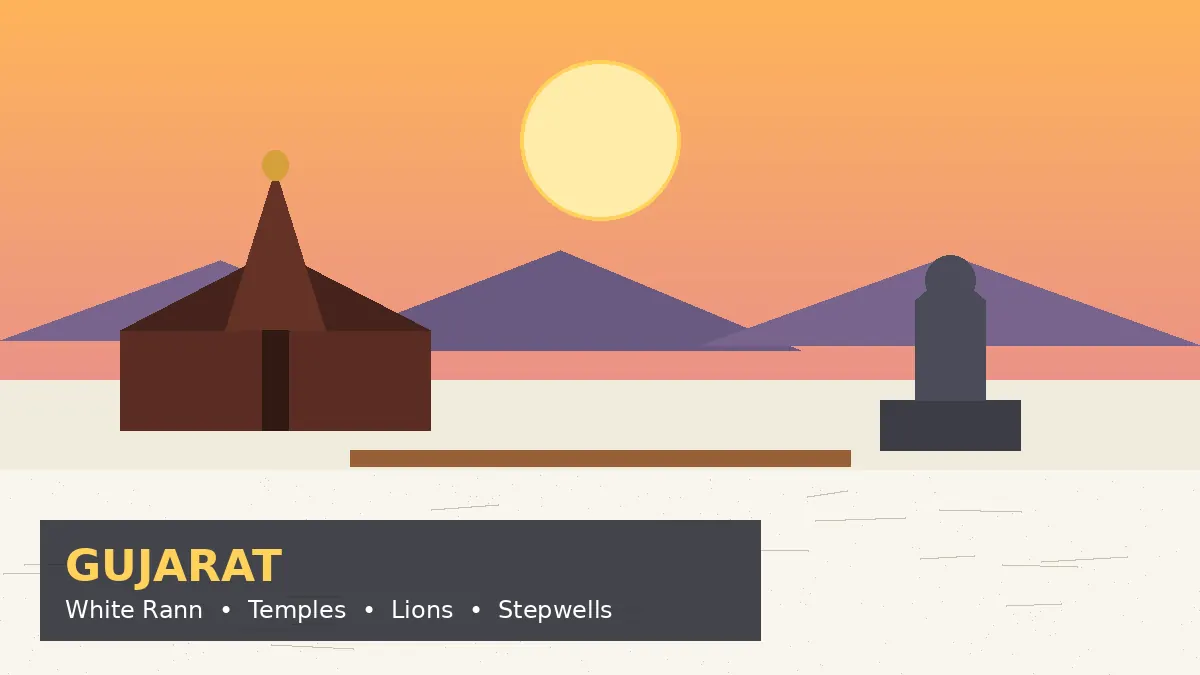
Gujarat surprises almost everyone who visits it properly. Moreover, the state refuses to fit into one simple travel story. You can walk across a white salt desert in the morning. Meanwhile, you can watch wild lions in dry forest a few days later. Additionally, you can end the same trip inside carved stepwells and temple towns. Consequently, the top ten places to visit in Gujarat feel less like a list and more like several holidays combined.
This Gujarat travel guide keeps the focus practical and honest. Firstly, it explains what each place actually offers on the ground. Secondly, it shows how the famous places in Gujarat connect by region. As a result, you can build a route instead of chasing pins on a map. Furthermore, the guide favours depth over hype throughout. In short, these are the tourist places in Gujarat that most deserve your limited time.
How Should You Plan a First Trip to Gujarat?
Geography matters more here than in most Indian states. Indeed, Gujarat spreads widely from Kutch in the west to the hills near Maharashtra. Distances between Gujarat tourist attractions can therefore feel longer than expected. However, the places cluster neatly into four useful regions. Kutch holds the desert and craft villages. Saurashtra holds Gir, Somnath, and Dwarka along the coast. Central Gujarat holds Ahmedabad, Vadodara, and Champaner. Finally, the south and east add the Statue of Unity and Saputara.
Most first trips work best as one or two circuits. For example, Ahmedabad pairs naturally with Patan and Vadodara. Similarly, Gir combines smoothly with Somnath and then Dwarka. In contrast, Kutch deserves its own unhurried block of days. Above all, rushing across the whole state usually weakens every stop. A slower route, by comparison, lets each landscape change properly register.
1. Rann of Kutch — The White Desert That Defines Gujarat
No list of the best places to visit in Gujarat starts anywhere else. The Great Rann is a vast seasonal salt marsh near Bhuj. During dry months, its surface hardens into a dazzling white plain. Under a full moon, moreover, the salt reflects light in an almost unreal way. Photographers understandably treat it as one of the great natural sights in India.
Culture gives the Rann far more than scenery alone. Nearby villages practise embroidery, weaving, pottery, and Rogan painting. Additionally, the winter Rann Utsav festival brings folk music, dance, and craft stalls to the desert edge. Bhuj works well as your base and gateway town. There, palaces and museums add useful context before the desert itself. Ultimately, allow the Rann at least two unhurried days.
2. Gir National Park — The Only Wild Home of Asiatic Lions
Gir protects something found nowhere else on Earth. Specifically, it is the only wild home of the Asiatic lion. Safaris cross dry teak forest, scrub, and open grassland patches. Along the way, you may also spot leopards, deer, antelope, and crocodiles. Birdlife, furthermore, adds colour to almost every drive through the park.
Expectations need gentle handling at Gir, however. Sightings are never guaranteed on any single safari drive. Nevertheless, the forest itself rewards patience and quiet attention. Sasan Gir serves as the main visitor base for the park. From there, Somnath lies conveniently on the same Saurashtra circuit. Therefore, wildlife travellers rarely need a separate trip for Gir. Instead, they can fold it neatly into the temple coast route.
3. Somnath Temple — Gujarat’s Great Temple by the Sea
Somnath ranks among the most revered tourist places in Gujarat for pilgrims. Hindus honour it as the first of the twelve Jyotirlinga shrines. Moreover, its history of destruction and rebuilding spans many centuries. The present temple rises in pale stone above the Arabian Sea. Waves below, meanwhile, give the whole site a powerful coastal setting.
Even non-religious visitors usually find Somnath deeply moving. Architecture, sea air, and devotion combine in a rare balance. Nearby, the Triveni Sangam marks a sacred river confluence. Bhalka Tirth, additionally, holds strong associations with Lord Krishna. Consequently, a half day here often stretches into a full, reflective day. Pairing Somnath with Gir, in particular, creates Gujarat’s most satisfying short circuit.
4. Dwarka — Krishna’s Ancient Coastal City
Dwarka stands at the western edge of the Saurashtra coast. Tradition links the city closely with Lord Krishna’s ancient kingdom. Furthermore, Hindus count Dwarka among the sacred Char Dham pilgrimage sites. The Dwarkadhish Temple dominates the town with its tall, carved spire. Pilgrims gather there throughout the day in steady, colourful streams.
Beyond the main temple, Dwarka rewards slower exploration too. A short boat ride reaches Bet Dwarka, an island temple town. Meanwhile, the Gomti River ghats offer calmer, more local scenes. Nageshwar, one more Jyotirlinga shrine, also sits near the town. As a result, Dwarka works for both devotion and coastal wandering. If temple towns interest you elsewhere in India, our guide to places to visit in Mathura and Vrindavan in one day makes a fascinating companion read.
5. Ahmedabad — Heritage, Gandhi, and Glorious Street Food
Ahmedabad became India’s first UNESCO World Heritage City. Its old quarter, notably, preserves dense lanes, wooden havelis, and community pols. Heritage walks reveal carved facades hidden behind ordinary-looking streets. In addition, the Sidi Saiyyed Mosque displays its famous stone lattice window. Few single artworks, arguably, represent a city quite so completely.
History takes a quieter form across the Sabarmati River. Sabarmati Ashram was Mahatma Gandhi’s home for many years. From there, significantly, the famous Dandi Salt March began. Today the ashram feels peaceful, simple, and quietly powerful. Food, however, pulls Ahmedabad firmly back into the present. Manek Chowk transforms at night into a beloved street-food market. Overall, give the city two days rather than one rushed afternoon.
6. Statue of Unity — The Modern Landmark at Kevadia
The Statue of Unity honours Sardar Vallabhbhai Patel, India’s first deputy prime minister. Importantly, it stands as the tallest statue in the world. The figure rises above the Narmada River near Kevadia. From its viewing gallery, visitors look across the dam and surrounding hills. Scale alone, therefore, makes the visit memorable for most families.
Kevadia has grown into a full destination around the statue. Gardens, river views, and family attractions fill a complete day. Moreover, the site pairs naturally with Vadodara on a central Gujarat route. Some travellers, admittedly, prefer older monuments to modern landmarks. Nevertheless, the engineering and setting persuade most sceptics on arrival. In fact, it now anchors many Gujarat sightseeing places lists for first-time visitors.
7. Rani ki Vav, Patan — The Queen of Stepwells
Rani ki Vav may be the most beautiful structure in Gujarat. Builders created this stepwell in Patan during the eleventh century. UNESCO, significantly, lists it as a World Heritage Site. Steps descend through levels covered in hundreds of carved figures. Gods, goddesses, and everyday scenes cover almost every surface. Consequently, the deeper you walk, the richer the carving becomes.
Patan offers more than the stepwell alone, fortunately. The town is famous for Patola silk weaving traditions. Watching weavers at work adds a living craft dimension. Furthermore, Rani ki Vav pairs perfectly with the Modhera Sun Temple nearby. Together, both sites make north Gujarat essential for heritage lovers. Anyone comparing great Indian heritage days might also enjoy our guide to places to visit in Khajuraho Madhya Pradesh.
8. Champaner-Pavagadh — A Lost Capital Beneath a Sacred Hill
Champaner-Pavagadh blends archaeology, faith, and forest in one landscape. UNESCO protects the archaeological park at the hill’s base. There, mosques, tombs, gateways, and ruined palaces survive from a former capital. Above them, Pavagadh Hill carries an important temple pilgrimage tradition. As a result, one visit mixes history and devotion unusually well.
Many Gujarat itineraries overlook Champaner, which is a mistake. Admittedly, the site rewards visitors who enjoy exploring on foot. Scattered remains appear gradually among trees and quiet paths. Meanwhile, views from the hill stretch across the surrounding plains. Vadodara, conveniently, works as the natural base for this day trip. Therefore, heritage travellers based there should not skip it.
9. Vadodara — Palaces, Parks, and an Easygoing Cultural City
Vadodara brings a calmer, greener rhythm to Gujarat sightseeing. The Laxmi Vilas Palace remains its most celebrated landmark. Gaekwad rulers built the palace in grand Indo-Saracenic style. Its grounds, moreover, feel more like a small estate than a city attraction. Inside, paintings and armoury collections reward unhurried browsing.
Daily life gives Vadodara much of its charm too. Sayaji Baug offers gardens, a zoo, and museum visits in one park. Additionally, the city has a strong reputation for art and education. Food streets and old markets, meanwhile, keep evenings pleasantly occupied. Crucially, Vadodara also unlocks Champaner and the Statue of Unity as day trips. Hence, it earns its place among the top tourist places in Gujarat on usefulness alone.
10. Saputara — Gujarat’s Only Hill Station
Saputara closes this list with a complete change of pace. Tucked into the Sahyadri ranges, it is Gujarat’s only hill station. Cooler air arrives quickly once the road starts climbing. Around town, viewpoints overlook layered green valleys and ridges. A lake, gardens, and sunset points shape its gentle appeal.
Families particularly appreciate Saputara after Gujarat’s hotter plains. Boating, short walks, and local markets fill days without pressure. Furthermore, tribal culture in the surrounding Dang region adds real depth. The area is known for its art, music, and village traditions. During monsoon, admittedly, mist and waterfalls transform Saputara completely. Overall, it suits travellers seeking rest rather than monuments. For more slow, green escapes, browse our roundup of the best nature places to visit in the world.
How Can You Combine These Places Into One Route?
Smart circuits save both time and energy in Gujarat. Firstly, try the Saurashtra circuit for temples and wildlife together. That route links Gir, Somnath, and Dwarka in one coastal sweep. Secondly, consider the central heritage circuit around Ahmedabad. It connects Patan, Vadodara, and Champaner without exhausting drives. Finally, treat Kutch as a separate, slower western journey.
Longer trips can certainly join two circuits together. For instance, ten days allow Ahmedabad, Saurashtra, and one extra region comfortably. However, adding Kutch as well demands genuinely generous timing. Otherwise, every destination becomes a brief photograph rather than an experience. Travellers planning wider India trips often compare Gujarat with southern routes too. Our guide to the best places to visit in Kerala during summer helps with that comparison. Similarly, coastal temple days pair in spirit with places to visit in Rameshwaram in one day.
What Is the Best Time to Visit Gujarat?
Winter generally offers the most comfortable Gujarat weather. Broadly, the cooler months suit deserts, cities, and safaris alike. The Rann, in particular, only reveals its white surface in the dry season. Summer, by contrast, brings intense heat across the plains. Consequently, sightseeing then requires early starts and patient pacing.
Monsoon reshapes the state in greener, quieter ways. Saputara and the southern hills look especially fresh then. However, some desert and coastal plans work less well in heavy rain. Festivals can also transform an ordinary week into something special. Navratri fills Gujarat with dance, music, and late-night celebration. Uttarayan, meanwhile, turns Ahmedabad’s skies into a sea of kites. If seasonal timing drives your travel choices, our pick of the best place to visit this time of year offers useful ideas.
Which Gujarat Places Suit Different Travellers?
Families usually love the Statue of Unity and Saputara most. Both offer space, variety, and relaxed pacing for children. Wildlife lovers, obviously, should prioritise Gir above everything else. History enthusiasts, meanwhile, get the most from Ahmedabad, Patan, and Champaner. Pilgrims naturally build their route around Somnath and Dwarka.
Photographers face the happiest problem of all here. The Rann delivers minimal, graphic white landscapes at dawn. Old Ahmedabad, conversely, offers dense colour and carved detail. Coastal light at Somnath and Dwarka adds yet another mood. Ultimately, matching places to interests beats copying any fixed ranking. That approach, indeed, is how the best Gujarat trips get built. Travellers who enjoy comparing regions globally may also like the best place in Thailand to visit and our notes on the safest places to visit in the Middle East.
Frequently Asked Questions
How many days do you need for the top places in Gujarat?
Seven to ten days cover two regions comfortably. Moreover, that pace allows proper time at Gir and the Rann. Shorter trips, however, should focus on one circuit only. Trying everything in four days rarely satisfies anyone.
Is Gujarat good for a family holiday?
Yes, Gujarat works very well for families overall. Children enjoy safaris, the Statue of Unity, and Saputara’s lake. Additionally, Gujarati food is flavourful without being overwhelmingly spicy. Good roads between major hubs also help family logistics considerably.
Can you visit Somnath and Dwarka on one trip?
Certainly, both temples sit on the same Saurashtra coastal route. Most travellers visit Somnath first and then continue towards Dwarka. Furthermore, Gir fits between them without major backtracking. That combination forms Gujarat’s classic pilgrimage and wildlife circuit.
Final Thoughts on Gujarat’s Top Ten
Gujarat rewards travellers who give it proper time and attention. Its deserts, lions, temples, and stepwells share one state remarkably well. Moreover, each region feels distinct rather than repetitive. Choose your circuit, travel in the cooler season, and slow down. Do that, and these famous places in Gujarat will likely exceed every expectation.