
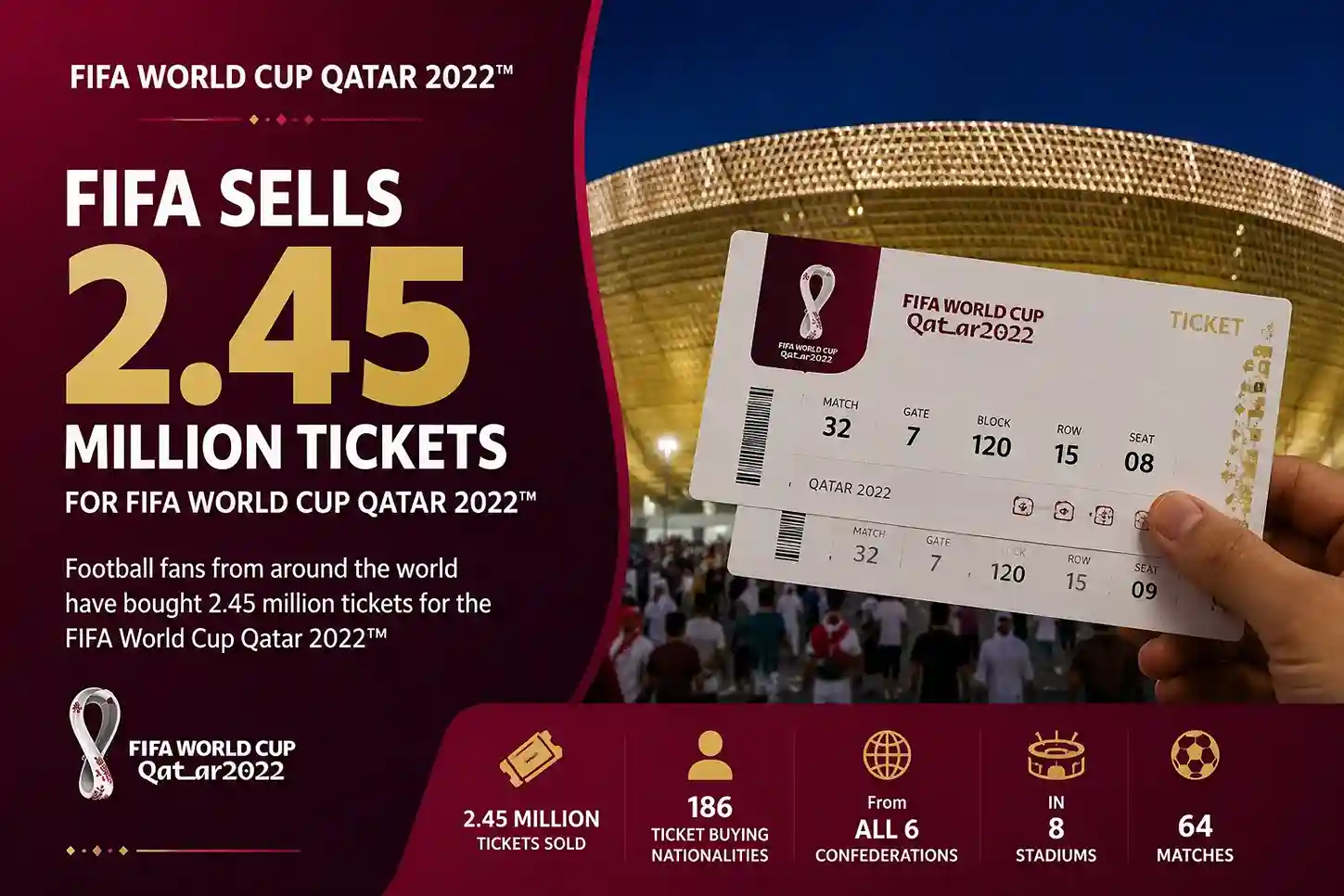
When FIFA announced that 2.45 million tickets had been sold for the 2022 World Cup in Qatar, the global sports community took notice. That number was not just a sales milestone — it reflected how deeply fans wanted to be part of the first World Cup ever held in the Middle East. For anyone tracking 2022 World Cup Qatar tickets, the figure told a clear story: demand was strong, travel plans were locked in early, and Qatar had successfully positioned itself as a major destination on the world sports map.
The tournament ran from November 20 to December 18, 2022, breaking the traditional summer schedule because of Qatar’s climate. Stadiums were compact, cities were connected, and fans from dozens of nations filled stands night after night. Whether you followed the sales numbers closely or simply wanted to understand what made this edition so different, the ticket story sits at the center of everything that happened on and off the pitch.
What the 2.45 Million Ticket Figure Actually Means?
FIFA’s official capacity for the 2022 World Cup was roughly 3 million tickets across all 64 matches. Selling 2.45 million meant that more than 80 percent of available seats were purchased before and during the tournament — an impressive rate for any global event, especially one held in a country with a population of under three million.
That sales volume also showed how the 2022 World Cup Qatar tickets rollout worked in phases. Early sales opened to fans who had registered interest. Later windows opened to the general public. Hospitality packages, team-specific allocations, and last-minute sales filled remaining gaps. Each phase had its own pricing tier, and fans who planned ahead often secured better rates than those who waited until the final weeks.
For context, the 2018 World Cup in Russia sold around 2.4 million tickets by the time the final whistle blew. Qatar matched and slightly exceeded that figure despite being a smaller host nation with fewer existing hotel rooms and less international flight capacity. The host country invested heavily in infrastructure, temporary accommodation, and fan zones to absorb the surge of visitors that strong ticket sales guaranteed.
How FIFA Structured Ticket Sales for Qatar 2022
FIFA used a phased sales model that became familiar to regular World Cup followers but still confused first-time buyers. Understanding that structure helps explain why 2.45 million tickets moved as quickly as they did.
Phase One: Random Selection Draw
The first sales phase opened months before the tournament. Fans submitted applications for specific matches or team packages. FIFA then ran a random selection process — similar to a lottery — because demand exceeded supply for high-profile fixtures like opening matches, knockout rounds, and games involving Brazil, Argentina, and European powerhouses.
Applicants who were selected received a purchase window. Those who missed out could apply again in later phases. This system prevented website crashes during instant sell-outs but also created anxiety for fans who applied multiple times without success.
Phase Two and Three: First-Come, First-Served
Later sales windows operated on a first-come, first-served basis. Inventory appeared in real time on FIFA’s ticketing portal. Category 1 seats — closest to the pitch — disappeared within minutes for marquee matches. Category 3 seats, positioned higher in the stands, remained available longer and offered the most budget-friendly entry point for supporters traveling on a tighter budget.
Last-Minute Sales and On-Site Availability
Even after 2.45 million tickets had been sold, FIFA kept a limited pool for last-minute sales during the tournament itself. Some group-stage matches in less high-demand slots still had seats available days before kickoff. Knockout-stage tickets, however, were nearly impossible to find without paying premium resale prices — a reminder that planning early was essential for anyone serious about attending.
Ticket Categories and Pricing Breakdown
FIFA divided stadium seating into four main categories for most matches. Prices varied depending on the stage of the tournament, with group-stage games costing far less than the final.
- Category 1: Premium seats along the sidelines, typically ranging from $605 to $1,607 for later-stage matches.
- Category 2: Excellent views from slightly elevated positions, priced between $425 and $1,005 depending on the round.
- Category 3: Upper-tier seating that still offered clear sightlines, with group-stage tickets starting around $69.
- Category 4: Restricted-view or fan-section seats designed for supporters of participating nations, often at the lowest price points.
The most affordable group-stage tickets started at roughly $69 for international fans, while the final at Lusail Stadium topped out above $1,600 for Category 1 seats. Hospitality packages — which included lounge access, food, and premium seating — ran into thousands of dollars per match and accounted for a smaller but significant share of total revenue.
Smart budgeting mattered. Fans who mapped out financial planning strategies before applying often managed flights, hotels, and tickets without overspending. Those who treated the trip as a spontaneous purchase frequently paid two or three times more through secondary markets.
Why Qatar 2022 Generated Such Strong Ticket Demand?
Several factors combined to push sales toward 2.45 million. Some were unique to Qatar; others reflected broader trends in global sports tourism.
First World Cup in the Middle East
Hosting the tournament in the Middle East was historic. Fans from across the region — Saudi Arabia, the UAE, Kuwait, Egypt, and beyond — traveled short distances to attend matches. For many, this was the first realistic chance to attend a World Cup without flying across continents. Qatar’s location also made it accessible to fans from South Asia, East Africa, and parts of Europe within a single flight connection.
Travelers researching the region often looked at guides covering the safest destinations in the Middle East before booking, and Qatar consistently ranked among the most secure and well-organized options for international visitors.
Compact Tournament Format
Unlike previous World Cups spread across vast countries — think Brazil 2014 or Russia 2018 — Qatar’s eight stadiums were all within roughly an hour’s drive of central Doha. Fans could attend multiple matches in a single day without domestic flights. That convenience encouraged longer stays and higher per-person ticket purchases.
The compact layout drew comparisons to how some travelers prefer efficient routes, similar to choosing getting around efficiently by air when covering ground quickly matters more than road trips.
Star Power and Storylines
Lionel Messi’s final World Cup, Cristiano Ronaldo’s last dance with Portugal, Morocco’s historic run to the semifinals, and Argentina’s emotional penalty-shootout victory in the final — these narratives drove casual fans to buy tickets they might otherwise have skipped. A World Cup with this much drama on the field naturally boosted last-minute interest in whatever seats remained available.
Stadiums That Held the 2.45 Million Ticket Holders
Qatar built seven new stadiums and renovated one existing venue for the tournament. Each had its own character, capacity, and fan experience.
Lusail Stadium
The largest venue, with capacity for 88,966 spectators, hosted the opening match and the final. Its golden exterior and futuristic design became one of the defining images of the tournament. Fans who held 2022 World Cup Qatar tickets for the final witnessed one of the greatest matches in World Cup history — Argentina versus France, ending 3-3 after extra time before Argentina won on penalties.
Al Bayt Stadium
Designed to resemble a traditional Bedouin tent, Al Bayt hosted the opening ceremony and several knockout matches. With a capacity of 68,895, it offered a more intimate feel than Lusail while still delivering a world-class atmosphere.
Stadium 974
Built from 974 recycled shipping containers, this temporary stadium seated 40,000 and was dismantled after the tournament — a statement about sustainability that resonated with environmentally conscious fans.
Other Venues
Ahmad bin Ali Stadium, Khalifa International Stadium, Education City Stadium, Al Thumama Stadium, and Al Janoub Stadium each hosted group-stage and knockout matches. Smaller capacities in some venues meant tickets for games at these locations were slightly easier to obtain during public sales phases.
The Fan Experience Beyond the Stadium Seat
Buying a ticket was only the beginning. FIFA and the Qatari organizing committee created fan zones across Doha where ticket holders and visitors without match tickets could watch games on giant screens, enjoy live music, and sample food from around the world.
The FIFA Fan Festival at Al Bidda Park became a daily gathering point for thousands. Entry was free, though 2022 World Cup Qatar tickets holders often prioritized stadium time over festival time during their own team’s matches.
Off the pitch, visitors explored Souq Waqif, rode dhow boats along the Corniche, and took day trips to desert camps. The overlap between sports tourism and general travel was obvious — many attendees treated the World Cup as a gateway to discovering a region they had never visited before, much like travelers who consult lists of the most visited places worldwide before choosing their next destination.
Travel and Accommodation During the World Cup
Strong ticket sales put pressure on flights and hotels. Qatar Airways added extra routes. Neighboring cities in the UAE and Saudi Arabia hosted overflow fans who commuted by shuttle and short flights. Cruise ships docked in Doha harbor to serve as floating hotels — an creative solution that mirrored how major events always strain local accommodation.
Fans who booked early secured reasonable rates at official FIFA partner hotels and alternative lodging through platforms like Airbnb. Late bookers faced nightly rates that tripled or quadrupled normal prices. Travelers accustomed to finding reliable stops along the road appreciated resources like the ultimate pit stop for travelers when planning long driving routes, though most Qatar visitors relied on the Metro rather than cars.
Qatar’s Metro system, expanded specifically for the World Cup, connected airports, stadiums, and fan zones. The Doha Metro was free for ticket holders on match days — a perk that simplified movement and reduced taxi costs for international visitors unfamiliar with the city layout.
Some wealthy supporters arranged private jet travel to avoid crowded commercial terminals during peak arrival days. Most fans, however, flew commercial into Hamad International Airport, which underwent upgrades to handle the passenger surge without major delays.
Sports Culture and the Global Audience
The 2.45 million ticket sales figure represents physical attendance, but billions watched on television and streaming platforms. The gap between stadium seats and global viewership highlights how World Cups function as both live events and broadcast spectacles.
For athletes, performing on this stage connects to broader conversations about training, recovery, and peak performance. Clinics focused on sports medicine and athletic performance often reference World Cup workloads when explaining how elite players manage grueling tournament schedules across compressed timelines.
Youth programs worldwide used the tournament to inspire the next generation. Community leagues emphasizing youth sports passion and development saw enrollment spikes in the months following Qatar 2022, especially in nations that exceeded expectations — Morocco, Japan, South Korea, and Australia among them.
Training facilities and academies promoting sports excellence at every level reported increased interest from parents who wanted their children to experience the same discipline and teamwork visible on World Cup broadcasts.
Even equipment and performance brands tied to elite sports performance technology saw marketing opportunities as fans purchased jerseys, boots, and training gear inspired by their favorite players.
Technology’s Role in Ticketing and Viewing
FIFA’s digital ticketing system used mobile passes linked to personal identification. Fans scanned Hayya cards — a combined visa and fan ID — at stadium entrances alongside their digital ticket. This integration reduced fraud and made resale through unauthorized channels harder, though it also created frustration for fans who struggled with app glitches during early sales phases.
For viewers at home, broadcast technology delivered multiple camera angles, real-time statistics, and augmented-reality graphics. The broader field of virtual and simulated environments continues to push toward immersive viewing experiences that may one day complement — though never fully replace — the feeling of holding a live match ticket.
Semi-automated offside technology made its World Cup debut in Qatar, reducing controversial decisions and speeding up reviews. Fans inside stadiums saw VAR decisions on big screens within seconds, adding transparency to a process that had frustrated supporters for years.
Economic Impact of Selling 2.45 Million Tickets
Ticket revenue alone generated hundreds of millions of dollars for FIFA and the local organizing committee. But the broader economic effect extended far beyond gate receipts. Restaurants, retail shops, transportation providers, and tourism operators all benefited from the influx of visitors that ticket sales predicted months in advance.
Qatar reportedly spent over $200 billion on infrastructure in the decade leading up to the tournament — a figure that includes roads, hotels, stadiums, and public transit rather than ticketing operations alone. Strong ticket sales validated that investment in the eyes of many stakeholders, though economists continue to debate the long-term return on such massive event spending.
For fans, the total trip cost often exceeded the ticket price significantly. Flights, hotels, meals, and local transport could push a week-long World Cup visit into the thousands of dollars per person. Budget-conscious travelers looked at affordable summer travel destinations for future trips while accepting that a World Cup carries a premium price tag by nature.
Comparing Qatar 2022 Ticket Sales to Previous World Cups
Every World Cup generates intense ticket demand, but patterns differ by host nation size, regional fan base, and economic conditions at the time of sale.
| Tournament | Approximate Tickets Sold | Host Nation |
|---|---|---|
| Brazil 2014 | ~3.3 million | Brazil |
| Russia 2018 | ~2.4 million | Russia |
| Qatar 2022 | ~2.45 million | Qatar |
Brazil sold more tickets partly because it has a massive domestic population and football-obsessed culture that fills stadiums regardless of international visitors. Qatar relied more heavily on international fans traveling from abroad, which made the 2.45 million figure particularly notable given the host country’s small domestic base.
Lessons for Future World Cup Ticket Buyers
If Qatar 2022 taught prospective ticket buyers anything, it is that preparation wins. Here are practical takeaways for anyone targeting tickets to future tournaments — including the expanded 2026 World Cup across the United States, Mexico, and Canada.
- Register early on FIFA’s official portal. Create your account before sales open and verify your identity documents in advance.
- Apply in the first random-selection phase. Even if you are not selected, you gain priority in some subsequent windows.
- Target lower-demand matches. Group-stage games without marquee teams often have better availability and lower prices.
- Avoid unauthorized resale sites. FIFA repeatedly warned that tickets purchased outside official channels could be invalid at stadium gates.
- Book accommodation before buying tickets. Or at least confirm that lodging exists at reasonable rates before committing to expensive match seats.
- Plan transport in advance. Research airport connections, local transit, and cross-border options if staying in neighboring countries.
Travelers who pack smart often rely on gear guides like the Magellan travel vest to keep documents, phones, and essentials accessible in crowded stadium environments where bags face strict size restrictions.
Those combining World Cup attendance with broader vacation plans sometimes extend trips to other destinations — exploring popular spots like the most visited East Coast USA locations when heading to 2026 venues, or booking stays at destinations such as Mediterranean beach hotels for side trips during longer stays abroad.
Entertainment and Lifestyle Around the Tournament
World Cups are as much cultural festivals as sporting events. Doha hosted concerts, art installations, and celebrity appearances throughout November and December 2022. Fans who wanted breaks from football found plenty to do between match days.
The connection between live sports and broader entertainment experiences shows up whenever major tournaments arrive in a host city — local venues capitalize on the visitor surge with special programming and extended hours.
Lifestyle travelers who blend events with personal interests — food, fashion, nightlife — often approach trips the way enthusiasts explore lifestyle and character-driven experiences, building itineraries that reflect their personality rather than following a generic tourist checklist.
Long journeys to Qatar also raised familiar travel questions about culture shock, language barriers, and navigation — topics that overlap with honest discussions about whether travel can sometimes feel overwhelming when visiting unfamiliar countries for the first time.
Legacy of the 2022 World Cup Ticket Sales
The sale of 2.45 million tickets for the 2022 World Cup in Qatar left a lasting mark on how future tournaments may be organized. FIFA saw that a compact host nation could sell tickets at rates comparable to much larger countries. Qatar proved that regional fans would travel in huge numbers when the World Cup came to their part of the world for the first time.
Some stadiums will continue hosting club and international matches. Others, like Stadium 974, fulfilled their temporary purpose and were removed. The ticketing infrastructure — digital passes, fan IDs, integrated transit perks — set benchmarks that future hosts will likely adapt rather than reinvent.
For fans who held 2022 World Cup Qatar tickets, the memories attached to those seats remain vivid: Messi lifting the trophy, Morocco’s underdog triumphs, Saudi Arabia’s shock win over Argentina, and the deafening noise inside every venue. The numbers tell one part of the story. The experiences tell the rest.
What Comes Next for World Cup Ticketing?
The 2026 World Cup in North America will offer far more seats across 16 host cities in three countries. Expanded format with 48 teams means more matches and potentially more total tickets available — though demand will almost certainly still outpace supply for premium fixtures.
Fans who missed Qatar should monitor FIFA’s official channels for 2026 sales announcements expected to begin well before kickoff. Early registration, flexible match preferences, and realistic budget planning remain the best strategies based on what Qatar’s 2.45 million sales taught the global football community.
Whether you attended in person or watched from home, the ticket sales milestone for Qatar 2022 confirmed something simple: the World Cup still commands unmatched passion. Millions of people were willing to pay, travel, and plan for years just to sit in a seat for ninety minutes — or less, if their team lost early. That hunger for live football is not fading. It is growing.
Frequently Asked Questions
How many tickets did FIFA sell for the 2022 World Cup in Qatar?
FIFA sold approximately 2.45 million tickets for the 2022 World Cup in Qatar. That represented more than 80 percent of the roughly 3 million tickets made available across all 64 matches during the tournament.
What was the cheapest ticket price for the Qatar 2022 World Cup?
The most affordable international fan tickets for group-stage matches started at around $69 in Category 3 seating. Prices increased significantly for knockout rounds and the final, with Category 1 seats for the championship match costing over $1,600.
Could you buy 2022 World Cup Qatar tickets at the stadium on match day?
FIFA offered limited last-minute sales through its official portal during the tournament, but knockout-stage tickets were extremely scarce. Buying from unauthorized sellers risked invalid tickets that would not grant stadium entry.
Why was the 2022 World Cup held in November and December instead of summer?
Qatar’s summer temperatures regularly exceed 40°C (104°F), which would have been unsafe for players and fans. Moving the tournament to late November and December provided cooler conditions, though it disrupted domestic league schedules worldwide.
Will the 2026 World Cup have more tickets available than Qatar 2022?
Yes. The 2026 tournament expands to 48 teams and 104 matches across 16 venues in the United States, Mexico, and Canada. Total ticket inventory will be substantially higher, though high-demand matches will still sell out quickly through FIFA’s phased sales system.