
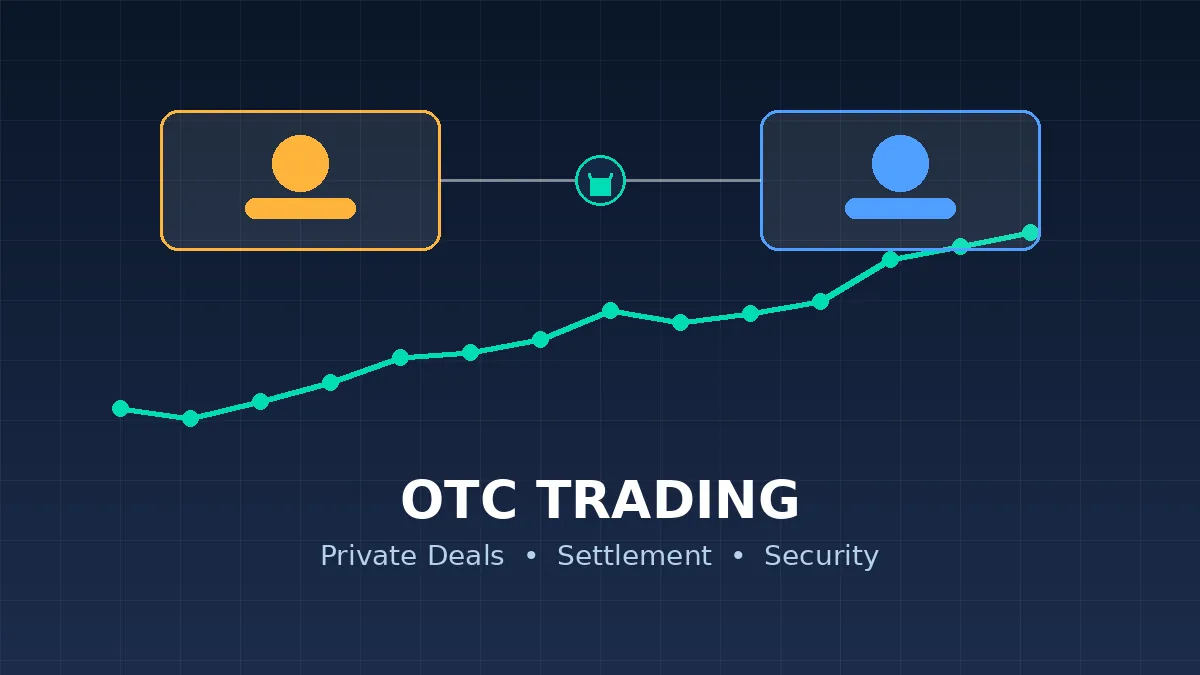
Most crypto trades happen on a public exchange, in full view. However, the biggest trades often happen somewhere else entirely. In fact, OTC trading cryptocurrency activity takes place privately, between two parties, away from any order book. Consequently, beginners rarely see how these deals work until something goes wrong.
This guide explains the system in plain language, for learning only. Specifically, it covers what an OTC desk is and why large orders move off-exchange. Additionally, it walks through a typical deal, step by step. Most importantly, it gives scam warnings the prominence they deserve.
Educational note: This article is for general education only. It is not financial advice. It does not recommend any desk, platform, or trade.
What does OTC trading cryptocurrency actually mean?
OTC stands for over the counter. In simple terms, over the counter crypto trading means a buyer and seller agree a deal directly. Therefore, no public order book sits between them. Instead, the two sides negotiate the asset, the amount, and the price in private.
By contrast, an exchange trade is public and automatic. You place an order, and the matching engine finds a counterparty instantly. Similarly, every exchange order leaves a visible footprint in the market. An OTC deal, however, leaves almost no public trace at the time.
Moreover, OTC trading is not a crypto invention. Traditional markets have used over-the-counter dealing for bonds and shares for decades. Crypto simply adopted the same idea for digital assets. As a result, the language and the process feel familiar to finance professionals.
For broader background on how financial concepts fit together, our guide to understanding basic finance is a helpful starting point. Meanwhile, readers who follow trading topics may also compare this with our explainer on cryptocurrency shorting, which covers a very different market activity.
What is an OTC desk, and what types exist?
An OTC desk is a service that arranges or takes part in these private deals. Essentially, a crypto OTC desk helps large buyers and sellers complete a trade safely. The desk may act in different ways, however, and the difference matters.
How does a principal desk work?
A principal desk trades from its own inventory. In other words, the desk itself becomes your counterparty. It quotes you a firm price, and then it takes the other side. Consequently, the desk carries the market risk after the deal.
How does an agency desk differ?
An agency desk does not trade against you. Instead, it searches for another party on your behalf. It then charges a fee or commission for arranging the match. Therefore, its incentives are usually easier for a client to understand.
What other forms should you know about?
Some large exchanges run their own OTC services for verified clients. Meanwhile, independent brokers operate separately from any exchange. Peer-to-peer arrangements also exist, where two parties deal without a formal desk. Nevertheless, peer-to-peer deals carry the highest trust burden of all.
Reputable desks also run identity and source-of-funds checks. For example, they verify who the client is before any money moves. Similarly, they follow anti-money laundering rules in their jurisdiction. A desk that skips these checks entirely is a warning sign, not a convenience.
Why do large trades happen off-exchange?
The main reason is size. A very large order can overwhelm a public order book quickly. As a result, the price moves against the trader while the order fills. Traders call this problem slippage and market impact.
How does slippage hurt a large exchange order?
Imagine a buyer placing one huge order on a thin market. First, the order consumes the best available prices. Next, it reaches into weaker and weaker prices. Finally, the average price paid ends up far worse than expected. In short, the market punishes visible size.
An OTC block trade cryptocurrency deal avoids that spiral. The two sides agree one price for the whole block in advance. Consequently, the buyer knows the full cost before committing. The seller, similarly, knows exactly what they will receive.
Why does privacy matter to large traders?
Large orders attract attention. If the market spots a major buyer, other traders may rush in first. Likewise, a visible large seller can trigger fear and copycat selling. Private off-exchange trading reduces that exposure significantly.
Privacy is not secrecy for its own sake, however. Institutions also protect internal strategy and timing this way. For instance, a company adjusting its treasury does not want headlines mid-trade. Therefore, discretion is a practical business need, not just a preference.
What about flexibility and asset choice?
Exchanges list specific pairs and impose fixed processes. OTC desks, by contrast, can arrange less common assets or pairings. Additionally, they can agree settlement timing that suits both sides. That flexibility helps complex deals, although it also demands stronger paperwork.
The growth of crypto in everyday commerce adds useful context here. Our article on cryptocurrency in ecommerce shows how digital assets are used beyond trading screens. Similarly, work on financial technology and user retention explains why platforms design carefully around trust.
How does a typical OTC deal flow, step by step?
A typical OTC crypto trading deal follows a clear sequence. Each stage exists to reduce misunderstanding and risk. Skipping stages, therefore, should always raise questions.
Step one: onboarding and verification
First, the client opens an account with the desk. The desk checks identity documents and the source of funds. Additionally, both sides confirm which wallets and bank accounts will be used. Only after verification does any quoting begin.
Step two: the Request for Quote
Next, the client sends a Request for Quote RFQ. The request states the asset, the amount, and the desired pairing. For example, a client might ask to buy a stated amount of bitcoin for dollars.
The desk then responds with a firm price. However, that quote stays valid only for a very short window. Prices move quickly in crypto, after all. Therefore, the client must accept or decline promptly.
Step three: agreement and confirmation
Once the client accepts, the price is locked. The desk then issues a written trade confirmation. Crucially, the confirmation records the amount, price, wallets, and settlement terms. Both sides should keep this document and check every detail.
Step four: settlement
Settlement is the exchange of the two sides of the deal. One side sends payment, and the other side sends crypto. Sometimes this happens through pre-funded accounts held with the desk. In other cases, an escrow arrangement holds assets until both sides perform.
After settlement completes, the desk provides final records. The client then verifies the received amount on-chain or in their account. Finally, both sides retain records for accounting and tax purposes. Rules vary by country, so local advice matters there.
Technology also shapes how desks operate behind the scenes. Our overview of how brokers update technology shows why execution systems keep changing. Meanwhile, the finance fundamentals in mastering the principles of finance help readers judge any trading service more calmly.
What are escrow and settlement risks in OTC deals?
Settlement is the most delicate stage of any private deal. Simply put, someone usually has to move first. That first mover is exposed if the other side fails. Experts call this exposure counterparty risk, and the timing gap creates settlement risk.
How does escrow reduce the risk?
Escrow for crypto trades means a neutral third party holds the assets temporarily. First, one side deposits funds or crypto with the escrow holder. Then, the other side deposits its side as well. Only when both sides are confirmed does the escrow release everything.
Escrow only works, however, if the escrow holder is genuinely independent. A scammer can easily invent a fake escrow service, after all. Therefore, you must verify the escrow provider through its official channels. Never trust an escrow link sent by the counterparty alone.
What is delivery versus payment?
Delivery versus payment is a settlement method designed for fairness. Under this approach, the crypto delivery and the payment happen together. If one leg fails, then the whole trade unwinds. As a result, neither side is left holding nothing.
Some arrangements use smart contracts to automate this exchange on-chain. Others rely on custodians who release both sides simultaneously. Either way, the principle is the same. Both sides complete, or neither side completes.
What other settlement problems can appear?
Bank transfers can be delayed, especially across borders or weekends. Wallet addresses can also be copied incorrectly, with irreversible results. Additionally, network congestion can slow on-chain confirmations unexpectedly. Careful desks therefore confirm addresses in writing and use test steps where appropriate.
Custody is another consideration during the settlement window. Assets in transit are assets at risk, however briefly. Consequently, clear custody arrangements matter as much as price. A cheap quote with weak settlement is never a bargain.
What are the biggest scam red flags in OTC trading?
This section matters most, so read it slowly. OTC trading scams exploit the private nature of these deals. Because no public exchange supervises the chat, criminals can impersonate desks easily. Indeed, many victims lose everything in a single transfer.
Red flag one: unsolicited desks on messaging apps?
Be extremely wary of strangers offering OTC deals on Telegram or WhatsApp. Legitimate desks do not cold-message random people with amazing prices. Therefore, treat every unsolicited approach as hostile until proven otherwise. In most cases, it is simply a scam.
Red flag two: send crypto first, trust us?
Never send crypto first to an unverified counterparty. Scammers insist on this sequence because crypto transfers are hard to reverse. Once your coins leave, recovery is unlikely. A real desk, by contrast, explains its settlement protection in writing.
Red flag three: a price that looks too good?
A quote far below the visible market price is bait. Scammers use unrealistic prices to rush your decision. Meanwhile, legitimate quotes track the broader market closely. If a deal looks strangely generous, walk away and verify independently.
Red flag four: fake escrow and fake licences?
Criminals create convincing escrow websites and forged licence documents. They also copy the names of real firms to look credible. Therefore, check licences directly on the regulator’s own website. Additionally, contact the firm through contact details you found yourself, not links they sent.
Red flag five: pressure, urgency, and secrecy?
Pressure is a classic manipulation tool. Messages like “send now or lose the deal” are designed to stop thinking. Similarly, requests to keep the deal secret from your bank or adviser are alarming. Honest firms welcome questions, checks, and a slower pace.
Other warning signs deserve attention too. For instance, a desk that refuses video calls or written agreements is risky. Likewise, shifting wallet addresses at the last minute is a serious alarm. In short, every unexplained change should pause the deal immediately.
How can you protect yourself before any OTC deal?
Protection starts long before money moves. The steps below are educational, not a guarantee of safety. Nevertheless, they filter out most common fraud patterns.
- First, verify the firm independently through official regulator registers and its real website.
- Second, insist on a written agreement that names the parties, price, wallets, and settlement method.
- Third, use an independent escrow provider or delivery-versus-payment settlement where possible.
- Fourth, confirm wallet addresses through a separate channel, character by character.
- Fifth, start with a small test amount where the arrangement genuinely allows it.
- Finally, keep full records of chats, confirmations, and transaction hashes.
Additionally, involve a qualified legal or financial professional for significant sums. Their fee is small compared with a total loss. Similarly, tell your bank what the payment is for, if asked honestly. Concealing the purpose of a transfer creates further problems later.
Choosing regulated venues also reduces risk considerably. Regulation does not remove market risk, of course. However, it adds identity checks, complaint routes, and accountability. Unregulated private arrangements offer none of those protections.
Businesses researching visibility in this space should also stay cautious. Our piece on choosing an SEO agency for cryptocurrency shows how bold marketing claims deserve the same scepticism. In both areas, verification beats enthusiasm every time.
How does OTC trading compare with exchange trading?
Exchange trading suits small, frequent orders well. It is transparent, fast, and largely self-service. Anyone can watch the order book and the resulting price history. For everyday amounts, that openness is a real advantage.
OTC trading, by contrast, suits unusually large or sensitive orders. It offers privacy, a single agreed price, and flexible settlement. However, it replaces exchange safeguards with counterparty trust. That trade-off is the heart of the whole topic.
Retail traders generally do not need OTC services at all. Desks are built around large blocks, standing relationships, and verification. Therefore, a small trader offered “OTC access” by a stranger should be suspicious. The offer itself is often the scam.
Neither route removes the underlying volatility of crypto assets. Prices can move sharply on either venue, without warning. Consequently, understanding the mechanism is only one part of responsible learning. Position size and personal risk limits matter just as much.
Frequently asked questions about OTC crypto trading
Is OTC trading cryptocurrency legal?
OTC trading is a recognised market practice in many places. However, the firms offering it may need licences or registration locally. Rules differ widely between countries and change over time. Therefore, check your local regulator before engaging any service.
Can beginners use an OTC desk?
Most desks serve large, verified clients rather than beginners. Their processes assume experience, documentation, and significant order sizes. Beginners, meanwhile, face the highest scam risk in private channels. Learning the concepts first is far safer than attempting a deal.
Why do OTC trades not appear on exchange charts?
OTC trades never pass through a public order book. Consequently, charting platforms cannot display them as exchange volume. The underlying transfers may still settle on-chain later. Even then, the agreed price stays private between the parties.
What is the safest settlement method for an OTC deal?
No method is completely risk-free. However, independent escrow and delivery-versus-payment reduce the first-mover problem. Both approaches aim to complete both sides together. Written confirmation of the method, before any transfer, is essential.
How can you verify an OTC desk is real?
Start with the regulator’s register in the firm’s claimed jurisdiction. Then, contact the firm through details from that register or its verified site. Additionally, be suspicious if the firm avoids calls or paperwork. A real firm expects scrutiny and handles it professionally.
What should you remember about OTC trading cryptocurrency?
OTC trading cryptocurrency deals exist because large orders strain public markets. Desks solve real problems: slippage, privacy, and flexible settlement. At the same time, private dealing creates counterparty and settlement risks. Those risks grow dramatically when scammers enter the conversation.
Therefore, treat knowledge as your first protection. Understand the quote, agreement, and settlement flow before anything else. Verify every firm, escrow service, and wallet address independently. And if anyone pressures you to send crypto quickly, stop.
Final reminder: This article is educational only and is not financial advice. Crypto assets are volatile and high risk. Always do your own research and consider independent professional advice before any transaction.




