
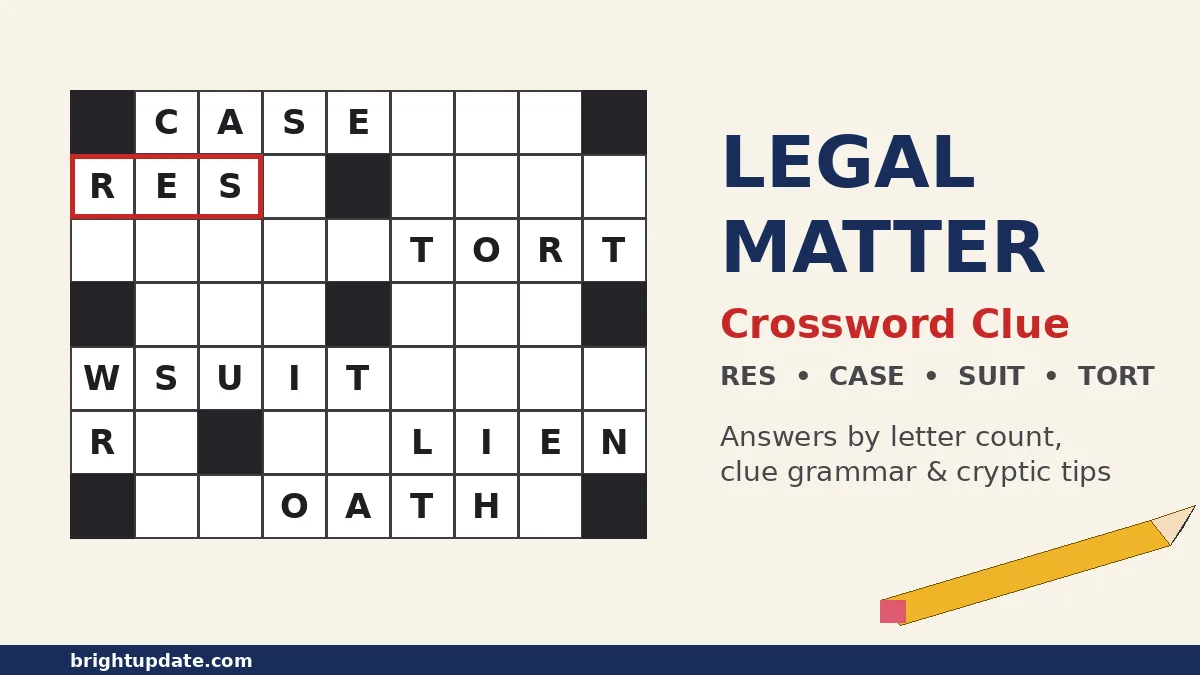
Few clues stall solvers faster than plain legal wording. However, the legal matter crossword clue looks simpler than it really is. In practice, two ordinary words can hide several different answers. Moreover, each answer depends on letter count and crossing letters. Consequently, experienced solvers treat this clue as a small logic test.
Constructors love legal language for very practical grid reasons. Indeed, courts supply short words with friendly vowel patterns. Additionally, law terms carry precise meanings that setters can clue fairly. Therefore, the same handful of answers returns week after week. Learning that handful turns a stubborn clue into free squares.
This guide gives you the answers first and the method second. Firstly, you will meet RES, CASE, SUIT, and TORT by length. Secondly, you will learn why Latin keeps appearing in legal clues. Finally, you will see how clue grammar and crossings confirm answers. Regular solving also rewards patience, as our piece on crosswords and cognitive well-being explains well.
What is the most common answer to the legal matter crossword clue?
Letter count decides this clue before meaning even matters. However, most solver databases put one three-letter answer first. Specifically, RES answers Legal matter in major newspaper puzzles repeatedly. Meanwhile, four-letter slots usually want CASE, SUIT, or TORT instead. Consequently, your enumeration narrows the field within seconds.
- RES (3 letters) — Latin for thing or matter, and the classic legal matter crossword clue answer.
- CASE (4 letters) — a matter before a court, and the standard answer for Matter before a court.
- SUIT (4 letters) — a lawsuit or civil action, although the word also means clothing elsewhere.
- TORT (4 letters) — a civil wrong, and solver sites also list it under Legal matter.
- CASES (5 letters) — the plural form, answering Matters for courts or detectives and similar plural clues.
- LAWSUIT (7 letters) — a longer, fuller answer when the clue describes a court action directly.
- CASE FILE (8 letters) — the documents on a legal matter, rather than the matter itself.
Qualifiers in the clue can stretch the answer much further. For example, Quickly resolved legal matter points to OPENANDSHUTCASE instead. Indeed, that fifteen-letter answer appeared in a recent LA Times puzzle. Therefore, solvers should read every adjective before guessing any answer. In short, plain wording hides a surprisingly flexible answer family.
Why does RES answer the legal matter crossword clue so often?
RES comes straight from Latin, where res means thing or matter. Moreover, Roman law organised whole arguments around that single word. Consequently, English legal Latin kept res inside many set phrases. Solvers meet those phrases in law reports and textbooks alike. Hence, setters can clue RES fairly for any attentive reader.
Grid mechanics also keep RES alive in modern American puzzles. Indeed, R, E, and S rank among the commonest English letters. Moreover, the word contains no awkward consonant clusters at all. Consequently, constructors can place RES almost anywhere without strain. Additionally, its vowel sits centrally and supports many crossing words. Therefore, frequency in language and frequency in law reinforce each other.
Several famous phrases show how deeply res sits inside law. For instance, res judicata means a matter already judged and settled. Similarly, res ipsa loquitur means the thing speaks for itself. Meanwhile, in rem describes actions against a thing or property. Together, those phrases explain why dictionaries gloss res legally. Precise legal language also builds trust, as discussions of how legal services present excellence often note.
What about CAUSA in Latin-flavoured puzzles?
CAUSA offers a second Latin route into the same territory. In Latin, causa means a cause, a reason, or a case. Moreover, legal writers use causa for the grounds behind an action. Therefore, learned puzzles occasionally clue CAUSA as a legal matter. Nevertheless, everyday American puzzles still favour RES far more often. Accordingly, solvers should try CAUSA only when crossings support it.
How does crossword clue grammar actually work?
Every fair clue quietly obeys a small set of grammar rules. However, beginners often read clues as ordinary English sentences. Instead, setters write clues as contracts between definition and answer. Moreover, each word must earn its place inside that contract. Consequently, parsing the grammar beats guessing from vibes alone.
Where does the definition sit inside a clue?
Quick clues usually offer one straight definition and nothing else. By contrast, cryptic clues place the definition at either end. Typically, the definition opens the clue or closes the clue. Meanwhile, the remaining words supply wordplay that builds the answer. Therefore, cryptic solvers always test the first and last phrases first.
American quick clues follow a simpler but stricter fairness rule. Specifically, the clue and answer must share part of speech. Additionally, both sides must agree in tense and number. Hence, a plural clue demands a plural answer every time. Likewise, a past-tense clue demands a past-tense answer form. Punctuation can help too, because a question mark signals wordplay. American editors use that mark for puns and playful definitions. Solvers exploring clue styles can compare a familiar example in our guide to a pet sitter clue in the NYT crossword tradition.
Why do tense and number agreement matter so much?
Agreement rules turn vague hunches into testable crossword answers quickly. For example, Matters for courts points firmly towards CASES, not CASE. Similarly, Matter before a court points towards singular CASE instead. Moreover, verb endings in clues mirror verb endings in answers. Consequently, one small letter S can redirect your whole solve. In practice, checking agreement takes seconds and prevents silly errors.
How do abbreviation signals change a legal clue?
Setters must flag abbreviations honestly in American-style quick puzzles. Usually, phrases like for short or briefly signal shortened answers. Additionally, the tag Abbr. after a clue warns solvers directly. Therefore, Legal assistants, for short fairly delivers PARAS in grids. Meanwhile, cryptic clues hide abbreviations inside wordplay without extra warnings. Indeed, cryptic solvers memorise abbreviation lists as core solving equipment.
How do cryptic clues handle legal matter differently?
Cryptic clues give you two routes towards the same answer. Firstly, one part defines the answer like an ordinary clue. Secondly, another part builds the answer letter by letter. Moreover, an indicator word usually announces which building trick applies. Consequently, a correct cryptic answer feels proved, not merely guessed.
SUIT shows the gentlest cryptic trick, the double definition. Here, one definition means a set of formal clothes. Meanwhile, the second definition means a legal action in court. Therefore, both halves define SUIT without any letter manipulation. Double definitions suit beginners because the wordplay stays purely semantic. However, harder clues add anagrams, containers, reversals, or hidden words. Anagram indicators include words like wild, broken, or badly arranged. Similarly, hidden-word indicators include phrases like found in or inside. Reversal indicators include words like back, returning, or around. Homophone indicators include phrases like sounds like or we hear. Each indicator tells solvers exactly which operation to perform.
Legal vocabulary feeds cryptic wordplay especially well through abbreviations. For instance, setters often use law itself for LEX in Latin. Additionally, court can shrink to CT inside longer cryptic answers. Meanwhile, company becomes CO and doctor becomes DR very frequently. Therefore, short legal answers often hide inside longer themed entries. Awareness of local legal language helps too, as benchmarking a local legal ecosystem nicely illustrates.
Which short legal words do crosswords love most?
Short legal words fill grids because law favours compact Latin forms. Moreover, their letters repeat across many common English words. Consequently, constructors reach for this vocabulary whenever grids tighten. Learning twelve core terms covers most law clues you meet. Additionally, each term below answers real clues in published puzzles.
- ACT (3) — a statute or law, and also something someone does.
- BAR (3) — the legal profession, or the exam lawyers must pass.
- LAW (3) — the rules themselves, clued through statutes, codes, or ordinances.
- LEX (3) — Latin for law, appearing in phrases like lex loci.
- SUE (3) — to bring a legal action against someone in court.
- RES (3) — Latin for thing or matter, the star of this article.
- BAIL (4) — security money that frees an accused person before trial.
- DEED (4) — a legal document proving ownership or transferring property rights.
- JURY (4) — the panel that hears evidence and delivers a verdict.
- LIEN (4) — a legal claim against property until a debt gets paid.
- OATH (4) — a sworn promise to tell the truth in court.
- PLEA (4) — a defendant answer to a charge, such as guilty.
- TORT (4) — a civil wrong that grounds a claim for damages.
- WRIT (4) — a formal written court order directing someone to act.
Real-world legal work uses these words with far heavier consequences. Indeed, an oath inside a courtroom binds a witness legally. Similarly, a lien can block a family from selling property. Therefore, puzzle familiarity helps recognition, but never replaces proper advice. Anyone facing real deadlines should study organised systems like structured legal compliance for modern businesses instead.
How should you use crossing letters and letter patterns?
Crossing letters settle arguments that definitions alone cannot settle. However, many beginners guess whole answers before checking any crossings. Instead, strong solvers enter one letter and retest every candidate. Moreover, each confirmed crossing removes rival answers very quickly. Consequently, the grid itself becomes your most reliable solver tool.
Unchecked letters deserve extra suspicion during any careful grid check. However, British lattice grids leave more letters unchecked than American grids. Therefore, a doubtful letter may belong to only one entry there. Meanwhile, American grids usually test every letter at least twice. Consequently, one impossible crossing exposes a wrong legal answer fast. In practice, solvers should recheck unchecked squares before declaring victory.
Patterns reveal answers even when the clue still feels opaque. For example, the pattern C_SE strongly suggests CASE for legal clues. Similarly, a pattern like _ORT makes TORT almost unavoidable here. Meanwhile, three-letter patterns ending in ES invite RES immediately. Therefore, writing patterns visibly helps your brain spot candidate words. Solver websites formalise this trick through pattern search boxes. Typically, you enter known letters and mark unknown squares clearly. Additionally, you filter results by exact answer length first. Hence, the database returns only words matching your grid pattern. Used well, that process teaches vocabulary rather than replacing thought. Broader legal reading habits also sharpen pattern sense, as coverage of the future of legal services shows.
How do quick and cryptic crosswords differ across the Atlantic?
American and British puzzles grew from one invention into two traditions. However, their grids and clue styles now differ quite sharply. American grids check nearly every letter through crossing answers. Moreover, American grids use dense blocks with strong rotational symmetry. Consequently, American clues lean towards definitions, trivia, and playful puns.
British newspapers publish two distinct styles for different solver appetites. Firstly, the British quick crossword offers straight definitions without wordplay. Secondly, the British cryptic crossword adds wordplay to every clue. Meanwhile, British grids use a lattice with more black squares. Therefore, many British answers receive fewer checked letters overall. Enumeration also differs, because British clues print letter counts in brackets. American cryptics exist too, but editors there enforce stricter clue rules. Specifically, American cryptic clues must account for every clue word. By contrast, British setters allow slightly looser, more playful clue surfaces. Real legal questions need similar care with jurisdiction, as our explainer on whether visiting abandoned places is illegal shows.
What should you do when two answers both seem to fit?
Rival answers appear whenever legal vocabulary overlaps in daily solving. However, a calm checking routine resolves most clashes within minutes. Firstly, recount the enumeration printed beside or inside the clue. Secondly, test tense and number agreement against both candidate answers. Thirdly, check every crossing letter you already trust completely. Finally, ask which answer the clue wording defines most precisely.
Context inside the puzzle also breaks ties more often than dictionaries. For instance, a themed puzzle may favour Latin answers throughout. Similarly, a Monday puzzle usually prefers the commonest answer available. Meanwhile, a Saturday puzzle may deliberately choose the rarer legal term. Therefore, difficulty level forms part of the clue evidence too. Overall, the legal matter crossword clue rewards method over memory. Keep RES, CASE, SUIT, and TORT ready by length. Additionally, learn the glossary words and trust your crossing letters. Consequently, the next legal clue will feel like a gift.
Frequently asked questions
What is the three-letter answer to the legal matter crossword clue?
RES fills the three-letter slot in most newspaper puzzles. Indeed, solver records show RES answering Legal matter repeatedly. Moreover, Latin gives the clue a fair and checkable basis. Therefore, solvers should test RES before rarer three-letter options.
Why do crosswords use Latin words for legal clues so often?
Latin shaped English law for centuries through courts and universities. Consequently, legal English still preserves Latin terms like res and lex. Additionally, those short words fit tight grid corners beautifully. Hence, setters return to Latin whenever legal clues appear.
How can you tell CASE from TORT in a four-letter slot?
Clue wording separates CASE from TORT more reliably than length. Specifically, matter or court business points towards CASE most times. Meanwhile, wrong, injury, or lawsuit basis points towards TORT instead. Crossing letters then confirm whichever reading the wording supports.
Does a question mark always signal wordplay in a clue?
American editors usually place a question mark after playful clues. However, the mark promises a pun, twist, or loose definition. Moreover, British cryptic clues rarely need that extra warning sign. Therefore, treat the mark as a helpful hint, not proof.




