
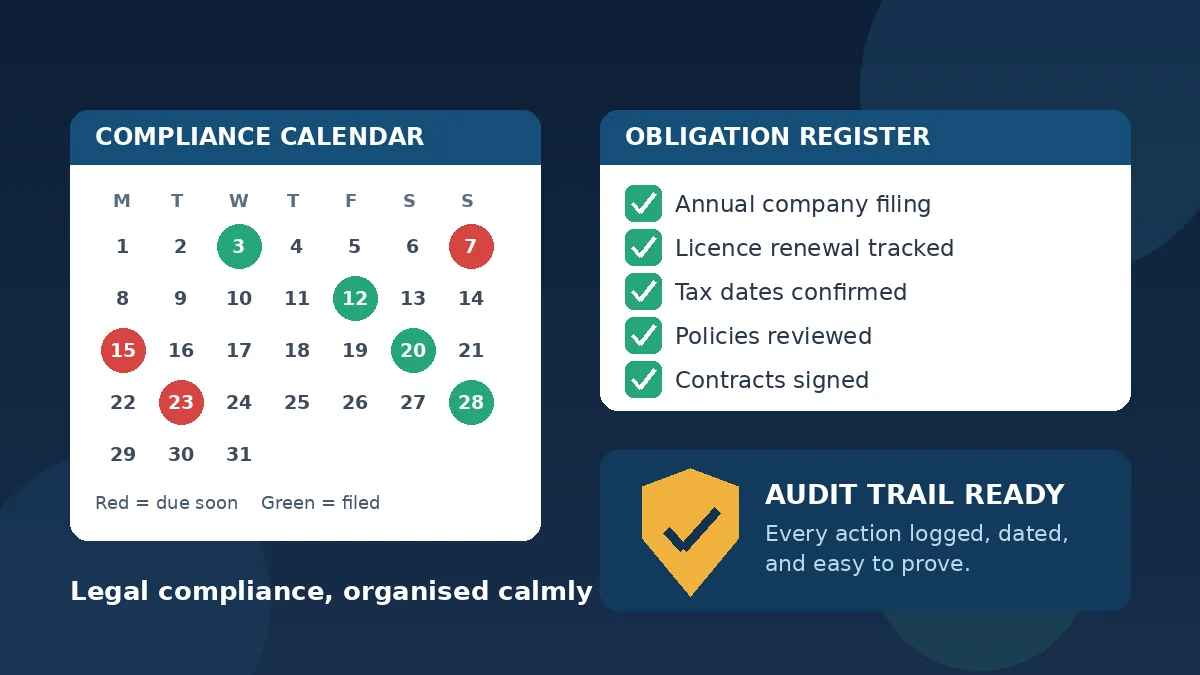
Every growing company collects deadlines quietly. However, those deadlines rarely sit in one place. In practice, legal compliance for businesses spans filings, licences, contracts, staff records, and tax dates. Moreover, each duty carries a different owner and a different renewal cycle. Consequently, owners often feel busy yet still unsure about coverage.
Searches for names like Snagaslip Legal usually reflect that same search for a calmer system. Nevertheless, the real fix rarely comes from a single brand name. Instead, the fix comes from clear records and steady habits. Therefore, this guide explains the tools and workflows behind calm compliance. Specifically, it covers software functions, core duty areas, evaluation checks, and common pitfalls.
Importantly, this article offers general information only, not legal advice. Rules differ by country and state, so check your local requirements carefully. Likewise, sectors add extra duties on top of general company rules. Hence, use this guide as a planning framework, not a legal ruling. Ultimately, a qualified local adviser should confirm any doubtful point.
What does legal compliance for businesses actually involve?
Simply put, compliance means proving that your business follows the rules that apply to it. Usually, those rules come from company law, tax law, and employment law. Additionally, privacy rules and sector licences often apply as well. As a result, compliance blends daily administration with legal responsibility. Indeed, the work feels operational long before it feels legal.
For example, a small retailer still files annual company returns each year. Similarly, that retailer renews licences, keeps payroll records, and protects customer data. Meanwhile, a consultancy handles contracts, invoices, insurance renewals, and staff onboarding checks. Therefore, the duty list changes with size, sector, and location. Consequently, no universal checklist fits every business perfectly.
Documentation matters just as much as action itself. For instance, regulators and auditors usually ask for evidence, not intentions. Hence, owners need records that show what happened and when. Moreover, tidy records help during funding rounds, sales, and partner reviews. In short, compliance means doing each duty and proving it afterwards. Guidance on how legal services present excellence and trust shows why that proof also shapes reputation.
What does compliance management software actually do?
Basically, compliance management software organises duties, dates, documents, and owners in one system. However, good software does far more than store files. In practice, the software turns scattered obligations into visible tasks. Moreover, managers see overdue items before those items become penalties. Consequently, teams replace memory and guesswork with a shared routine.
Start with an obligation register
An obligation register lists every duty your business must meet. Typically, each entry names the duty, the owner, and the due date. Additionally, each entry links to the rule or filing behind it. As a result, new staff understand responsibilities without hunting through emails. Indeed, the register becomes the single source of truth.
For example, one entry might cover the annual company confirmation filing. Another entry might cover a premises licence renewal in spring. Meanwhile, a third entry might track quarterly tax submissions for the finance lead. Therefore, the register groups duties by area, owner, and frequency. Consequently, reviews become faster, calmer, and far more reliable.
Turn dates into a live compliance calendar
A compliance calendar converts register entries into dated reminders and tasks. Usually, the calendar sends alerts well before each deadline arrives. Moreover, deadline tracking escalates overdue items to a manager automatically. Hence, a missed date triggers action rather than silence. In practice, that early warning prevents most avoidable fines.
Licence renewal tracking deserves special attention inside that calendar. For instance, trading licences, permits, and insurance policies often renew on different cycles. Similarly, director filings and registered office updates follow their own schedules. Therefore, owners should load every recurring date into one view. As a result, the business sees clashes and busy months early.
Keep documents, evidence, and signatures together
Strong document management for compliance links each duty to its supporting evidence. Typically, the system stores filed returns, certificates, policies, and signed contracts centrally. Additionally, version control shows which document version is current. Moreover, an audit trail records who opened, changed, or approved each item. Consequently, audits become evidence exercises rather than frantic searches.
Electronic signature tools also belong inside this document flow. For example, directors can sign approvals without printing and scanning pages. Similarly, clients and suppliers can sign standard contracts through a tracked link. However, signature rules vary by document type and jurisdiction. Therefore, owners should confirm which documents need formal witnessing locally. Planning this alongside wider digital transformation in business operations keeps the rollout coherent.
Which compliance areas do growing businesses juggle most?
Most businesses juggle five broad areas at once. Firstly, company filings keep the legal entity in good standing. Secondly, employment duties cover contracts, payroll records, and workplace policies. Thirdly, tax dates drive regular submissions and payments throughout the year. Additionally, privacy duties govern how the business handles personal data. Finally, licences and insurance protect permission to trade.
Company filings and entity management
Entity management covers the formal life of your company or group. Usually, the work includes annual filings, director changes, and shareholder records. Moreover, registered office details and company registers need regular updates. For example, a new director appointment triggers filings and internal record changes. Consequently, sloppy entity records create problems during sales or investment checks.
Multi-entity groups face even greater pressure here. Indeed, each subsidiary carries its own filings, accounts, and governance dates. Meanwhile, parent teams still need one consolidated view of status. Therefore, entity tools or structured registers help groups avoid duplication. In contrast, a single small company may manage with a simpler setup. Benchmarks from benchmarking success in a local legal ecosystem show how structured oversight supports steadier growth.
Employment, tax, and data protection duties
Employment compliance starts before a new hire signs anything. Typically, employers prepare contracts, right-to-work checks, and policy acknowledgements in advance. Additionally, payroll records, leave records, and training logs need consistent retention. As a result, HR files become compliance evidence, not just admin paperwork. Hence, owners should treat onboarding as a compliance workflow.
A tax compliance calendar then anchors the financial year. For instance, sales tax, payroll tax, and corporation tax follow separate timetables. Similarly, bookkeeping deadlines feed directly into filing deadlines each period. Therefore, finance teams should review upcoming tax dates monthly. Moreover, early preparation reduces errors during busy trading periods.
Data protection compliance adds another steady layer of work. Usually, businesses map what personal data they hold and why. Additionally, teams set retention periods, access controls, and breach response steps. For example, a marketing list, a payroll file, and CCTV footage need different handling. Consequently, privacy work touches marketing, HR, IT, and customer service alike. Support routes such as an a legal referral panel for urgent guidance also remind owners that specialist help exists.
How should you evaluate a compliance tool before you buy?
Careful evaluation prevents expensive and disruptive tool changes later. However, feature lists alone rarely reveal real day-to-day fit. In practice, owners should test the tool against their actual duty register. Moreover, the test should include real users from finance, HR, and operations. Consequently, weaknesses appear during trials rather than after contracts.
Jurisdiction coverage deserves the first and hardest questions. For example, does the tool track the filings for your country and state? Similarly, does the vendor update content when local rules change? Therefore, ask vendors for sources and update processes in writing. In contrast, vague promises about global coverage should raise caution. Indeed, a smaller tool with accurate local content often wins.
Integrations then decide whether staff actually use the system. Typically, useful links include calendars, email, accounting tools, and HR platforms. Additionally, an electronic signature connection reduces separate document chasing. As a result, data flows once instead of being retyped repeatedly. Hence, owners should map integrations before comparing headline prices. Discussions about the future of legal services in changing markets highlight how connected tools now shape client expectations.
Security and support complete the evaluation picture. For instance, owners should check access controls, backups, and encryption standards carefully. Moreover, audit trail exports matter when auditors request evidence quickly. Similarly, responsive support matters during filing week, not just onboarding. Therefore, test support with a real question during the trial. Finally, confirm exit options and data export formats before signing.
What are the common pitfalls that undo good systems?
Most compliance failures come from habits, not from missing software. However, one pitfall towers above the rest in practice. Specifically, owners sometimes treat software as a substitute for legal advice. Nevertheless, software tracks tasks and stores evidence only. Consequently, software cannot interpret ambiguous rules for your exact situation. Therefore, professional advice remains essential for complex or high-risk questions.
Missed renewals form the second classic pitfall for businesses. For example, a licence expires quietly during a busy trading month. Similarly, insurance cover lapses because nobody owned the renewal date. As a result, the business trades uninsured or unlicensed without realising. Hence, every recurring duty needs a named owner and a deputy. Indeed, ownership prevents more failures than reminders alone.
Scattered records then undermine otherwise careful compliance work. Typically, contracts sit in email, certificates sit in drawers, and filings sit in folders. Moreover, departing staff sometimes take key knowledge with them. Consequently, audits become slow, stressful, and embarrassingly incomplete. In contrast, one central register and repository fixes this quickly. Local help models like an a community legal assistance programme for timely help show the value of organised access.
Overbuying creates a quieter but real pitfall too. For instance, a five-person firm rarely needs enterprise-grade workflow suites. Similarly, unused dashboards and alerts quickly train staff to ignore notifications. Therefore, owners should match tool complexity to actual duty volume. In short, a simple system used weekly beats a powerful system ignored. That discipline mirrors advice on scaling small business growth with focused systems rather than scattered tools.
When should you bring in a lawyer or compliance professional?
Professional help becomes essential whenever the stakes or ambiguity rise. For example, a regulator letter always deserves professional review immediately. Similarly, a data breach, employment dispute, or tax investigation needs expert handling. Moreover, contract negotiations with major clients carry long-term legal consequences. Consequently, early advice usually costs less than later repairs.
Growth events also trigger a clear need for advice. Typically, hiring senior staff, raising investment, or entering new markets changes obligations. Additionally, launching regulated products or handling sensitive data raises the bar. Therefore, owners should schedule legal reviews before major launches. In practice, a short review often prevents months of corrective work.
Ongoing support can stay proportionate for smaller businesses. For instance, many firms use a lawyer for annual governance reviews only. Meanwhile, accountants handle tax calendars and filing preparation throughout the year. Additionally, a part-time compliance consultant can review the register quarterly. As a result, the business gains expert oversight without building a legal department. Indeed, proportionate support suits most growing companies well.
How do you build a simple compliance workflow that lasts?
A lasting compliance workflow starts with one honest inventory. Firstly, list every filing, licence, policy, and recurring duty you know. Secondly, add the owner, frequency, and next due date for each item. Thirdly, attach the latest evidence document to every single entry. Consequently, the first register already reveals gaps and duplicates. Therefore, treat that first clean-up as valuable progress.
Next, turn the register into a monthly operating rhythm. Typically, one short monthly review checks upcoming deadlines and overdue items. Moreover, a quarterly review samples evidence and tests the audit trail. Additionally, an annual review refreshes the register against new activities. As a result, compliance becomes routine maintenance rather than annual panic. Hence, consistency matters far more than software sophistication.
A compliance checklist for small business owners keeps that rhythm practical. For example, the checklist can prompt contract reviews, insurance checks, and policy updates. Similarly, the checklist can trigger staff training refreshers and privacy reviews. In practice, short checklists work because busy owners actually complete them. Finally, owners should record each completed review inside the system. Overall, steady records create calm audits and confident decisions.
Regulatory compliance will keep changing as your business grows. However, a clear register, a live calendar, and tidy evidence absorb most change. Moreover, good tools simply support those three foundations every week. Therefore, start with the workflow, then choose software that fits it. Ultimately, seamless compliance comes from habits, ownership, and timely expert advice.
Frequently asked questions
Does compliance software replace a lawyer for a small business?
No, software organises tasks, deadlines, and documents for your team. However, software cannot interpret rules for your specific facts. Moreover, software cannot represent you during disputes or investigations. Therefore, use software for routine tracking and lawyers for judgement calls. Indeed, that combination gives small businesses both structure and protection.
What should a first obligation register include?
Basically, each entry needs a duty name, owner, and due date. Additionally, each entry should link to supporting evidence and source rules. For example, filings, licences, tax dates, and policy reviews belong there. Consequently, anyone can see status without asking around the office. Hence, completeness matters more than fancy formatting at first.
How often should owners review the compliance calendar?
Monthly reviews suit most small and mid-sized businesses well. Typically, a monthly check catches deadlines with enough lead time. Moreover, quarterly deep reviews can test evidence quality and ownership. In contrast, annual-only reviews leave dangerous gaps between checks. Therefore, build the monthly habit before adding extra reporting layers.
Which documents should stay ready for an audit?
Filed returns, licences, insurance certificates, and signed contracts matter most. Additionally, keep board approvals, policy versions, and training records accessible. For instance, auditors often sample items across several years quickly. As a result, a central repository with clear naming saves hours. Finally, store the audit trail export alongside the documents themselves.