
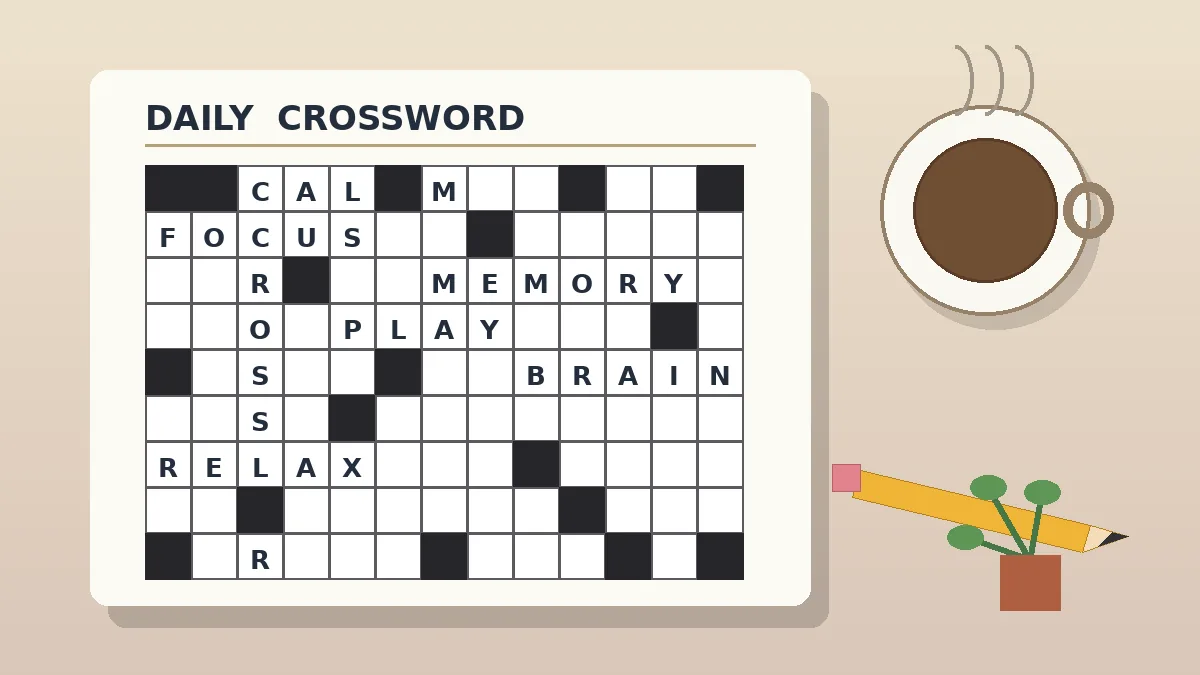
A quiet table can hold a surprisingly powerful ritual. Indeed, a printed grid, a pencil, and ten calm minutes can change the feel of a morning. Crossword mental health is not about chasing a perfect score, though. Instead, it is about giving your mind meaningful work in a gentle, enjoyable way.
Many people discover crosswords during a commute or a slow Sunday. Others return to them later in life, after years away from word games. Either way, the appeal is easy to understand. A crossword asks you to remember, to reason, and to play with language at once.
Moreover, that combination feels different from passive scrolling or background television. You are not simply receiving information during a puzzle. Rather, you are searching your memory, testing ideas, and making choices. Consequently, even a short session can feel mentally awake and quietly satisfying.
What happens in your mind while you solve a crossword?
Each clue starts a small search through your stored knowledge. For example, a clue about a river might trigger geography, stories, and past travel memories. Simultaneously, the crossing letters narrow your options and guide the next guess. As a result, several kinds of thinking work together in one simple activity.
Verbal memory sits at the centre of that process. You recall word meanings, spellings, synonyms, and familiar phrases from long-term storage. Meanwhile, working memory holds the clue and the crossing letters in mind. Therefore, a crossword exercises both stored knowledge and present attention.
Why does retrieving a word matter so much?
Retrieval is harder than recognition, and that difficulty is useful. When you read a list, the answer sits in front of you. In contrast, a crossword makes you produce the answer yourself. Hence, the effort of remembering can make the connection feel stronger afterwards.
Additionally, clues rarely point in only one direction. A single word might involve a definition, a pun, or a cultural reference. Consequently, you practise flexible thinking while you weigh several possible meanings. That flexibility is a valuable part of everyday problem-solving skills.
How do crossing letters train problem-solving skills?
Crossing letters turn guessing into careful reasoning. Firstly, one confirmed answer gives you letters for neighbouring answers. Secondly, those new letters either support or challenge your earlier ideas. Finally, the grid itself tells you when an answer cannot fit.
Such feedback is immediate and honest. If a word fails, you erase it and try another route. In short, the puzzle teaches patience, checking, and revision without any real-world penalty. Those habits transfer nicely into study, work, and daily decisions.
Why does cognitive engagement matter for cognitive well-being?
Cognitive well-being is about more than remembering names quickly. It also includes clear thinking, curiosity, confidence, and mental flexibility. Moreover, it involves feeling able to learn new things at any age. A regular puzzle habit can support several of those qualities at once.
Studies of cognitively stimulating activities suggest that engaged minds stay active minds. Reading, learning languages, playing strategy games, and solving puzzles all share that pattern. However, association is not the same as a guarantee. Therefore, crosswords belong inside a wider, balanced lifestyle.
Still, the logic behind cognitive engagement is appealing. Activities that demand attention and effort give the brain varied practice. In contrast, long stretches of passive entertainment ask very little from you. As a result, many people use puzzles as one deliberate way to stay mentally involved.
| Activity | Main mental demand | Social option? |
|---|---|---|
| Crossword puzzles | Verbal memory, vocabulary, and reasoning | Yes, clues can be shared aloud |
| Reading a novel | Imagination, memory, and empathy | Yes, through book groups |
| Learning a language | Recall, listening, and pattern spotting | Yes, through classes and partners |
| Strategy board games | Planning, prediction, and flexibility | Yes, naturally group based |
The table shows a simple truth about variety. Each activity stretches the mind in a slightly different direction. Consequently, crosswords work best alongside reading, movement, conversation, and sleep. Together, those habits create a richer form of daily brain care.
How can a daily crossword routine support mental sharpness?
Consistency usually beats occasional marathon sessions. A short daily crossword routine is easier to keep and easier to enjoy. Moreover, returning to the grid each day builds a familiar rhythm. That rhythm can make mental exercise feel normal rather than forced.
Routine also creates a helpful sense of progress. Yesterday, a themed clue may have completely defeated you. Today, however, a similar clue feels familiar and manageable. As a result, you notice your vocabulary and language skills growing quietly over time.
Furthermore, a set time protects the habit from a busy day. Some solvers prefer breakfast with a mini puzzle and coffee. Others, meanwhile, save a larger grid for the evening wind-down. Either pattern works, provided the session feels calm and unhurried.
Readers who enjoy broader reflections on wellbeing may also like our guide to turning the page to a healthier mind. That piece explores fresh starts and supportive habits. Similarly, a daily puzzle can mark a small fresh start each morning.
Can crosswords help with stress relief and mindful focus?
For many solvers, a crossword creates a quiet pocket in a noisy day. The grid gives wandering thoughts one clear place to land. Consequently, attention moves away from worries and towards the next clue. That gentle shift is the heart of stress relief puzzles for many people.
Mindful focus does not always require silence or meditation cushions. Sometimes, it simply means doing one absorbing thing at a time. While solving, you read carefully, pause, think, and write. In other words, the puzzle naturally slows the pace of your attention.
Why does single-tasking feel so calming?
Single-tasking removes the constant switching that drains modern attention. Your phone may buzz, yet the half-finished grid invites you back. Moreover, the task has clear boundaries, unlike endless news feeds. Therefore, finishing or pausing a puzzle feels cleaner and more restful.
Naturally, difficulty changes the experience completely. A puzzle far above your level can create frustration instead of calm. Conversely, a puzzle slightly below your level may feel soothing but dull. Hence, the sweet spot sits in the middle, challenging yet reachable.
When should you put the puzzle down?
Frustration is useful information, not a personal failure. If your shoulders tense, the break is probably overdue. Similarly, if checking answers becomes compulsive, the fun has likely faded. At that point, a walk or a drink of water helps more.
Pleasant surroundings can restore the calm feeling afterwards. For instance, our roundup of places to visit for rest and relaxation celebrates slower settings. Likewise, a quiet corner at home can become your regular puzzle place. Setting matters, although the habit matters more.
Why does a sense of mastery feel so satisfying?
Every filled square offers visible proof of progress. A blank grid slowly becomes a completed pattern under your pencil. As a result, small wins accumulate into a genuine sense of mastery. That feeling can lift confidence far beyond the puzzle itself.
Unfinished business, meanwhile, has a curious pull on the mind. Interestingly, our article on the Zeigarnik effect and cognitive closure explores that pull in another setting. Crosswords use the same tension kindly, through one stubborn clue. Consequently, solving that clue later brings a disproportionate burst of pleasure.
Mastery also grows through honest difficulty steps. Firstly, mini puzzles teach common clue styles and short answers. Secondly, weekday-sized grids introduce wordplay and themed entries. Finally, larger weekend puzzles reward patience and broader general knowledge.
- Start small: mini grids build confidence without draining energy.
- Notice patterns: repeated clue styles become friendly over time.
- Celebrate finishes: completed grids deserve a moment of pride.
- Raise difficulty slowly: steady steps keep motivation alive longer.
Importantly, mastery here is personal rather than competitive. Your only meaningful rival is yesterday’s version of yourself. Therefore, comparing times with expert solvers adds little value. Enjoyment, after all, is what keeps the habit alive.
What role does social puzzling play?
Crosswords look solitary, yet they often become shared entertainment. One person reads the clues aloud at the kitchen table. Others call out ideas, argue playfully, and celebrate tricky answers. Consequently, social puzzling turns quiet thinking into warm conversation.
Shared solving also softens difficult clues. A partner may know sports while you know films and geography. Together, your combined knowledge fills gaps that neither person could alone. Moreover, teaching a clue to someone else deepens your own understanding.
Families discover this during holidays and long journeys. Grandparents, parents, and children can all contribute something useful. For example, a child might spot a simple rhyme that adults overlooked. As a result, the grid becomes a rare activity across generations.
Even clue culture can spark conversation beyond the grid. Our explainer on a crossword clue about a legal matter shows that world clearly. Similarly, pet lovers may smile at our guide to a pet sitter clue in the NYT crossword. Clues, evidently, connect puzzles to everyday life.
How do crosswords fit into healthy aging brain habits?
Interest in brain health puzzles often grows with age. Older solvers value activities that feel enjoyable, familiar, and mentally demanding. Crosswords meet all three tests without special equipment or high cost. Therefore, they remain a popular part of healthy aging brain routines.
Research on cognitively stimulating leisure generally links engagement with maintained abilities. In particular, verbal tasks may help people keep using rich vocabulary over time. However, crosswords are only one piece of that larger picture. Movement, social contact, hearing care, and sleep also matter greatly.
Moreover, familiar formats can encourage reluctant beginners. A printed crossword feels less intimidating than a technical brain-training app. Consequently, many older adults stick with puzzles they already understand. Enjoyment, in this case, supports consistency beautifully.
Why does variety protect the benefit over time?
The brain adapts quickly to repeated, identical challenges. If every puzzle feels automatic, the workout becomes much lighter. In contrast, varied grids introduce new themes, clue styles, and vocabulary. Hence, changing sources and difficulty keeps the activity genuinely engaging.
Variety can also come from mixing puzzle types. Sudoku stresses numbers and logic rather than words. Jigsaws, meanwhile, train visual attention and patience. Together with crosswords, they create a broader and fresher mental menu.
Learning itself remains a lifelong ally in this story. Indeed, our overview of educational theorists and lifelong learning shows why curiosity endures. Similarly, a crossword rewards curiosity with a new fact in almost every grid. That steady drip of discovery keeps solving fresh.
Which other habits strengthen the effect?
Puzzles work best inside a lifestyle that supports the brain. Sleep, for example, helps memory settle and attention recover overnight. Likewise, regular walking supports mood, energy, and clear thinking. Therefore, a crossword should complement, never replace, those foundations.
Balanced routines also include people and purpose. Volunteering, hobbies, friendships, and learning goals all demand real engagement. Moreover, they provide the novelty that a single hobby cannot supply alone. As a result, your weekly mix matters more than any single activity.
- Move daily: walks and gentle exercise support overall brain health.
- Sleep properly: rested minds remember and focus far better.
- Stay social: conversation challenges listening, memory, and empathy together.
- Keep learning: courses, books, and skills add fresh mental variety.
- Eat sensibly: regular, balanced meals support steady energy and focus.
Broader wellness thinking helps people connect those pieces. For instance, our profile of Cleerly Health and its wellness approach reflects that joined-up view. Similarly, crossword mental health makes most sense inside whole-person care. No single hobby, however enjoyable, carries wellbeing on its own.
What can crosswords not do for your mental health?
Honest limits make the benefits more believable, not less. Crosswords do not cure or prevent dementia, depression, or anxiety. Moreover, no puzzle can replace diagnosis, therapy, medication, or medical advice. Therefore, please treat enthusiastic headlines about puzzles with healthy caution.
Instead, think of crosswords as a complement to professional care. They can offer focus, pleasure, routine, and gentle mental exercise. However, persistent low mood or memory worries deserve proper attention. A doctor or mental health professional should assess those concerns promptly.
Please also seek support early rather than struggling alone. Talking to a trusted person can be a sensible first step. Subsequently, professional guidance can clarify what kind of help fits best. Puzzles may accompany that journey, although they cannot lead it.
Frustration deserves the same honesty from the other side. If puzzles regularly increase stress, choose a gentler activity instead. Reading, gardening, music, and walking can engage the mind differently. Ultimately, the best hobby is the one that leaves you feeling better.
How do you start a crossword habit that actually sticks?
Begin with a puzzle that feels almost too easy. Early wins teach clue conventions and build welcome momentum. Moreover, short minis fit into five spare minutes without pressure. As confidence grows, longer grids will naturally become more inviting.
Next, attach the habit to an existing daily moment. Breakfast, a train ride, or an evening tea can anchor it. Consequently, you will rely less on motivation and more on routine. A pencil kept beside the puzzle removes one more small barrier.
Should you check answers while you solve?
Checking answers is a learning tool, not a moral failing. If one clue blocks the whole grid, revealing it can restart momentum. Afterwards, study why the answer fitted the clue’s wordplay. In that way, a checked answer still teaches something useful.
Nevertheless, give each clue a fair attempt first. Guessing, erasing, and returning later exercises retrieval most fully. Meanwhile, crossing letters may quietly solve the problem for you. Patience, therefore, often beats the answer key.
Should you solve on paper or on a screen?
Paper offers a calm, tactile break from glowing screens. Many solvers love crossing out, annotating, and seeing the whole grid. Apps, however, provide timers, hints, archives, and instant checking. Either format works, provided you return to it willingly.
Your setting can matter as much as your format. A comfortable chair and good light reduce needless strain. Similarly, a regular puzzle place signals that thinking time has begun. Small comforts, in practice, protect long-term consistency.
Questions people often ask about crossword mental health?
How often should you do a crossword?
Most keen solvers enjoy a short puzzle most days. Consistency matters more than long, exhausting sessions, however. Therefore, choose a frequency that fits your life comfortably. Even a few sessions each week can sustain the routine.
Are crosswords better than other brain games?
Crosswords emphasise language, whereas other games stress logic or speed. Neither type is automatically superior for every person. Instead, the best choice is the activity you enjoy and repeat. Variety, moreover, gives your mind the broadest workout.
Can children and teenagers benefit from crosswords?
Young solvers can build spelling, vocabulary, and general knowledge playfully. Age-appropriate grids keep the challenge fair and encouraging, though. Furthermore, family solving turns homework-like practice into shared fun. That positive feeling can support a lasting love of words.
What should you do when a puzzle feels too hard?
Start by completing every clue you know, however simple. Then use those crossing letters to attack the harder entries. If progress stops completely, switch to an easier grid without shame. Confidence, after all, grows from finishing as well as stretching.
In the end, crossword mental health is a modest, human story. A grid will not transform your brain overnight, of course. Nevertheless, regular solving can sharpen attention, exercise verbal memory, and calm a busy mind. Most importantly, it can make caring for your mind feel enjoyable.




