
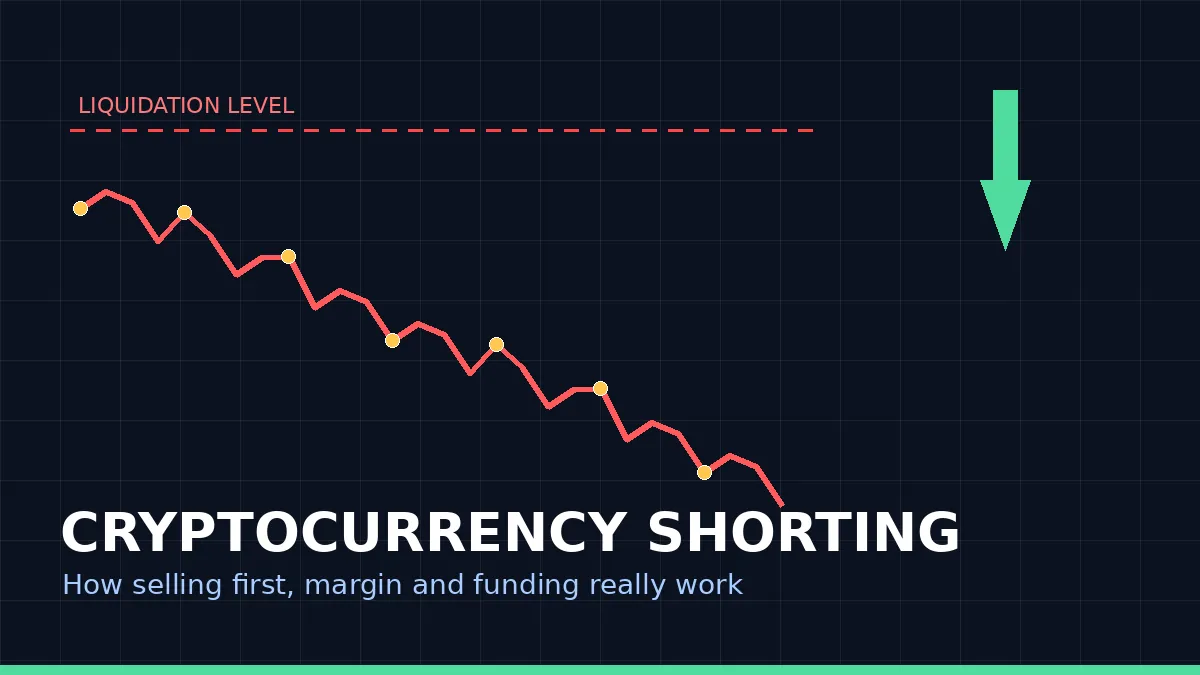
Most people first meet crypto through buying. You buy a coin, you hope the price rises, and you sell later. Cryptocurrency shorting flips that idea completely. Instead of buying first, you sell first. Then you hope to buy back later at a lower price. Consequently, the position gains value when the price falls. However, it loses value when the price rises. This guide explains how that process actually works, step by step and in plain language.
Moreover, this is an educational explainer only. It is not financial advice, and it does not recommend shorting anything. Shorting is one of the riskiest activities in crypto markets. Therefore, understanding the mechanics matters far more than chasing any outcome. Additionally, the numbers in this article are clearly hypothetical. They exist only to show the maths clearly. In reality, fees, funding, and sudden price moves change every result.
What does cryptocurrency shorting actually mean?
Cryptocurrency shorting means opening a position that benefits if a coin falls in price. Traders often call this going short, while buying is called going long. In contrast, a long position loses money when the price falls. A short position does the opposite. Indeed, short selling cryptocurrency has existed in traditional markets for a very long time. Crypto exchanges simply adapted the same basic idea for digital assets.
Furthermore, shorting does not mean you dislike a project forever. Sometimes traders use a short to hedge coins they already own. For example, someone may hold Bitcoin for years but still worry about a short dip. In that case, a temporary short can offset some paper losses elsewhere. Nevertheless, many shorts are purely speculative bets on a fall. Either way, the mechanics stay exactly the same.
Additionally, you should separate the idea from the tools. The idea is simple: profit requires a lower buy-back price. The tools, however, are more complex. You can short through margin trading crypto products on an exchange. Alternatively, you can short through perpetual futures contracts. Each route works slightly differently, and each route carries its own costs. Therefore, learning both routes gives you a fuller picture.
How does short selling work step by step?
Firstly, it helps to picture the classic margin route. This is the oldest form of short selling, and it still explains the logic best. You borrow a coin you do not own. Then you sell that borrowed coin straight away. Later, you buy the same amount back. Finally, you return the coin to the lender and close the loan.
Borrowing and selling on margin
To begin, you need a margin account with funds inside it. That money acts as collateral for the loan. The exchange lends you coins against that collateral. Then the exchange, or its lending pool, records what you owe. For instance, imagine a hypothetical coin priced at 100 dollars. You borrow one coin and sell it immediately for 100 dollars.
Meanwhile, your debt is not measured in dollars. Instead, you owe one full coin back. That detail matters more than beginners expect. If the price rises, buying back one coin costs you more dollars. Conversely, if the price falls, buying back costs you fewer dollars. Additionally, borrowing is rarely free for long. Interest or borrowing fees can apply while the loan stays open.
Buying back and closing the position
Closing a short is often called covering. You buy back the same amount you borrowed earlier. Then you return it, and the exchange settles your profit or loss. Suppose the hypothetical coin falls from 100 dollars to 80 dollars. You buy back one coin for 80 dollars. As a result, you keep the 20 dollar difference, before fees and interest.
However, the reverse outcome is just as possible. Suppose the coin rises to 130 dollars instead. Then buying back costs you 130 dollars, not 100 dollars. Consequently, you lose 30 dollars, plus any fees and interest. Moreover, there is no natural ceiling on that rise. In theory, the price could keep climbing far beyond 130 dollars. That open-ended risk shapes everything else in this article.
What is a margin account and how does leverage work?
A margin account lets you control a position larger than your deposit. The deposit itself is called margin, and it works as security. Leverage in crypto trading describes how much larger the position is. For example, 5x leverage means a 100 dollar deposit controls 500 dollars. Therefore, price moves feel five times bigger against your deposit.
Specifically, leverage magnifies both directions equally. A small favourable move creates a larger gain on your margin. Likewise, a small adverse move creates a larger loss on your margin. Leverage does not improve your chances of being right. Instead, it simply shrinks the room you have for error. In practice, that shrinking room is what catches most beginners out.
Furthermore, exchanges require you to maintain a minimum margin level. This level is often called maintenance margin. If your losses eat too deeply into your collateral, warnings appear. Then the exchange may demand more funds from you. If you cannot add funds quickly enough, forced closure follows. That forced closure has a specific name, which this article covers shortly.
What is the difference between isolated margin and cross margin?
Isolated margin ring-fences one position from the rest of your account. You assign a fixed amount of collateral to that single trade. If the trade fails, only that assigned amount is at risk. The rest of your balance stays untouched and separate. Consequently, isolated margin gives beginners a clearer worst case.
Cross margin works in the opposite way. Your whole account balance backs every open position together. Profitable positions can therefore support a losing position for longer. However, that support comes with a serious trade-off. One runaway losing trade can drain funds meant for everything else. In the worst case, cross margin can put your entire balance at risk.
- Isolated margin limits the loss to the funds set aside for one position.
- Cross margin shares collateral across all positions in the account.
- Isolated positions can liquidate sooner, because no extra funds support them.
- Cross positions survive longer, but they expose the full account balance.
Additionally, many platforms default to cross margin without making that obvious. Therefore, checking the margin mode before opening any position is essential. A quick guides page on basic finance ideas, such as understanding basic finance principles, can also help you think clearly about collateral and risk before you study derivatives in depth.
How do perpetual futures let you short without borrowing coins?
Perpetual futures are now the most common way to short crypto. A perpetual future is a contract that tracks a coin price. Crucially, it has no expiry date at all. You never hold the actual coin itself. Instead, you hold a position that rises or falls with the price.
To short crypto with a perpetual, you simply open a sell position. No borrowing takes place behind the scenes. The contract itself creates your exposure to falling prices. Moreover, you choose your leverage and your margin mode at entry. Then the exchange calculates your liquidation level straight away. For readers comparing market structures, our explainer on how OTC crypto trading works shows how large trades happen away from public order books, which is a useful contrast to on-exchange perpetuals.
What is the funding rate and who pays it?
Because perpetuals never expire, their price could drift from spot. The funding rate exists to stop that drift. Funding is a small periodic payment between traders. Longs and shorts exchange this payment directly with each other. Importantly, the exchange itself does not keep the funding payment.
When the perpetual price sits above the spot price, funding is positive. In that case, longs pay shorts at set intervals. Conversely, when the perpetual trades below spot, funding turns negative. Then shorts pay longs instead. Funding intervals vary by platform and by contract. Therefore, a short held for days can quietly gain or lose money through funding alone, even if the price barely moves. In short, funding is a holding cost you must factor into any example.
Additionally, funding often signals how crowded a trade has become. Very positive funding suggests many traders are long and eager. Very negative funding suggests the short side is crowded instead. Neither signal predicts the next price move reliably. Nevertheless, both signals warn you that one side is paying heavily to stay in the trade. Meanwhile, broader market news can still flip sentiment in minutes, as coverage of events like exchange delistings and what they mean for investors often shows.
A worked example with hypothetical numbers
Now let us walk through one complete hypothetical trade. Every number here is invented and deliberately round. Firstly, imagine a fictional coin trading at exactly 200 dollars. You believe the price looks vulnerable to a fall. You deposit 200 dollars of margin into an isolated margin position. Then you open a short at 5x leverage for practice.
That leverage gives you 1,000 dollars of total exposure. At 200 dollars per coin, your short covers five coins. Secondly, suppose the price falls by 10 percent to 180 dollars. Each coin now costs 20 dollars less to buy back. Therefore, your gross gain is five coins times 20 dollars. That equals 100 dollars before fees and funding.
What happens if the price rises instead?
Thirdly, consider the opposite path instead. Suppose the price rises by 10 percent to 220 dollars. Each coin now costs 20 dollars more to buy back. Consequently, your gross loss is also 100 dollars. That loss equals half of your original 200 dollar margin. Moreover, a rise of roughly 20 percent would threaten the whole margin. In practice, liquidation would likely arrive slightly before that point. Maintenance margin and fees pull the trigger a little earlier.
- Entry price in this example: 200 dollars per coin, purely hypothetical.
- Margin posted: 200 dollars, with 5x leverage and 1,000 dollars exposure.
- A 10 percent fall produces a 100 dollar gross gain before costs.
- A 10 percent rise produces a 100 dollar gross loss before costs.
- Trading fees, borrowing costs, and funding payments reduce gains and deepen losses.
Finally, notice what leverage did in this example. Without leverage, a 10 percent move changes your money by 10 percent. With 5x leverage, the same move changes your margin by 50 percent. That magnification explains both the appeal and the danger. Indeed, the maths is neutral, but human emotions rarely are. Readers who want stronger foundations can review core principles of finance before returning to leveraged products.
What is liquidation and how is the liquidation price reached?
Liquidation is the forced closing of your position by the exchange. It happens when your remaining margin cannot support the position. Every leveraged short has a liquidation price above its entry. If the market price reaches that level, the position closes automatically. As a result, you lose most or all of the margin assigned to it.
The liquidation price depends on several linked factors. Leverage is the biggest factor by far. Higher leverage places the liquidation price much closer to entry. Maintenance margin requirements also pull that price closer. Additionally, fees and funding payments slowly reduce your available margin. Therefore, a position can drift toward liquidation even while the price stands still.
For example, a 2x short can survive a fairly large rise. A 10x short, however, can fail after a rise near 10 percent. A 50x short can fail after a rise of only about 2 percent. Crypto prices can move that far within a single hour. Sometimes a brief spike, often called a wick, is enough. Even if the price recovers minutes later, the liquidated position stays closed. Consequently, survival depends on distance, not just on being eventually right.
Moreover, liquidations rarely happen in neat isolation. When many shorts liquidate together, their forced buying pushes prices higher. That buying then triggers even more liquidations nearby. Exchanges use insurance funds and partial liquidation systems to limit chaos. Nevertheless, during extreme volatility those systems are tested hard. Understanding how trading platforms build and update their systems, as explored in how brokers update their trading technology, helps explain why execution can differ so much between venues under stress.
Why is shorting crypto so risky?
Shorting combines several risks that rarely appear together elsewhere. Firstly, the loss potential is theoretically unlimited. Secondly, leverage accelerates losses and brings liquidation closer. Thirdly, crypto volatility can produce violent moves without warning. Finally, extra costs and platform risks keep working against you quietly. Each risk deserves its own clear explanation.
Can losses really be unlimited?
Yes, in principle they can. A coin bought for 100 dollars can only fall to zero. Therefore, a long trader can lose at most 100 dollars per coin. A short seller faces no matching ceiling at all. If that coin rises to 500 dollars, the short loses 400 dollars. If it rises to 2,000 dollars, the loss grows again.
In practice, margin and liquidation cut the position earlier. The exchange closes you out before losses exceed your collateral. However, that protection is not a comfort. It simply means your posted margin can disappear very quickly. In fast or illiquid markets, slippage can make outcomes even worse. Consequently, unlimited loss potential remains the defining risk of shorting.
What is a short squeeze?
A short squeeze happens when rising prices trap short sellers. As the price climbs, shorts rush to buy back and limit losses. Their buying adds fresh demand to the market. That demand pushes the price even higher still. Then more shorts hit their liquidation prices and buy back too. The loop feeds on itself and can move extremely fast.
Squeezes are more likely when several conditions appear together. Low liquidity makes each buy order move the price further. Crowded short positioning means many traders must exit through the same door. Unexpected positive news can light the fuse without warning. Additionally, thin weekend order books can make moves sharper. Therefore, a short that looks calm can become dangerous within minutes. Behavioural patterns matter here as well, and research into how financial technology shapes user behaviour shows how product design and crowd psychology can amplify rushed decisions.
How do volatility and funding costs add up?
Crypto markets trade around the clock, every single day. News can break while you sleep, and prices can gap sharply. Unlike stock markets, there are no regular closing bells to pause panic. Moreover, smaller coins can swing wildly on modest trading volume. A short on an illiquid coin therefore carries extra danger.
Costs add a slower, quieter pressure. Funding payments can drain a short held for many days. Borrowing interest does the same on margin-based shorts. Trading fees apply when you open and when you close. Individually, each cost may look small and harmless. Together, however, they steadily lower your margin buffer. As a result, your effective liquidation price creeps closer over time. Exchange risk sits on top of everything else, because outages, withdrawal problems, or platform failure can trap an open position when you most need control.
What risk-management concepts should you understand first?
Risk management cannot make shorting safe. However, it can make losses more predictable and less catastrophic. Two concepts matter most for beginners to understand. Position sizing decides how much damage one idea can cause. Stop losses decide when a losing idea gets closed. Both concepts are educational basics across all leveraged trading.
How does position sizing limit damage?
Position sizing means choosing your trade size relative to your account. A smaller position loses less money on the same price move. Therefore, sizing is your first and strongest line of defence. Many educational guides suggest risking only a small fraction per trade. The exact fraction is a personal decision, not a rule here.
Additionally, sizing and leverage must be considered together. A large position at low leverage can still be dangerous. Conversely, a tiny position at high leverage may risk little overall. What matters is the total loss if your exit level is reached. Calculating that number before entry changes your behaviour completely. It turns a vague hope into a measurable, bounded risk. For a wider view of how digital commerce and risk interact, how local e-commerce marketplaces manage growth offers a calmer, non-leveraged contrast in business risk.
Why do traders use stop losses?
A stop loss is an order that closes your position at a set level. For a short, that level sits above your entry price. If the market rises to that level, the position closes automatically. Consequently, a planned small loss replaces an unplanned large one. Stop losses also remove the need for split-second decisions.
Nevertheless, stop losses are not perfect protection. In fast markets, the actual exit price can slip beyond your level. This problem is called slippage, and volatile coins suffer it most. Guaranteed stops exist on some platforms, but they usually cost extra. Therefore, treat a stop loss as a strong tool, not a promise. Combining a sensible size, modest leverage, and a stop gives a clearer risk picture than any single tool alone.
Common questions about shorting crypto
Do you need to own a coin before you can short it?
No, you do not need to own the coin first. On margin, the exchange lends you the coin to sell. With perpetual futures, you hold a contract instead of any coin. In both cases, ownership is never required to open the short. However, both cases require collateral in your account.
Is shorting the same as selling coins you already own?
No, those two actions are quite different. Selling your own coins simply closes your long exposure. You cannot lose more than the value those coins had. Shorting, by contrast, opens a new position with borrowed exposure. Therefore, shorting carries margin, funding, and liquidation risks that simple selling never does.
Can beginners practise shorting without real money?
Many platforms offer demo accounts or paper trading modes. These tools simulate positions using pretend balances and live prices. As a result, you can watch funding and liquidation mechanics safely. Paper trading cannot reproduce real emotions or real slippage perfectly. Nevertheless, it remains the safest classroom for these mechanics.
Final thoughts on learning how shorting works
Cryptocurrency shorting is best understood as a mechanics lesson first. You sell high, you aim to buy back lower, and margin makes it possible. Perpetual futures simplify access, while funding rates keep contracts anchored. However, liquidation, squeezes, and unlimited loss potential punish mistakes harshly. Therefore, the educational value lies in understanding the machine, not in romanticising its outcomes.
If you remember only three ideas, remember these ones. Firstly, leverage shrinks your room for error very quickly. Secondly, costs and funding quietly move your liquidation price closer. Thirdly, a short can be right eventually and still lose everything first. Study the mechanics, respect the risks, and treat every example here as education only, never as financial advice or a recommendation to trade.




