
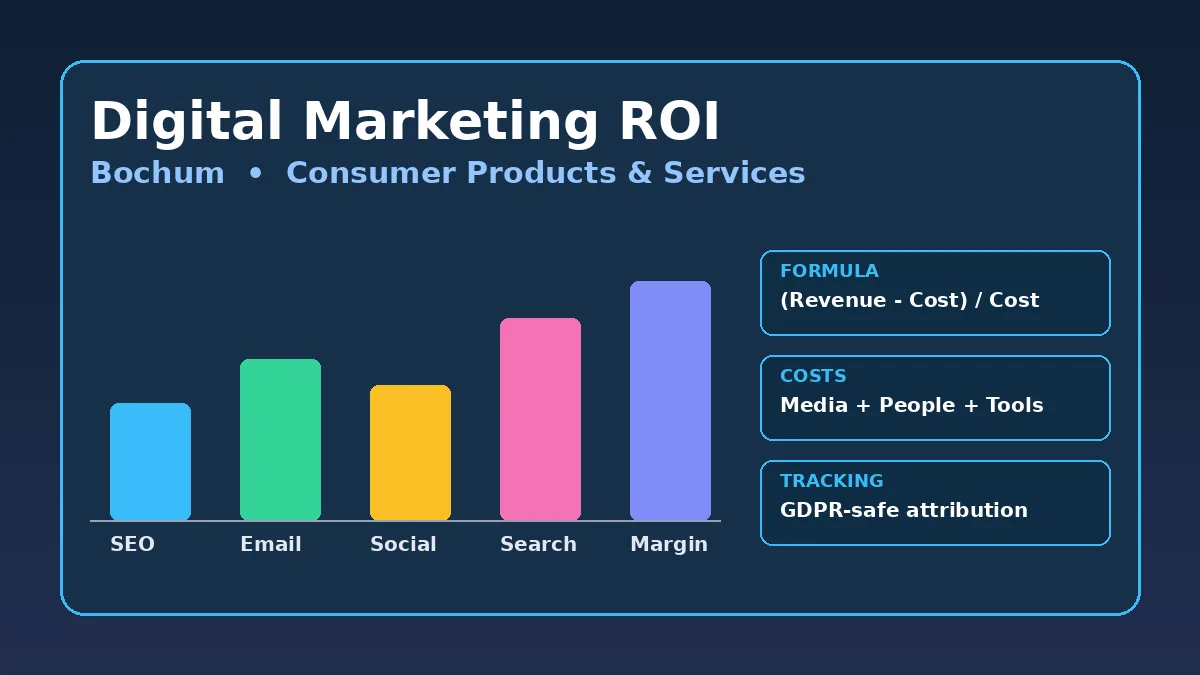
A Bochum shop owner can see clicks rising every week. Orders, however, may stay completely flat. That gap is exactly why the ROI of digital marketing in Bochum deserves careful attention. Clicks alone never pay rent, wages, or supplier invoices. Revenue after full costs tells the real story instead. Moreover, consumer products and services firms face short, repeat purchase cycles. Consequently, sloppy measurement can mislead budget decisions very quickly.
This guide teaches a clear measurement method, step by step. First, you will learn the digital marketing ROI formula properly. Next, you will see how to count costs honestly. Later, worked numbers show the method in action. Those numbers are illustrative, and they are labelled clearly throughout. Above all, no invented Bochum benchmark is presented as fact here. Instead, you get a system you can run yourself.
What does ROI actually mean for a consumer brand in Bochum?
Return on investment compares gain against total cost. In marketing, that gain should be attributed revenue or profit. For example, a household goods store sells products online and in store. Its campaigns therefore need one shared revenue definition. Otherwise, every channel report will tell a different story. Indeed, most ROI arguments start with mismatched definitions, not bad campaigns.
Consumer brands also sell through several routes at once. Shoppers may discover a product on social media first. Subsequently, they search for reviews in German. Finally, they buy in store near the city centre. A single-touch report would miss most of that journey. Hence, return on marketing investment needs a wider lens. That lens must cover discovery, comparison, purchase, and repeat buying.
Bochum adds a useful local dimension to this picture. The city sits inside the wider Ruhr region. Shoppers therefore move easily between Bochum, Essen, and Dortmund. Moreover, a campaign seen in Bochum may produce a sale elsewhere. Conversely, a Dortmund campaign may drive a Bochum store visit. Good measurement accepts that regional spillover openly. Rather than hiding it, smart teams record it deliberately.
The core formula, and why the simple version misleads
The basic digital marketing ROI formula looks deceptively simple. Take attributed revenue, subtract total marketing cost, then divide by cost. Afterwards, multiply the result by one hundred for a percentage. For instance, revenue of three units minus cost of one unit gives 200 percent. That arithmetic is easy, and anyone can check it. Nevertheless, the inputs decide whether the answer means anything.
Problems begin when revenue is counted loosely. Platforms often claim the same sale several times over. In addition, teams sometimes use total company revenue by mistake. That error inflates results dramatically, and it hides weak campaigns. Similarly, costs are often counted far too narrowly. Ad spend alone is never the full marketing cost. Honest marketing cost accounting must include people, tools, and production.
Three related measures help you avoid that confusion. Firstly, revenue ROI uses attributed revenue against full cost. Secondly, margin ROI uses gross profit instead of raw revenue. Thirdly, return on ad spend compares revenue with media spend only. Each measure answers a different management question, so label them clearly. Mixing them in one report, by contrast, creates instant confusion. Clear labels protect every later budget conversation.
Which version should a small firm report first?
Start with margin ROI for internal decisions. Gross profit reflects what the business actually keeps. Meanwhile, revenue ROI still helps with quick campaign comparisons. Return on ad spend, however, belongs inside media optimisation only. Used alone, it flatters campaigns with heavy hidden costs. Therefore, report all three side by side, always separately. Comparability improves immediately when definitions stay fixed month after month.
Count every cost before you judge a campaign
A complete cost list is the foundation of credible measurement. Begin with paid media across search, social, and display. Then add agency fees or freelancer invoices for the period. Next, include creative production such as photography, video, and copywriting. Software subscriptions also belong in the total, at least proportionally. Finally, add internal staff time at a realistic hourly rate.
Many Bochum firms quietly omit that staff time. As a result, in-house campaigns look artificially cheap. Freelance campaigns, conversely, look artificially expensive beside them. Fair comparison requires the same cost rules for both. In fact, one shared cost sheet solves most disputes. Update that sheet monthly, and keep its structure unchanged. Consistency matters more than perfect precision at this stage.
Hidden costs deserve explicit attention as well. Landing page builds, for example, support several campaigns over time. Product photography similarly serves the shop, ads, and social channels. Allocate such shared costs using a simple, documented rule. Perhaps split them evenly, or weight them by usage. Either approach works, provided the rule stays transparent. What matters most is never counting shared costs twice.
Scaling work offers a useful warning here. Growing online sales adds platform, fulfilment, and support costs quickly. Our guide to scaling eCommerce growth with digital marketing explores that expansion challenge in depth. Likewise, the article on eCommerce scalability frameworks and technical debt shows how systems affect margins. Both perspectives remind managers that revenue growth is not profit. ROI improves only when the full cost base stays visible.
Choose an attribution window that fits how people actually buy
Attribution decides which touchpoints receive credit for a sale. First-touch models credit the channel that introduced the shopper. Last-touch models, by contrast, credit the final interaction before purchase. Linear models spread credit evenly across every recorded touchpoint. Time-decay models give more credit to recent interactions instead. Data-driven models use observed conversion paths to assign weight. No single model is perfect for every business.
Window length matters just as much as model choice. A low-cost household item may sell within days. A considered service booking, however, may take several weeks. Therefore, match the attribution window to the real buying cycle. Short windows undervalue content, reviews, and early search visits. Excessively long windows, meanwhile, overvalue almost everything vaguely related. Test two windows side by side before changing budgets.
Practical discipline helps more than fashionable tools here. Use consistent UTM tags on every campaign link. Record the source inside your shop or booking system. Afterwards, reconcile platform reports against actual orders weekly. Discrepancies will appear, and they are genuinely informative. For example, duplicated platform claims reveal overlapping attribution windows. Investigating those gaps teaches more than any dashboard headline. Over time, that habit builds real marketing analytics confidence.
How can you test whether a channel truly adds sales?
Incrementality testing answers that harder question directly. Pause a channel in one area, or for one period. Then compare results against a similar unchanged control group. If sales barely move, the channel was claiming existing demand. If sales fall meaningfully, the channel was creating demand. Admittedly, small firms cannot run perfect experiments every month. Even a simple holdout test, however, beats blind trust. Small tests still reveal large attribution illusions.
A worked example for a fictional Bochum retailer
Consider a fully invented example, created only for illustration. Imagine a fictional Bochum retailer selling home fragrance products. During one illustrative month, its attributed revenue totals 18,000 euros. That figure is hypothetical, and no real business sits behind it. The example exists purely to demonstrate the calculation method. Please replace every number with your own recorded figures.
Now count the fictional costs for that same month. Media spend comes to 3,000 euros in this example. Freelance creative work adds another 900 euros, hypothetically. Software allocation adds 300 euros, and staff time adds 1,200 euros. Consequently, total marketing cost reaches 5,400 euros in total. Notice how media is only part of that total. Ignoring the rest would badly distort the final percentage.
Apply the digital marketing ROI formula to those invented figures. Subtract 5,400 from 18,000, which leaves 12,600 euros. Then divide 12,600 by 5,400, which gives roughly 2.33. Multiply by one hundred, and revenue ROI equals about 233 percent. Return on ad spend, meanwhile, equals six to one. Both numbers describe the same fictional month very differently. That contrast is precisely the lesson of this example.
Margin ROI tells an even stricter story here. Suppose the fictional gross margin on those sales was 40 percent. Gross profit would then equal 7,200 euros, hypothetically. Subtract the 5,400 euro cost, leaving 1,800 euros. Divide that by 5,400, and margin ROI equals about 33 percent. Suddenly, the campaign looks profitable but far less spectacular. Finance teams usually prefer this stricter, more honest view.
Which metrics explain the headline number?
A single ROI percentage never explains itself. Supporting metrics show why a result rose or fell. Customer acquisition cost is the first diagnostic to check. Divide total acquisition cost by new customers gained. If that cost climbs, growth may be getting inefficient. Conversely, falling acquisition cost may signal better targeting or creative. Always read it beside revenue, never in isolation.
Customer lifetime value provides the necessary long view. Estimate average spend, purchase frequency, and relationship length. Then multiply those three elements for a simple lifetime estimate. A costly first order can still be worthwhile, for example. Repeat purchases may repay the acquisition cost many times over. Services firms should also track rebooking and referral behaviour carefully. Those behaviours often matter more than the first transaction.
Conversion rate connects traffic quality with offer quality. Divide conversions by visitors, then watch the trend closely. Rising traffic with falling conversion usually signals weaker intent. Alternatively, a landing page problem may be wasting good traffic. Cost per lead suits service enquiries and appointment bookings. Average order value, similarly, explains revenue changes without traffic changes. Together, these metrics turn one percentage into a story. Managers can then act on causes, not symptoms.
Comparisons with other markets can sharpen that thinking. The companion analysis of digital marketing ROI for consumer firms in Vevey applies similar logic elsewhere. Likewise, our guide to scaling consumer products growth in Ciudad de México stresses disciplined expansion. Another useful companion is the piece on scaling consumer products and services growth in Doral. Different cities, yet the measurement principles remain identical everywhere.
How should each channel be judged on its own terms?
Paid search ROI usually appears fastest and clearest. Shoppers searching with buying intent convert relatively quickly. Track search spend against attributed orders within a short window. Also separate brand searches from generic category searches carefully. Brand terms often claim demand created by other channels. Generic terms, in contrast, reveal genuine new demand creation. That distinction changes how confidently you scale budgets.
SEO and content marketing ROI behaves very differently. Costs arrive early, while returns build gradually over months. Judging a guide after two weeks is therefore unfair. Instead, track organic visits, assisted conversions, and branded search growth. Content also lowers later acquisition costs by answering questions early. German-language buying guides, for instance, can support many campaigns. Measure content across a longer attribution window, consistently applied.
Email marketing ROI benefits from low marginal distribution costs. Existing subscribers, however, are not a free audience forever. List building, tools, design, and copywriting all cost money. Include those costs, then track revenue per campaign and subscriber. Repeat purchase rate matters especially for consumer products firms. Social media ROI measurement needs similar honesty about production time. Video, community replies, and influencer fees accumulate quickly. Track assisted conversions and repeat visits, not likes alone.
Local and marketplace channels add another layer entirely. Shoppers increasingly research nearby options before visiting any store. Our article on local eCommerce and neighbourhood marketplaces examines that behaviour closely. For Bochum firms, that local layer deserves separate reporting. Separate local campaign costs from national or regional activity. Then compare store visits, calls, and directions requests fairly. Blended reporting hides exactly the insight local managers need.
Measuring honestly under GDPR and consent limits
German marketing measurement operates inside strict privacy expectations. GDPR compliant marketing measurement starts with clear, recorded consent. Without consent, many analytics and advertising cookies cannot run. Consequently, part of your audience will remain partially unmeasured. That gap is normal, and it must be acknowledged openly. Pretending tracked data covers everyone leads to false certainty.
Consent mode and server-side tracking can help responsibly. Both approaches respect the choices visitors actually made. Aggregated reporting also protects privacy while preserving useful trends. Moreover, first-party data from your own shop deserves priority. Orders, bookings, and newsletter sign-ups are recorded with permission. Those records anchor ROI calculations when cookie data thins. Reliable anchors matter more as browser tracking keeps shrinking.
Transparency can become a commercial strength, surprisingly. German shoppers often scrutinise privacy notices and imprint pages carefully. Clear language about data use builds trust before purchase. That trust, in turn, supports conversion and repeat buying. Avoid dark patterns that pressure visitors into accepting everything. Short-term data gains rarely repay long-term reputational damage. Privacy-respecting measurement is therefore both a legal and commercial discipline.
Local search and German-language content in the Ruhr
Local SEO Bochum work influences ROI in quiet ways. Accurate opening hours, address, and category details reduce wasted enquiries. Reviews in German also shape trust for nearby shoppers. Responding to reviews takes staff time, so count it. That time belongs inside your local marketing cost base. Ignoring it understates the cost of maintaining local visibility.
Language quality affects conversion more than many firms expect. Shoppers comparing household products often read details very carefully. Awkward machine-translated copy can undermine an otherwise strong offer. By contrast, clear German product guidance answers real buying questions. It also reduces returns, support questions, and abandoned baskets. Those savings rarely appear in platform reports, unfortunately. Record them qualitatively beside your monthly ROI figures anyway.
Regional intent also changes campaign structure meaningfully. Some shoppers search by neighbourhood, others by city, others regionally. Separate those search themes instead of blending them together. Then compare conversion and acquisition cost by intent group. Bochum-specific pages may convert fewer visitors but at better value. Ruhr-wide pages, meanwhile, may deliver volume with weaker intent. Separate reporting reveals which pattern your business actually shows.
Build a dashboard and a monthly review rhythm
A marketing analytics dashboard should fit on one screen. Show spend, attributed revenue, and margin ROI first. Below that, display acquisition cost and lifetime value estimates. Add conversion rate, average order value, and repeat purchase rate. Finally, include a short note about data completeness. That note might record consent rates or tracking gaps. Context prevents confident decisions based on partial data.
Monthly reviews work best with a fixed agenda. Start by checking whether cost accounting stayed complete. Next, compare attribution results under two different models. Then examine channel diagnostics for the biggest movements. Afterwards, agree one budget change and one measurement improvement. Limiting actions keeps the team focused and accountable. Endless optimisation lists, by contrast, rarely get finished. Small, completed improvements compound into much better reporting.
Broader change programmes need the same discipline, incidentally. Our overview of digital transformation in business and digital marketing connects tools with organisational habits. Technology alone never fixes unclear ownership or definitions. Assign one person to own the cost sheet. Assign another person to own attribution settings and documentation. When ownership is clear, reporting arguments shrink noticeably.
Common mistakes that inflate or destroy ROI
Double counting is the most damaging reporting mistake. Two platforms claim one sale, and both get believed. Reconcile platform totals against real orders every single week. Another common error is mixing revenue with profit carelessly. High revenue on thin margins can still lose money. A third error is changing attribution settings mid-quarter. Comparisons then break, and trends become completely meaningless.
Short measurement windows quietly destroy good channels too. Content, reviews, and local SEO need time to work. Cutting them after one weak month is premature. Conversely, long windows can protect genuinely weak paid campaigns. Balance therefore matters more than loyalty to any model. Review assisted conversions before cutting any awareness channel completely. Many journeys start quietly, long before the final click.
Vanity metrics create a subtler form of self-deception. Impressions, followers, and likes feel encouraging in weekly meetings. Nevertheless, they do not prove commercial return on investment. Tie every reported metric back to revenue or cost. If a metric cannot connect, demote it to context. Dashboards become shorter, clearer, and far more useful. Teams then discuss money and customers, not applause.
A practical 90-day measurement plan
Days one to thirty should focus on foundations. Build the shared cost sheet with finance input. Fix UTM naming, consent settings, and conversion tracking. Document your primary attribution model and window in writing. Also record a baseline month before changing any budgets. Baselines make later improvement claims credible and checkable.
Days thirty-one to sixty should focus on comparison. Run two attribution models side by side, without panic. Compare channel acquisition costs against lifetime value estimates. Identify one channel with likely double counting, then investigate. Test one landing page improvement with a clear hypothesis. Measure that test over a full buying cycle. Rushed tests produce noise, not reliable learning.
Days sixty-one to ninety should focus on decisions. Move a modest budget share toward proven incremental activity. Run one simple holdout or pause test somewhere sensible. Review margin ROI, not only revenue ROI, with leadership. Finally, write down what you learned and what remains uncertain. That honesty improves the next quarter far more reliably. Measurement maturity grows through documented learning, not dashboard decoration.
Frequently asked questions about measuring ROI in Bochum
What is a good ROI for digital marketing?
There is no honest universal figure for every firm. Good depends on margin, growth stage, and purchase cycle. Therefore, judge ROI against your own break-even threshold first. Calculate the return needed after full costs and margins. Then compare campaigns against that internal threshold consistently. External averages cannot replace that business-specific calculation.
How long should you wait before judging a campaign?
Match the waiting period to the real buying cycle. Fast consumer purchases may justify a short review window. Considered services, however, need several weeks of observation. SEO and content usually need the longest evaluation period. Decide the window before the campaign launches, ideally. Changing it afterwards invites cherry-picking and internal arguments.
Should a small Bochum firm use revenue or profit for ROI?
Use profit for final decisions, and revenue for diagnostics. Revenue ROI helps compare creative, audiences, and landing pages quickly. Margin ROI, however, shows whether growth actually makes money. Reporting both prevents speed from turning into self-deception. Label each figure clearly in every single report.
How does GDPR affect digital marketing ROI measurement?
Consent limits reduce the share of journeys you can track. Some conversions will therefore appear as direct or unattributed. Accept that gap, and triangulate with first-party order data. Aggregated trends, holdout tests, and customer surveys can help. Never fill the gap by inventing precise-looking percentages. Honest ranges beat false precision in every boardroom.
Ultimately, the ROI of digital marketing in Bochum is a discipline, not a dashboard number. Count full costs, attribute revenue carefully, and respect consent limits. Moreover, judge each channel within a window that fits real buying behaviour. Additionally, test incrementality before making large budget moves. Follow that method, and the resulting percentage finally means something. More importantly, it will guide better decisions every month.




