
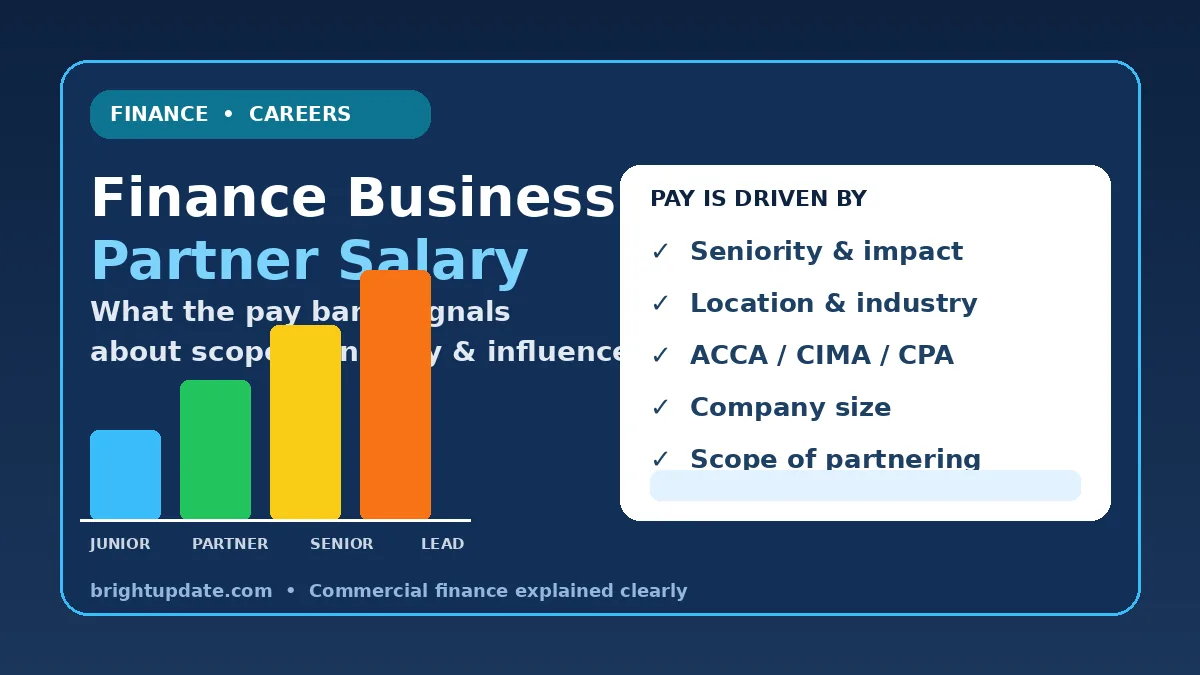
A finance business partner salary looks like a simple number on a job advert. In reality, however, that number tells a much bigger story. Indeed, it hints at how senior the role is, how wide its scope runs, and how much trust the business will place in you. Therefore, reading the salary well matters just as much as earning it.
Many qualified accountants reach a point where reporting alone feels too narrow. Consequently, they start looking for work that shapes decisions rather than simply recording them. Business partnering offers exactly that shift. Above all, it moves you from the edge of the business into the middle of its choices.
This guide explains what the role really involves day to day. It also shows what drives pay, what a pay band signals, and how the role can reshape your long-term career path.
What does a finance business partner actually do?
A finance business partner sits inside a business unit and supports its leaders with clear financial insight. For example, you might partner with operations, sales, marketing, or a regional leadership team. Your job is to help those leaders understand performance and choose better next steps. In short, you turn numbers into decisions.
The finance business partner role is deliberately forward looking. Whereas traditional reporting explains what already happened, partnering focuses on what should happen next. Therefore, you spend time on forecasts, scenarios, pricing choices, and investment cases. You also challenge plans that look optimistic, weak, or poorly costed.
Embedded in the business, not parked in finance
Most partners attend the meetings where real trade-offs get debated. As a result, you hear concerns early, rather than reading about them in a month-end pack. That early access changes your value completely. Specifically, you can flag risks while leaders can still act on them.
Relationships carry much of this work. Indeed, a partner who lacks trust will struggle, however strong their spreadsheets look. Operational leaders must believe that you understand their world. They also need to feel that your challenge helps them, rather than policing them.
The daily work behind the title
Typical work mixes analysis, conversation, and judgement in roughly equal measure. For instance, a single week might include a forecast review, a pricing discussion, and a difficult cost conversation. You might also build a business case for new kit, extra headcount, or a product launch. Meanwhile, you still need to explain variances clearly and calmly.
- Reviewing performance against budget and forecast, then explaining the story behind each gap
- Building scenarios that show what happens if sales, costs, or volumes move
- Testing investment proposals and pricing ideas before leaders commit money
- Translating complex results into plain language for non-finance managers
- Challenging assumptions respectfully, even when the room prefers an easier answer
That mix explains why employers describe the role as commercial finance rather than pure accounting. Certainly, technical accuracy still matters, because poor numbers destroy credibility fast. Nevertheless, accuracy alone will never make you an effective partner.
How is this role different from an accountant or an FP&A analyst?
Confusion around titles causes many disappointing job moves. Titles vary between employers, so two adverts with identical wording can describe very different jobs. Therefore, you should compare duties, audiences, and decision rights, rather than trusting the label alone. The contrasts below will help you read any advert with sharper eyes.
Management accountant versus finance business partner
A management accountant mainly produces the numbers. Their core output includes management accounts, reconciliations, and variance analysis for the finance team and the board. In contrast, a business partner mainly uses the numbers. Their core output is better commercial decisions, made by operational leaders.
Time orientation separates the roles just as clearly. Management accounting looks back at what happened last month, carefully and accurately. Business partnering looks forward at what leaders should do next quarter. Admittedly, both roles use budgets and forecasts, but they use them for different conversations.
This difference also explains a common career route. Many partners start as management accountants, then deliberately seek commercial exposure. Anyone strengthening their foundations first can revisit the basics covered in this guide to understanding basic finance before making that move.
FP&A analyst versus finance business partner
An FP&A analyst works within financial planning and analysis, usually serving the chief financial officer and senior finance leaders. Their strength lies in deep modelling, group forecasts, and board-level reporting. By comparison, a business partner serves one part of the business closely and deeply. Their strength lies in operational knowledge and day-to-day influence.
At smaller companies, however, one person often covers both jobs. That overlap is normal, and it can provide excellent early experience. Even so, you should ask who your main audience will be before accepting any offer. The answer reveals whether the job leans towards planning, partnering, or reporting.
Interim and project roles show a similar pattern of embedded support. For example, this overview of the business controller interim role shows how temporary finance leaders step into operational decision making.
What does a pay band actually signal about the role?
A pay band is rarely just about money. Instead, it acts as a coded summary of expectations. Higher bands usually signal wider scope, tougher stakeholders, and greater personal accountability. Lower bands usually signal narrower support work, closer supervision, and fewer independent decisions.
Consequently, you should read a band alongside the job description, not in isolation. Ask yourself what the employer expects in return for that level of pay. Then check whether the duties, team size, and reporting line match the promise. Mismatches in either direction should make you pause.
Scope, seniority, and decision rights
Scope drives pay more than almost anything else. A partner supporting one small cost centre carries limited exposure. Meanwhile, a partner supporting a whole division, region, or product line carries far greater exposure. The second role influences bigger budgets, riskier choices, and more senior people.
Decision rights matter just as much as budget size. Some partners only advise, while others can block spending or reshape a plan. Naturally, employers pay more where your judgement carries real consequences. They also pay more where mistakes would prove expensive and visible.
Total reward tells a story too
Base salary forms only part of the package. Bonus structure, car allowance, pension, and private healthcare all add meaningful value. In addition, hybrid working and study support can change the real worth of an offer. Therefore, compare total reward, rather than chasing the headline figure alone.
Bonus design reveals how the employer thinks about performance. A bonus tied to business results suits a genuine partnering role. Conversely, a bonus tied only to reporting deadlines hints at a reporting job in disguise. That small detail often exposes the true nature of the role.
What drives finance business partner pay?
Several forces combine to set pay for this role. No single factor explains a band on its own. Instead, employers weigh experience, location, industry, qualifications, company size, and scope together. Understanding that mix helps you judge offers fairly and negotiate calmly.
Seniority and proven impact
Experience raises pay only when it brings proven impact. Employers pay for decisions you influenced, savings you found, and growth you helped deliver. Simply repeating the same month-end routine for years adds far less value. Therefore, your evidence of impact matters more than your years of service.
Senior finance business partner roles demand a different level of confidence. At that level, you advise directors, lead difficult conversations, and sometimes manage other partners. You also handle ambiguity without waiting for perfect data. Those abilities take time to build, so employers price them accordingly.
Location and industry
Location shapes pay through living costs and competition for talent. Major financial centres usually pay more, because employers there compete harder for qualified people. Regional roles may pay less in cash terms, yet offer cheaper living and shorter commutes. Hence, the better offer depends on your whole life, not just the salary line.
Industry creates equally wide gaps. Sectors with complex margins, heavy regulation, or rapid growth tend to reward commercial finance skills generously. By contrast, stable sectors with thin margins often pay more cautiously. Neither setting is automatically better, since each offers different learning and pace.
Company size and complexity
Large organisations usually offer higher bands and more structured progression. Their finance teams are bigger, their budgets are larger, and their stakeholder groups are more complex. Smaller firms, however, often give partners broader exposure and faster responsibility. That breadth can accelerate your career, even when the starting band looks modest.
Growth stage matters too. A scaling business needs partners who can build processes while advising leaders. Meanwhile, a mature business needs partners who can refine margins and challenge established habits. Both settings reward partnering skills, although they reward slightly different strengths.
Digital change also reshapes what employers will pay for. Companies investing in new systems expect partners who can use data tools confidently. This piece on digital transformation in business shows why that expectation keeps growing across finance teams.
Which qualifications and skills move you up a band?
Most employers expect a recognised accountancy qualification for this role. Common routes include ACCA, CIMA, and CPA, alongside ACA in practice-trained markets. CIMA often suits management accounting and commercial roles particularly well. Nevertheless, employers care most about what you can do after qualifying.
A finance business partner job description usually blends technical and human requirements. On the technical side, employers want budgeting, forecasting, financial modelling, and sharp variance analysis. On the human side, they want communication, curiosity, and confident stakeholder management. Both sides matter, and weakness in either one will limit your progress.
The skills employers quietly test for
Interviews often probe for skills that adverts only mention briefly. For example, hiring managers listen for how you explain numbers without jargon. They also watch how you handle challenge, disagreement, and incomplete information. Those moments reveal whether you can influence a room, not just fill a spreadsheet.
- Commercial awareness, so you understand how the business actually earns money
- Financial modelling that supports choices, rather than impressing other accountants
- Clear storytelling, so leaders grasp the message within minutes
- Constructive challenge, delivered early and without personal friction
- Curiosity about operations, customers, and competitors beyond the finance office
Technology skills increasingly separate strong candidates from average ones. Dashboards, planning tools, and data visualisation now sit inside everyday partnering work. This analysis of financial technology and user behaviour shows how deeply digital thinking now runs through finance.
Experience that converts into higher pay
Certain experiences reliably strengthen your negotiating position. Leading a budget round, owning a forecast, or presenting to senior leaders all count heavily. So does rescuing a troubled project or turning around a loss-making area. In practice, employers pay for stories where your analysis changed an outcome.
Cross-functional projects help for the same reason. They prove that colleagues outside finance trust your judgement. They also build the operational knowledge that pure finance roles rarely provide. If your current job lacks such projects, volunteer for one before you move.
What does the career path look like beyond this role?
Business partnering opens doors that pure reporting rarely opens. The role builds commercial judgement, leadership exposure, and a network across the whole business. Consequently, many partners progress towards head of finance, finance director, and eventually chief financial officer roles. Others move sideways into commercial, strategy, or general management posts.
A typical finance business partner career path starts in transactional or assistant accounting work. From there, people qualify, move into management accounting or analysis, and then step into partnering. Senior partner and lead partner roles follow, often with team responsibility. Each step adds scope, influence, and stakeholder seniority.
That breadth matters for smaller companies too. Owners scaling a firm need finance insight long before they can hire a full leadership team. This executive guide to scaling small business growth underlines how wide the commercial brief becomes as firms expand.
How do you know you are ready to step up?
Readiness shows in your conversations before it shows in your title. You are probably ready when leaders seek your view before making decisions. You are also ready when you can defend a challenge calmly under pressure. Equally, comfort with ambiguity signals that you have outgrown purely structured work.
Gaps are equally informative, so assess them honestly. Weak modelling can be fixed with focused practice and feedback. Weak relationships take longer, because trust builds through repeated helpful contact. Either way, naming the gap clearly gives you a plan, rather than a vague worry.
Ambitious partners also study how strong companies frame commercial excellence overall. For instance, this look at redefining business excellence highlights the customer and growth thinking that senior finance leaders must share.
How should you judge an offer beyond the headline number?
Start by matching the offer against the duties, not against your hopes. Read the finance business partner job description line by line and mark the partnering content. Count how much reporting, processing, or system administration hides inside it. A role packed with processing will rarely deliver the career move you want.
Next, examine the reporting line and stakeholder group carefully. Partners reporting into a strong finance leader usually receive better coaching and protection. Partners supporting engaged operational leaders usually enjoy more influence and faster learning. Poor answers on either point can outweigh a slightly higher band.
Finally, consider the wider market context for finance and technology skills. Brokerage and trading firms, for example, keep investing in platforms and data, as this update on how brokers update technology illustrates. Similar investment elsewhere raises the value of partners who combine finance fluency with digital confidence.
Questions worth asking before you accept
- Which business area will I support, and how large is its budget?
- Who will I partner with, and how often will we meet?
- What decisions can this role influence or stop?
- How much of the week goes on reporting versus partnering?
- What happened to the last person in this role?
- How will success look after six months here?
Answers to those questions reveal the real job quickly. Vague answers suggest that the employer has not thought the role through. Clear answers, by contrast, signal a mature finance function that values partnering properly. Trust that signal, because it predicts your daily experience far better than the advert does.
What do people most often ask about this salary?
Is a finance business partner paid more than a management accountant?
Usually, yes, although titles and markets vary considerably. Partnering roles normally carry wider scope and direct influence over commercial decisions. Employers therefore price them above roles centred mainly on producing accounts. Still, a senior management accountant in a complex group can out-earn a junior partner elsewhere.
Do qualifications guarantee the top of a pay band?
No, qualifications alone never guarantee top-band pay. They open the door and confirm your technical foundation. After that, employers pay for commercial evidence, communication strength, and trusted relationships. A qualified accountant without partnering experience will usually enter below a proven partner.
Can you enter business partnering without a traditional accounting background?
Occasionally, yes, especially from FP&A, commercial analysis, or operational planning roles. Such candidates bring strong business knowledge and modelling skills. However, they may still need to close technical gaps around controls and accounting standards. Employers judge each case on evidence, rather than on background alone.
Does moving into partnering help you reach finance director level?
Yes, partnering often provides the strongest preparation for senior leadership. Directors must advise, challenge, and communicate far beyond the finance function. Partnering builds exactly those habits early in your career. It also gives you the commercial stories that senior interview panels want to hear.
So what does the salary really mean for your career?
A finance business partner salary is best read as a signal, not a score. It signals how much scope, trust, and commercial responsibility an employer is ready to hand you. It also signals how far you have moved from producing numbers towards shaping outcomes. That shift, more than any single pay rise, defines the career.
Chase the right scope before you chase the highest band. Roles with real stakeholders, real decisions, and real challenge build lasting value. Over time, that value compounds into senior partner, head of finance, and director opportunities. In the end, the salary matters most because of what it says about the work itself.




