
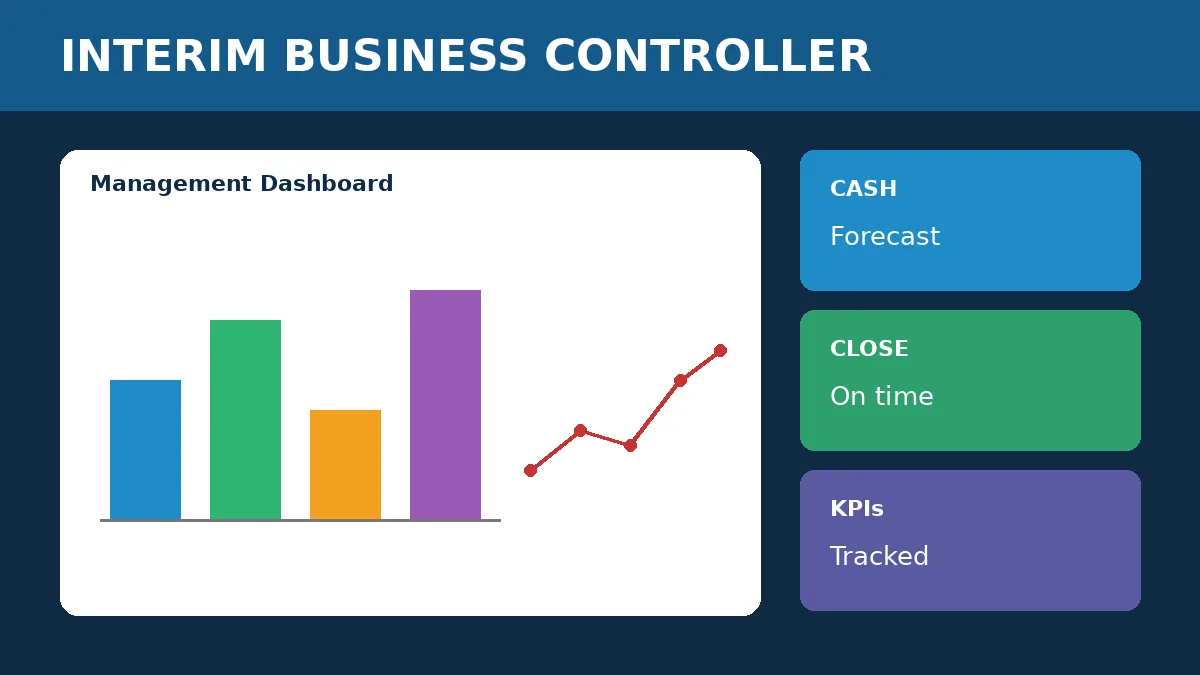
Finance rarely breaks loudly. Instead, it slips quietly. Reports arrive later each month. Forecasts feel less convincing. Cash decisions start relying on gut feel rather than evidence. An interim business controller steps into exactly that moment. The role brings senior financial control, clear reporting, and calm operational grip for a defined period. Moreover, it does so without a long permanent hiring cycle. For leaders who need answers quickly, that combination matters enormously.
This guide explains the role in practical terms. Firstly, it covers what a business controller actually does day to day. Secondly, it shows what changes when the controller is interim rather than permanent. Finally, it walks through hiring, engagement phases, and cost drivers. Throughout, the focus stays on financial agility. In other words, the article shows how a business can see its numbers clearly and act on them faster.
What Does a Business Controller Actually Do?
A business controller sits between accounting and decision-making. Accountants record what happened. Controllers explain what the numbers mean. Furthermore, they show what should happen next. That forward-looking element defines the role. A strong controller therefore protects accuracy in the past and improves choices about the future.
Consequently, the work blends technical control with commercial judgement. On one side, the controller owns reconciliations, reporting discipline, and compliance. On the other side, the controller partners with operational managers. For example, a controller might challenge a sales forecast or test a pricing assumption. Similarly, the controller might question whether a cost increase is temporary or structural. Those conversations turn finance from a scorekeeper into a genuine business partner.
The month-end close and financial reporting accuracy
The month-end close is the controller’s monthly heartbeat. During the close, the team completes journals, accruals, and provisions. Additionally, the controller reviews balance sheet reconciliations and resolves old or unclear items. Financial reporting accuracy depends on that discipline. Without it, management accounts become unreliable very quickly.
Moreover, a good controller shortens the close without cutting corners. The controller introduces a clear timetable and standard checklists. Owners are named for each task. Cut-off rules are documented. As a result, reporting arrives earlier and with fewer surprises. Managers can then discuss performance while the month still feels current.
Management reporting, budgeting and forecasting, and variance analysis
Management reporting translates ledgers into insight. A controller designs reports that highlight revenue, margin, costs, and cash. Importantly, the reports include commentary rather than raw tables alone. Variance analysis sits at the centre of that commentary. The controller compares actual results with budget and forecast. Then the controller explains the drivers behind each material difference.
Budgeting and forecasting give that reporting a forward frame. Typically, the controller coordinates the annual budget with department heads. The controller also maintains a rolling forecast during the year. A rolling forecast updates expectations as conditions change. Consequently, leaders stop steering by an outdated annual plan alone. Instead, they work from the latest credible outlook. That habit is central to financial agility.
Cash flow forecasting and working capital management
Profit and cash rarely move together. A profitable business can still run out of cash. Therefore, cash flow forecasting deserves separate and serious attention. A controller builds short-term cash forecasts week by week. Additionally, the controller links those forecasts to receivables, payables, and inventory.
Working capital management follows naturally from that visibility. For instance, the controller may tighten credit control follow-up. Alternatively, the controller may review payment runs and stock levels. Small improvements in each area release cash over time. More importantly, early warning of a cash squeeze allows calm action. Leaders can arrange facilities, delay discretionary spend, or accelerate collections before pressure becomes a crisis.
KPI dashboards, ERP systems, and internal controls
KPI dashboards give managers a shared view of performance. A controller selects a small set of meaningful indicators. Examples include gross margin, order intake, debtor days, and forecast accuracy. However, dashboards only help when definitions stay consistent. Therefore, the controller documents each metric carefully. Everyone then reads the same number in the same way.
Meanwhile, ERP and finance systems shape how easily data flows. Controllers often improve chart-of-accounts design, approval workflows, and reporting structures inside the ERP. Internal controls protect that entire system. Segregation of duties, approval limits, and review routines reduce error and fraud risk. Strong controls also support audit preparation later. In short, systems, dashboards, and controls turn scattered data into trusted information.
Business Controller or Financial Controller: What Is the Difference?
Job titles vary between companies and countries. Nevertheless, a useful distinction exists in practice. A financial controller usually emphasises statutory reporting, compliance, and control. A business controller usually emphasises analysis, planning, and operational partnership. Admittedly, many roles combine both sides. The label matters less than the mandate agreed at the start.
For example, a group reporting role may lean heavily towards consolidation and audit. In contrast, a divisional business controller may spend more time on pricing and margin. Either way, clarity prevents disappointment. Leaders should define the balance before the engagement begins. Does the business need control first, or insight first, or both in equal measure? That single question shapes the shortlist, the interview, and the first month’s priorities.
What Changes When the Controller Is Interim?
An interim business controller performs the same core duties. However, the context changes the work significantly. The interim arrives for a defined period and a defined purpose. Speed therefore matters from the first day. Permanent hires can grow into a role gradually. Interims cannot. They must assess, prioritise, and deliver within weeks.
Additionally, interims bring a fresh-eyes diagnosis. They have usually seen several finance functions before. Patterns become visible quickly as a result. A slow close, weak reconciliations, or unclear ownership rarely surprise them. Moreover, interims sit outside internal politics. They can raise uncomfortable findings without protecting a career position. That independence often unlocks honest conversations about data quality and process failure.
Fast onboarding is another defining feature. Experienced interims ask structured questions immediately. Who owns the close? Where does reporting break down? Which decisions lack reliable data? Within days, the interim maps people, systems, and deadlines. Consequently, stabilisation begins before a permanent recruitment process would even reach interviews. Companies reviewing wider approaches to business excellence often recognise the same principle. Outside perspective plus clear ownership improves performance faster than goodwill alone.
When Do Companies Bring One In?
Most engagements start with a trigger event. Sometimes the trigger is a simple vacancy. Sometimes it signals deeper change. The list below covers the situations that appear most often in practice. Each situation benefits from experienced cover that starts quickly and leaves cleanly.
- Vacancy cover. A controller resigns, and the permanent search will take time. Interim cover keeps the close, reporting, and team leadership running meanwhile.
- Leave cover. Maternity leave, parental leave, or long-term sickness creates a planned gap. A structured handover makes this the smoothest trigger of all.
- Audit preparation. Auditors are due, and reconciliations or documentation need attention. An interim tidies evidence, answers queries, and coordinates the audit timetable.
- ERP implementation. A new system changes processes, data, and reports simultaneously. Interim support protects daily reporting while the project absorbs permanent staff.
- Mergers and acquisitions. Deals demand due diligence support, integration planning, and aligned reporting. An interim adds capacity during the most reporting-heavy months.
- Rapid growth. Revenue and headcount outgrow informal finance routines. A controller installs scalable processes before complexity creates errors.
- Restructuring. Cost programmes and organisational change need reliable numbers. Independent financial control helps leaders test options honestly.
Furthermore, some companies hire an interim to test the role itself. Perhaps leadership suspects the business now needs a stronger controller. An interim assignment proves the value first. Afterwards, the permanent job description becomes much sharper. Businesses exploring digital transformation in business operations use a similar logic. Temporary expertise clarifies what permanent capability should look like.
How Does a Typical Engagement Run?
Successful engagements follow a recognisable rhythm. The phases below are illustrative rather than rigid. Timelines flex with company size and problem severity. Nevertheless, the sequence of assess, stabilise, improve, and hand over holds broadly true. Each phase has a distinct purpose and a distinct output.
| Phase | Main focus | Typical output |
|---|---|---|
| Assess | Understand people, processes, systems, and risks | Findings summary and prioritised action plan |
| Stabilise | Secure the close, reporting, and cash visibility | Reliable timetable and trusted core reports |
| Improve | Fix processes, dashboards, and controls | Better forecasts, cleaner data, documented routines |
| Hand over | Transfer knowledge to the permanent team | Handover notes, training, and a clean exit |
Phase one: assess
Firstly, the interim listens more than the interim speaks. Interviews with finance staff and operational managers reveal pain points. A review of recent closes shows where time disappears. Similarly, a look at reconciliations shows where risk accumulates. The interim also checks reporting packs critically. Do managers trust them? Do managers actually use them? The answers shape a short and honest action plan.
Phase two: stabilise
Secondly, the interim secures the basics. The close timetable gets fixed dates and owners. Reporting deadlines become non-negotiable. Cash flow forecasting starts immediately, even if the first version is simple. As a result, leadership regains a dependable rhythm. Confidence returns because promises about delivery dates start holding. Stabilisation rarely looks glamorous. However, it creates the platform for every later improvement.
Phase three: improve
Thirdly, attention shifts to lasting fixes. The interim redesigns weak processes and documents them clearly. KPI dashboards replace ad hoc spreadsheet requests. Forecast routines become rolling and collaborative. Additionally, finance business partnering improves during this phase. The controller attends operational meetings and challenges plans constructively. Managers begin receiving insight before month-end rather than explanations afterwards. Companies studying the global impact of digital marketing on modern enterprises see a parallel effect. Better information changes decisions across the whole organisation, not only inside one department.
Phase four: hand over
Finally, the interim prepares the exit from the beginning of the assignment. Documentation stays current throughout the engagement. Processes live in shared files rather than in one person’s memory. Moreover, the interim trains the permanent team on new routines. A structured handover then covers open items, key contacts, and recurring deadlines. Consequently, value survives the interim’s departure. A clean handover is therefore a deliverable, not an afterthought.
What Should You Look For When Hiring One?
Hiring well starts with a precise brief. Vague briefs attract vague candidates. Instead, describe the trigger, the deliverables, and the end date clearly. Which problems must be fixed first? Which reports must improve? Who will judge success? Specific answers help agencies and candidates self-select honestly.
Technical strength remains essential, of course. Look for proven ownership of the month-end close. Check experience with budgeting, forecasting, and audit contact. Ask about ERP exposure that matches your environment. Additionally, test financial reporting accuracy awareness directly. For instance, ask candidates how they would clean up neglected balance sheet reconciliations. Strong candidates answer with sequence, controls, and evidence. Weak candidates answer with generalities.
However, technical skill alone never guarantees success. Communication matters just as much. The interim must explain variances to non-finance managers plainly. The interim must also challenge senior leaders respectfully. Therefore, interview for finance business partnering ability explicitly. Present a short scenario during the interview. Then observe how the candidate structures the problem and communicates options. Speed of learning also deserves testing. Ask what the candidate would review during the first week. Good answers mention the close calendar, cash position, reconciliations, and stakeholder meetings. Finally, check references for delivery under pressure. Interim work rewards calm, organised, and self-starting personalities. Growing firms reading about scaling small business growth will recognise the hiring lesson. The right capability at the right moment beats a perfect hire who arrives too late.
What Drives the Cost of an Interim Engagement?
Cost questions deserve a straight answer without invented figures. Interim fees vary widely, and honest guidance stays qualitative. Several drivers explain most of that variation. Understanding the drivers helps leaders compare proposals fairly. It also helps leaders scope assignments realistically.
- Seniority and track record. Controllers who have led closes, audits, and system changes command stronger fees. Scarce turnaround or integration experience raises the price further.
- Scope of the mandate. Pure vacancy cover costs differently from transformation work. Broader responsibility and team leadership increase the required seniority.
- Duration and intensity. Full-time short assignments price differently from longer part-time arrangements. Urgency also affects availability and therefore cost.
- Location and working pattern. On-site expectations, travel, and regional labour markets all influence fees. Hybrid arrangements can widen the candidate pool considerably.
- Complexity of the environment. Multiple entities, currencies, or systems demand deeper expertise. Regulated sectors add compliance weight as well.
Moreover, leaders should weigh cost against the cost of delay. Late reporting, weak cash visibility, and audit problems carry real consequences. Those consequences rarely appear in a fee comparison table. Nevertheless, they often dominate the true economics of the decision. Service-focused firms reviewing business services excellence apply similar thinking. Value comes from outcomes delivered, not merely from the rate paid.
How Does the Role Support Financial Agility?
Financial agility means deciding quickly with trustworthy numbers. It does not mean rushing or guessing faster. Instead, agility grows from reliable data, short reporting cycles, and credible forecasts. An interim business controller builds exactly those foundations. Each improvement shortens the distance between event and response.
Consider a hypothetical example. Imagine a mid-sized distributor whose margins start slipping. Previously, managers noticed the problem two months later in delayed reports. With a controller in place, weekly KPI dashboards flag the margin movement early. Variance analysis then isolates a supplier price increase and discounting in one region. Leadership responds within the same month. Pricing discussions open, and the rolling forecast updates immediately. The example is generic, but the mechanism is real. Earlier signals create earlier choices.
Furthermore, agility improves because finance business partnering connects numbers to operations. Controllers who attend commercial meetings hear context first-hand. They model scenarios while options remain open. As a result, leaders test decisions before committing resources. Discussions about the future of business services highlight the same shift. Finance moves from reporting history towards shaping what happens next. Basic financial literacy across managers strengthens that shift too, as any overview of understanding basic finance principles makes clear. Shared language makes shared decisions faster.
Which Mistakes Undermine an Interim Assignment?
Firstly, unclear mandates waste the opening weeks. The interim guesses priorities while urgent issues wait. Secondly, restricted access slows everything down. System permissions, data, and stakeholder time must be ready on day one. Thirdly, some leaders treat the interim as pair-of-hands cover only. That choice wastes the diagnostic value entirely. Fresh eyes are part of what the business is paying for.
Additionally, poor handover planning destroys lasting value. Improvements must be documented and taught, not merely performed. Finally, delayed decisions hurt momentum. An interim can recommend fixes quickly. However, only leadership can approve process and system changes. Regular short check-ins keep approvals moving. Consequently, the engagement delivers improvement rather than temporary relief alone.
The Bottom Line for Leaders
An interim business controller is a strategic tool, not an emergency plaster. The role protects the month-end close, management reporting, and cash visibility during change. Moreover, the role improves forecasting, controls, and dashboards for the long term. Companies gain senior expertise quickly and without internal politics. They also gain a clearer view of the permanent hire they may need next.
Therefore, treat the assignment like any serious investment. Define the trigger and the deliverables precisely. Hire for technical depth and communication strength together. Demand documentation and a structured handover throughout. Done well, the engagement leaves finance calmer, faster, and far more useful. That is financial agility in practice, and it lasts well beyond the interim’s final week.