
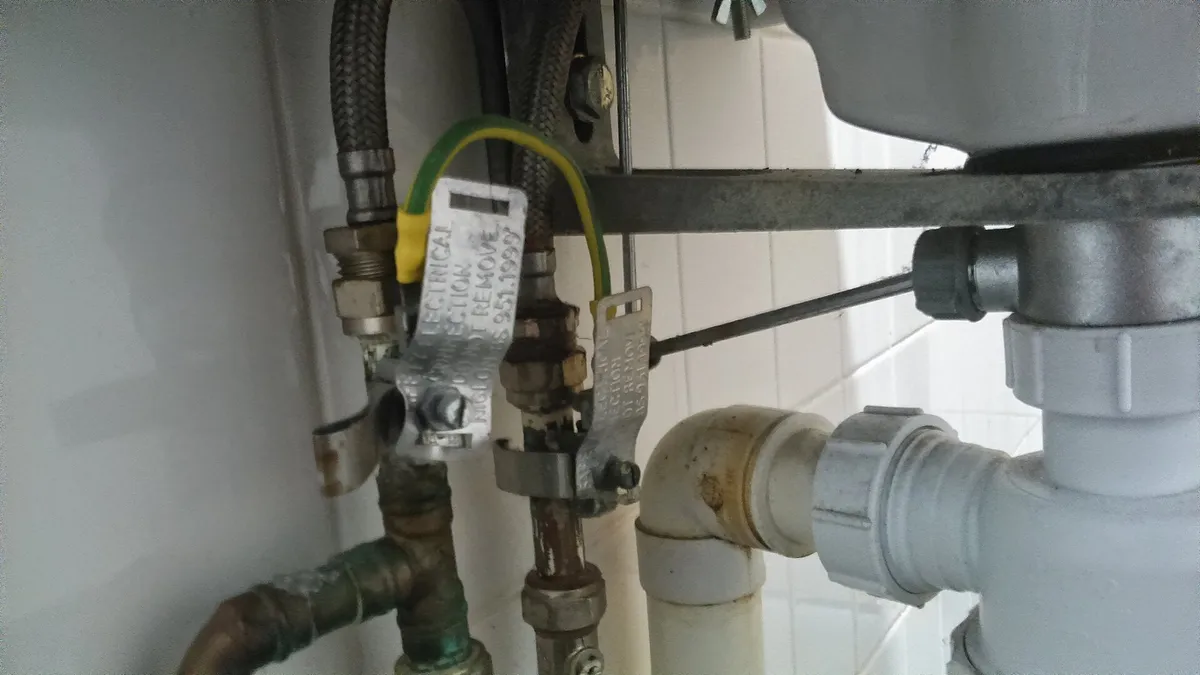
That single journey reveals the whole idea behind how home plumbing works. First, water travels into your home under pressure. Then it waits in pipes until a tap calls for it. After that, it leaves through a different set of pipes. Gravity alone carries it away on that second leg.
What Makes a Home Plumbing System Two Systems in One?
Every home plumbing system is really two systems in one building. One side brings fresh water in, and the other side carries used water away. In addition, each side runs on a different physical principle. That difference shapes every pipe and fitting you will meet here.
Supply water moves under pressure, so it can climb upstairs with ease. Drainage water, by contrast, moves downhill under gravity alone. Consequently, drain pipes must slope gently downward all the way out. Supply pipes can turn and climb wherever a fixture needs them.
The key contrast is the water supply system vs drainage system. Supply pipes are usually narrower, since pressurised water needs only a small opening. Drain pipes are wider, since gravity flow needs room for water and air. Similarly, supply pipes stay sealed tight, while drain pipes also need vents and traps.
How Does Plumbing Work in a House From the Street Inward?
Picture the edge of your property as a doorway for water. Outside it, water belongs to a public network or a private source. Inside it, water belongs to your home system. Between those two worlds sits a short chain of parts. Each part has one clear job, and together they start the indoor story.
Most homes begin their story beyond the walls, and the details vary by source. Some homes connect to a town or city network. Others draw from a private well on the property. Either way, water still crosses into the home at one main entry point. That entry point is where the indoor journey truly begins.
Where Does Your Water Come From in the First Place?
The municipal water supply vs well explained in plain terms comes down to one question. Who treats the water, and who moves it to your door? A municipal supply treats water at a central plant. It then pumps water through street mains to each connected home.
A private well works differently, since it draws water from underground nearby. A pump then lifts that water toward the house. However, both routes end at the same place. Both deliver water to the main entry pipe of the home.
Before that point, the journeys look very different indeed. Municipal water travels a long public route before it reaches your street. Well water travels a short private route from beneath the ground. Once water crosses the boundary, though, the home system treats it much the same way.
How Does a Water Meter Work?
Many homes on a municipal supply have a water meter near the entry point. Simply put, a meter measures how much water passes through it. Inside a typical meter, flowing water turns a small measuring mechanism. That movement becomes a reading on a dial or display.
Think of the meter as a counting gate, not as a tap. It does not decide how much water your home uses. It also does not change the pressure of water passing through. Instead, it quietly keeps score while water flows past indoors.
Therefore, the reading rises whenever taps and showers run. It also rises when washing machines and other fixtures draw water. When nothing runs, the reading stays still, since no water passes the gate.
How Water Gets to Your Taps?
Once water enters the home, it travels through a branching network. A thick trunk pipe carries water inward, and smaller branches split off toward each room. Still smaller pipes end at single fixtures, such as one tap or one toilet. Because the supply side stays pressurised, water can flow upward as easily as downward.
Opening a tap does not create water out of nothing. Rather, it opens a path that pressurised water already waits behind. Close the tap, and that path shuts again at once. The water then stands quietly in the pipes until the next use.
That simple idea answers how water gets to your taps. It also explains why a tap delivers water instantly, even when the source sits far away. Pressure does the pushing, and the tap merely opens the door.
What Is the Main Water Line?
The main water line explained in simple terms is one pipe with a big job. It carries all incoming water into the home before it branches out. Every tap and toilet ultimately draws from this one entry route. For that reason, it acts as the trunk of the whole supply tree.
From the main line, branch pipes divide the flow room by room. Each fixture then gets its own connection at the end of a branch. In addition, the main line usually enters near the front of the home. Often it arrives through a wall or floor in a utility area.
Knowing where it enters gives you a mental map of supply. Every branch can be traced back to that starting point. The shut-off valve and meter, where fitted, usually sit close by as well.
What Is a Shut-Off Valve?
A shut-off valve is a fitting that can stop water flow through a pipe. When closed, it blocks the flow completely at that point. When open, it lets water pass through freely once more. The main shut-off valve controls water for the whole home.
Smaller valves may control a single fixture or appliance instead. However, the idea stays the same at every size and location. Imagine the valve as a gate across a road for a moment.
When the gate stands open, traffic flows freely past it. When the gate closes, traffic stops at that point. Similarly, a closed main valve leaves indoor supply pipes without incoming water. Any plumbing work beyond understanding the system belongs to a qualified professional.
How Does Hot and Cold Water Supply Work?
So far, this journey has described cold water only. Yet most fixtures offer both hot and cold water. Hot and cold water supply explained simply means one cold supply splits into two paths. One path stays cold and runs straight to taps. The other path passes through a water heater first.
Inside a water heater, cold water warms up and stands ready for use. In other heater types, water warms as it passes through instead. Either way, heated water then travels through its own hot-water pipes. Those pipes run beside the cold pipes but never mix with them.
At a mixer tap, the two streams finally meet and blend. Tap controls set the proportions of hot and cold water. That blending is what lets you choose a comfortable temperature. Meanwhile, the split explains why homes have so many supply pipes.
Each fixture with both temperatures needs two supply connections. A toilet, by contrast, needs only a cold connection. Furthermore, pressure drives both halves with equal ease. Hot water climbs upstairs just as readily as cold water does. For a wider look at warmth in the home, home heating services show how heating sits beside plumbing, even though the two systems keep separate jobs.
How Do Drain Pipes Work Once Water Has Done Its Job?
After water has washed hands or rinsed dishes, its role changes completely. Used water no longer needs pressure, and indeed it has none left. Instead, it falls and flows downhill through drain pipes. Gravity alone pulls it toward larger pipes and out of the home.
That downhill journey is why drain pipes slope downward. A level drain pipe would let water sit still. A pipe sloping too steeply could let water rush past waste. Therefore, drains use a gentle and steady fall throughout. Water and waste then travel together smoothly toward the exit.
Fixtures connect through short drain pipes of their own. Those pipes join branch drains, and branch drains join the main drain. Along the way, water from sinks and baths joins water from showers. Water from washing machines and toilets joins the same stream. In contrast to supply, which branches outward, drainage gathers many small flows into one exit.
What Is a Plumbing Trap?
A plumbing trap is a curved section of drain pipe. Usually it takes a U shape or an S shape. It holds a small amount of water at all times. That standing water forms a seal across the pipe itself.
The seal blocks air and odours from drifting back indoors. Every sink and bath drain has a trap fitted. Shower drains have one too, and toilets have a trap built into their shape. Wastewater flows through the trap on its way out without trouble.
Picture the trap as a dip in a road that holds a puddle. Water on the road passes through the puddle with ease. Air on the far side, however, cannot cross the puddle. Similarly, wastewater passes through, while water left behind reseals the pipe. In addition, the trap only works while it holds water. Fixtures unused for a very long time can slowly lose that seal.
What Is a Vent Pipe in Plumbing?
A vent pipe in plumbing is a pipe that lets air move in and out. It usually rises through the roof of the home. Drains need air because water flowing downhill changes air pressure. Without vents, those changes could pull water out of traps. Vents solve that problem by giving the system a breathing route.
Think of drinking through a straw with a finger over the far end. Liquid struggles to move because air cannot get in behind it. Lift the finger, and the drink flows with ease. In the same way, a vent lets air in behind draining water. Flow then stays smooth, and trap seals stay in place.
Moreover, vents give drainage gases a safe route upward. Gases rise through the vent and leave above the roof. They do not push back through fixtures into living spaces. That quiet job matters as much as drainage itself.
How Does the Drain Waste Vent System Hold Together?
The drain waste vent system explained in full is three ideas as one team. Drains carry wastewater away from fixtures every day. Waste pipes carry the more solid output from toilets. Vents keep air pressure balanced so everything flows properly.
Together, those three parts form the system known as DWV. Every fixture in the home connects to it somehow. Traps and vents deserve special attention because they protect each other. A trap without a vent could lose its seal during a large flow.
A vent without traps would leave an open air path indoors. Together, however, they form a quiet partnership. The vent keeps pressures steady, and the trap keeps its seal intact. For a parallel in other household systems, heating and ventilation systems also depend on air moving freely through a planned network.
How Does a Sewer Line Work at the Edge of Your Home?
All branch drains inside a home eventually join one main drain. That main drain leaves the building through the sewer line. A sewer line is the underground pipe that carries wastewater away. It leads toward a public sewer network in many homes.
In other homes, it leads toward a private septic system instead. Gravity still does the work at this stage. The line keeps the same gentle downhill slope as indoor drains. Once wastewater leaves the home, it joins a larger network serving many properties.
Alternatively, it enters a private treatment arrangement on the property. Either way, the home system ends at that boundary. That mirrors the supply system, which began at its own boundary. Consequently, the sewer line acts as the final doorway of drainage. It mirrors the main water line as the first doorway of supply.
Outdoor fixtures fit the same picture with ease. Garden taps draw from the supply side of the system. Outdoor drains feed into the drainage side instead. That symmetry holds beyond the walls as well as indoors. Around a property, outdoor living spaces often include taps and drains of their own, and each one still belongs to one side or the other.
Why Does Plumbing Supply and Drainage Stay Separate?
Supply water must stay clean enough to drink and wash with. Drainage water carries soap and dirt away from the home. It also carries waste that must never return indoors. If the two streams ever mixed, clean water would no longer stay clean. That is why plumbing supply and drainage stay separate at every stage.
Several design choices protect that separation from street to sewer. Supply pipes run under pressure in their own sealed network. Drain pipes run by gravity in a separate network. Fixtures sit at the meeting point of the two networks. Yet they keep the two sides apart by design.
A tap delivers supply water into a basin from above. The basin drain then carries used water away below. An air gap sits between the tap outlet and the basin water. In addition, traps and vents guard the drainage side. Nothing from the drains can drift back into rooms.
Backflow prevention follows the same one-way logic throughout. Water should flow from supply toward a fixture only. From a fixture, it should flow toward a drain only. It should never flow backward along either route. Therefore, used water has no route back into clean water. Any concern about that boundary belongs to a qualified professional.
What Happens When You Follow One Drop All the Way Through?
Return to that single drop and trace it once more. It arrives through the main line and passes the meter. It waits under pressure in the supply branches nearby. At a tap, it flows out and does its job. Perhaps it blends with heated water from the hot supply.
Then it slips down the drain and passes through a trap. The trap reseals behind it at once. It joins other wastewater in the sloping drains below. Vents keep air pressure steady along the way. Finally, the sewer line carries it out of the home for good.
Notice how little of that journey stays visible. Most pipes hide inside walls and floors. Ceilings hide still more of the network from view. The only parts you normally see are taps and fixtures. Nevertheless, the hidden network follows a clear logic throughout.
Pressure brings water in, and gravity takes it away. Traps and vents guard the journey in between. The two halves never mix at any point. Once that logic clicks, every fixture starts to make sense. Each fixture acts as a meeting point between two sides.
What Does This Overview Mean Beyond the Pipes?
Homes differ in size and age, and their plumbing reflects those differences. Pipe routes vary, and fixture counts vary too. However, the underlying story stays the same in every case. Whether water comes from a municipal network or a private well, the drop still travels in through pressure. Whether wastewater leaves through a public sewer or a private system, it still travels out through gravity. For a broader sense of household life, comfort and care at home, home customer services and care services at home each look at the household from a different angle, while air conditioning in the home shows another hidden network behind comfort.
Understanding how home plumbing works will not turn anyone into a plumber. It is not meant to do that at all. Its real value is quieter and more practical. You can picture what lies behind the walls. You can describe a problem clearly if you ever need help. Above all, you can appreciate why the system is built this way. Pressure brings water in, gravity takes it away, and the two halves stay separate for safety.




