
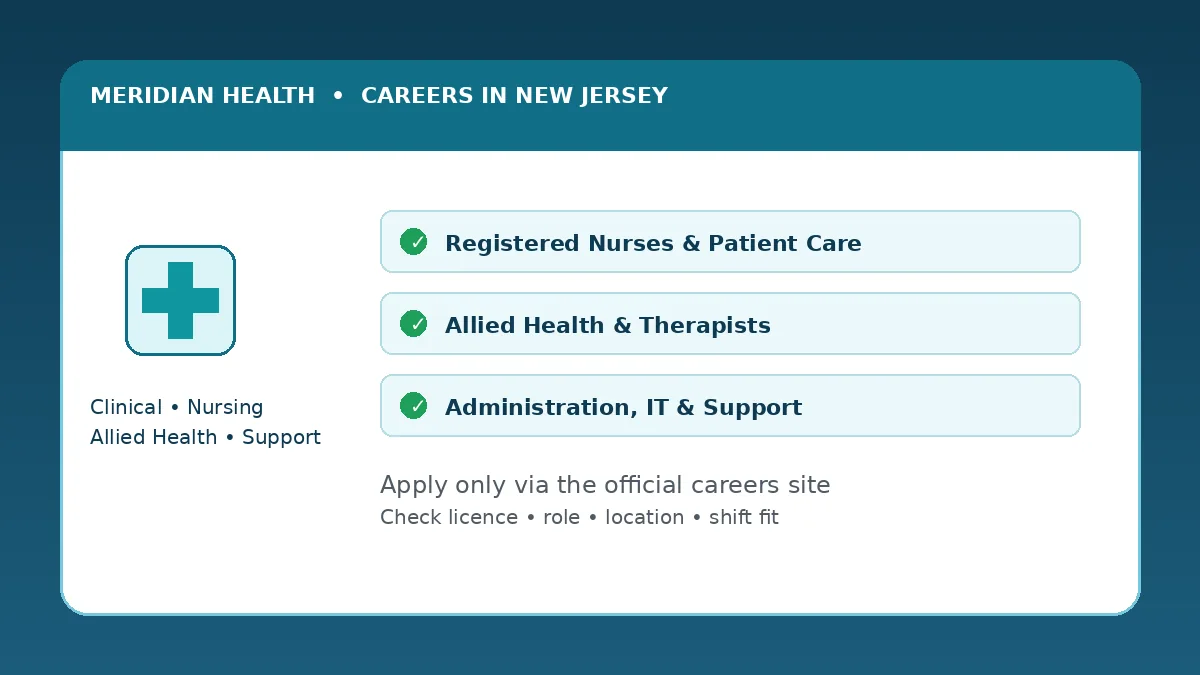
Searching for Meridian Health jobs can feel exciting and confusing at once. A large health system hires for hundreds of different tasks every year. Consequently, the listings can look endless when you first open them. You might see bedside nursing posts beside laboratory and office roles. However, the variety also means that more backgrounds can find a real fit. This guide explains the main role families in plain language. It also shows what qualifications employers usually expect for each path. In addition, it walks through the official application route step by step. You will learn how pay is shaped without chasing empty promises. Above all, you will learn how to judge whether a role suits your life.
What a Large Health System Actually Does Every Day
Hackensack Meridian Health is a large health network based in New Jersey. Its hospitals, clinics, and support sites serve communities across the state. Therefore, its workforce stretches far beyond doctors and nurses alone. Teams include therapists, technicians, coders, cleaners, cooks, and analysts. Indeed, a hospital cannot run safely without all of those people together. Patients arrive at every hour, so many services run around the clock. Meanwhile, outpatient clinics and offices follow more regular daytime patterns. The setting you choose will shape your hours and daily pace. For example, an emergency unit feels very different from a billing office. Understanding that difference early will save you time and frustration later.
Large systems also tend to work in networks rather than single buildings. As a result, the same job title can appear at several locations. Location matters because your commute and patient mix will change by site. Similarly, a role in a busy hospital will differ from community care. Home-based and community services add another layer to that picture. Our overview of home health services and at-home care shows how care extends beyond hospital walls. Likewise, a look at another health hub and its comprehensive care model helps you compare systems. Comparing settings in this way makes the job search much clearer.
The Main Families Inside Meridian Health Jobs
Most listings fall into a handful of broad families. Grouping roles in this way helps you search with purpose. Otherwise, you can waste hours scrolling through posts that never fit. Below, each family is explained with its usual duties and demands. Also, each section notes the training that employers typically look for. Read the families that match your experience first. Then, check the neighbouring families, because skills often transfer between them. For instance, customer service experience can support several patient-facing support roles. A careful read now will make your later shortlist far stronger.
Nursing and Direct Patient Care Roles
Nursing sits at the centre of most hospital care teams. Registered nurses assess patients, give medicines, and coordinate daily care plans. In addition, they communicate with doctors, families, and many other specialists. Licensed practical nurses provide hands-on care under defined supervision arrangements. Certified nursing assistants help with washing, feeding, mobility, and vital signs. Patient care technicians often combine basic care with technical tasks. For example, they may draw blood or operate monitoring equipment after training. These roles suit people who stay calm and notice small changes. They also require stamina, because shifts involve long periods of standing. Above all, they require kindness that holds up under pressure.
New nurses often worry about starting without hospital experience. However, many large systems run a structured nurse residency program for graduates. Such programmes pair classroom learning with supervised practice on real units. Consequently, new nurses build confidence in a supported and gradual way. Experienced nurses, by contrast, may move toward specialty or leadership posts. Specialties can include critical care, surgery, maternity, and emergency care. Each specialty brings its own pace, risks, and rewards. If emergency work interests you, our guide to emergency medical conditions and evaluations gives useful background. Still, only the official posting can confirm what a unit needs.
Physicians and Advanced Practice Clinicians
Doctors lead diagnosis and treatment across every clinical department. Advanced practice clinicians work alongside them in many settings. For instance, nurse practitioners and physician assistants assess and treat patients. They may also order tests, prescribe within their scope, and follow up. These roles demand long training and full professional licensure. In addition, they demand sharp judgement, because decisions affect patients directly. Some clinicians focus on primary care and long-term patient relationships. Others, meanwhile, focus on hospital medicine, surgery, or urgent problems. Research, teaching, and leadership duties can also form part of senior roles. Therefore, candidates should read the clinical scope in each posting carefully.
Allied Health Jobs and Clinical Specialists
Allied health jobs cover a wide and essential group of specialists. Radiologic technologists produce images that help doctors see inside the body. Respiratory therapists support patients who struggle to breathe safely. Similarly, physical and occupational therapists help patients regain movement and independence. Laboratory professionals test blood and other samples behind the scenes. Pharmacists and pharmacy technicians, meanwhile, keep medication use safe and accurate. Speech therapists, dietitians, and social workers also belong in this family. Indeed, modern care depends on this teamwork more than ever before. If innovation excites you, our piece on medical technology careers and healthcare innovation shows a related path. Each allied role, however, has its own credential and training route.
Training for allied roles varies more than many people expect. Some roles begin with a certificate or an associate degree. Others require a bachelor degree or a master degree instead. For example, therapy and laboratory science paths often need longer study. Certification exams are also common in imaging and respiratory care. In addition, many states require a licence before you can practise. Employers will state the exact credential in the job posting. Therefore, you should match your documents to that wording exactly. Guessing about eligibility wastes applications and disappoints hiring teams. A quick credential check before applying will protect your time.
Behavioral Health and Supportive Care
Behavioral health teams support mental health, recovery, and emotional wellbeing. Roles here include counsellors, social workers, and psychiatric nursing staff. In addition, support workers help patients feel safe during difficult periods. The work calls for patience, listening, and clear professional boundaries. It also calls for teamwork, because care plans involve several professionals. For readers exploring this direction, our article on turning the page toward a healthier mind offers helpful context. Still, personal interest alone does not replace formal training or licensure. Most clinical behavioral roles require relevant degrees and supervised experience. Administrative and peer support roles, by contrast, may require less training. Checking the posting closely will show which level a role needs.
Support, Operations, and Entry Level Healthcare Jobs
Entry level healthcare jobs open the door for many career changers. Support teams keep buildings clean, safe, fed, and properly supplied. For instance, environmental services staff protect patients through careful cleaning standards. Food service teams prepare meals that match clinical dietary needs. Transporters move patients and equipment safely around busy sites. Meanwhile, security and facilities staff keep the environment safe and working. Unit secretaries and patient observers also support care teams directly. These roles often ask for reliability more than long clinical training. However, they still demand care, because small errors can affect patients. Many people start here and later train for clinical roles. Consequently, a support post can become a genuine first career step.
Healthcare Administration Jobs and Healthcare IT Jobs
Healthcare administration jobs keep the business side of care running smoothly. Schedulers, registrars, and medical coders handle vital daily information. Billing and insurance staff, similarly, help patients understand coverage and payments. Managers and quality teams then use data to improve services. On the technical side, healthcare IT jobs support records and systems. Analysts maintain electronic health records and protect patient data daily. Help desk staff also solve problems that could slow clinical work. These roles suit people who like systems, detail, and steady problem solving. In addition, many of them offer more regular office hours. Daily work on the wards, by contrast, often involves rotating shifts. Even small details matter here, right down to the scrubs and standards that clinical teams rely on each day.
Qualifications That Employers Usually Expect
Every posting lists its own required and preferred qualifications. Reading those lists closely is the most useful habit you can build. Generally, clinical roles require a relevant licence or certification. Non-clinical roles, meanwhile, focus more on skills and proven experience. Education requirements also rise with responsibility and clinical risk. For example, senior and specialist posts usually need advanced degrees. Employers may also ask for basic life support certification. Such training is common for staff who work near patients. In addition, background checks and health clearances are standard in hospitals. Those checks protect patients, so they form a normal hiring step.
Licences, Certifications, and Registrations
A licence proves that you may legally practise in that state. Certification, by contrast, proves that you passed a professional standard. Some roles require both, while others require only one of them. Nursing roles in New Jersey require a state nursing licence. Imaging and laboratory roles often require national certification as well. Therefore, you should keep copies of every credential ready to upload. Expiry dates matter, so check them before you apply anywhere. If a credential is still in progress, say so honestly. Some postings allow hiring while a certification is being completed. Others do not, and the posting will state that boundary clearly.
Education and Experience Levels
Education signals that you can handle the science behind the work. Experience, however, shows that you can handle the work itself. Employers weigh both, and the balance changes by role family. A new graduate may qualify through a residency or training programme. An experienced hire may qualify through years of similar practice instead. Indeed, many postings describe an equivalent mix of study and experience. Transferable skills also count in support and administrative hiring. Customer service, cash handling, and scheduling experience can all transfer well. For readers planning further study, our guide to masters degrees and professional growth explains the wider value. Still, you should fund study only after checking real job requirements.
How Healthcare Pay Works Without the Hype
The title of this guide uses the word lucrative, so honesty matters. Healthcare can offer strong and stable earning potential over time. However, no honest guide can promise a salary for a specific post. Pay depends on the role, the unit, and your credentials. It also depends on experience, shift patterns, and local labour markets. Night and weekend work may attract additional shift differentials in some roles. Specialist skills and hard-to-fill areas can also influence offers. In addition, full-time and part-time roles may differ in benefits eligibility. Employers in New Jersey now state pay information in many postings. Therefore, you should read the live posting for any current figure. Compare the full package, including leave and retirement, before deciding.
Benefits deserve the same careful reading as the hourly rate. Health cover, paid leave, and retirement plans add real long-term value. Tuition support, where offered, can also change your future options. However, eligibility rules vary by role and by weekly hours. Consequently, you should confirm details during the offer stage directly. Ask what applies to your exact employment type and start date. Also, ask when each benefit begins and what it requires. Written offer documents matter more than general careers page summaries. Keeping that habit will protect you in any health system search.
How to Apply Through Official Channels
Always apply through the official Hackensack Meridian Health careers site. That site is the trusted home for live listings and applications. Third-party boards may copy postings, but copies can go stale quickly. Therefore, treat every advert elsewhere as a pointer, not a source. Start by searching the official site with a clear job title. Then, filter by location, department, and schedule that truly suit you. Read the full posting before you open the application form. In addition, note the requisition details and closing guidance, if shown. This simple discipline will prevent most wasted applications from the start.
- Create a profile on the official careers site with accurate contact details.
- Upload a current resume that matches the role you want.
- List licences and certifications exactly as they appear on documents.
- Answer every screening question fully and honestly.
- Check the posting again, because requirements can differ by location.
- Submit the application and save the confirmation for your records.
Your resume should mirror the language of the posting closely. For example, name the patient groups and systems you have used. Quantify experience where you can do so truthfully and clearly. Also, keep the layout simple, because automated systems read resumes first. A short cover note can help for career changers in particular. Use it to connect past work with the new role. Meanwhile, prepare references who can speak about reliability and teamwork. Hiring teams value those qualities across every role family. Finally, tailor each application instead of sending one generic version everywhere.
What Happens After You Apply?
After submission, recruiters usually screen applications against the stated requirements. Candidates who match closely may then receive a phone screening call. Next, hiring managers often hold structured interviews with shortlisted candidates. Some roles also include practical assessments or unit visits. Indeed, clinical hiring can involve several stages for safety reasons. Timelines vary, so silence for a short period is normal. However, you can track your application through your careers profile. If you receive an offer, pre-employment checks will usually follow. Those checks can include references, credential checks, and occupational health steps. Orientation and role training then prepare you for your first shifts.
Interviews reward preparation more than polished performance tricks. Research the department and think about real examples from your past. For instance, describe a time you handled pressure or helped a colleague. Also, prepare honest questions about staffing, training, and shift patterns. Your questions show judgement, and they help you judge fit too. After the interview, send a brief and polite thank-you message. Then, wait for the official update through the proper channel. Avoid chasing individual staff through personal accounts or social media. Professional patience, in contrast, leaves a strong and lasting impression.
How to Judge Whether a Role Truly Fits?
A good salary story means little if the shift destroys your health. Therefore, judge fit across schedule, setting, team, and growth together. Ask yourself whether the hours match your family and travel reality. Also, consider whether the patient group suits your strengths and temperament. Some people thrive in fast emergency work and constant change. Others, meanwhile, prefer planned clinics and longer patient relationships. Neither preference is better, because honest self-knowledge prevents early burnout. In addition, think about training support during your first months. Strong onboarding often matters more than a small pay difference. Finally, picture the role on a hard day, not a good day.
- Does the schedule match your sleep, family, and travel needs?
- Does the setting match the pace you handle best?
- Do you meet every required licence and education point?
- Does the location make the daily commute realistic and safe?
- Does the role offer training that supports your next step?
Red flags also deserve attention during any hospital job search. Be cautious if a recruiter asks for payment to process an application. Legitimate health systems do not charge candidates for applying. Similarly, be cautious if contact comes only through unofficial messaging apps. Always return to the official careers site to verify a posting. Also, never share bank details before a formal and verified offer. Scammers target healthcare job seekers because demand feels urgent. Therefore, slow verification is a skill, not a delay. Protecting your documents and identity matters as much as the resume.
Questions People Often Ask About These Careers
Where can you find live listings for clinical careers?
You can find live listings on the official careers site only. That site lets you search by title, location, and department. In addition, you can create alerts for roles that match you. Alerts help, because new clinical careers posts appear throughout the year. However, you should still open each posting and read it fully. A copied advert on another site may already be closed. Therefore, the official posting remains the only reliable version to trust.
Can you apply without hospital experience?
Yes, you can apply for some roles without hospital experience. Entry level support and administrative posts often welcome career changers. New nursing graduates may also qualify through residency style programmes. However, each posting sets its own minimum experience requirement clearly. Read that line carefully before you spend time applying. Also, highlight transferable experience, such as care work or service roles. Honest framing helps recruiters see your potential without exaggeration.
What qualifications do nursing jobs usually need?
Nursing jobs usually need a nursing qualification and a state licence. Many employers also expect basic life support certification after hiring. Some units prefer a bachelor degree or specialty certification as well. In addition, relevant clinical experience can strengthen an application greatly. New graduates, by contrast, may enter through supervised residency routes. The exact mix, however, always comes from the live posting. Therefore, treat general guidance as preparation, not as a guarantee.
How should you compare two similar healthcare job offers?
You should compare schedule, location, training, and total benefits together. Pay matters, but it is only one part of the picture. Also, consider team support and the patient group you will serve. A slightly lower offer with strong training may grow faster. Meanwhile, a higher offer with poor fit may end quickly. Write both offers down and score them against your needs. That calm method usually beats a rushed emotional decision.
Meridian Health jobs reward candidates who prepare with care and patience. Start with the role family that matches your training and temperament. Then, verify every requirement against the official posting before applying. Use the official careers site for listings, applications, and updates only. Also, judge each offer by schedule, support, and long-term growth together. Healthcare careers in New Jersey offer many genuine entry points and ladders. Indeed, the right first step matters more than the fastest one. With honest preparation, your next application can be both confident and well aimed.




