
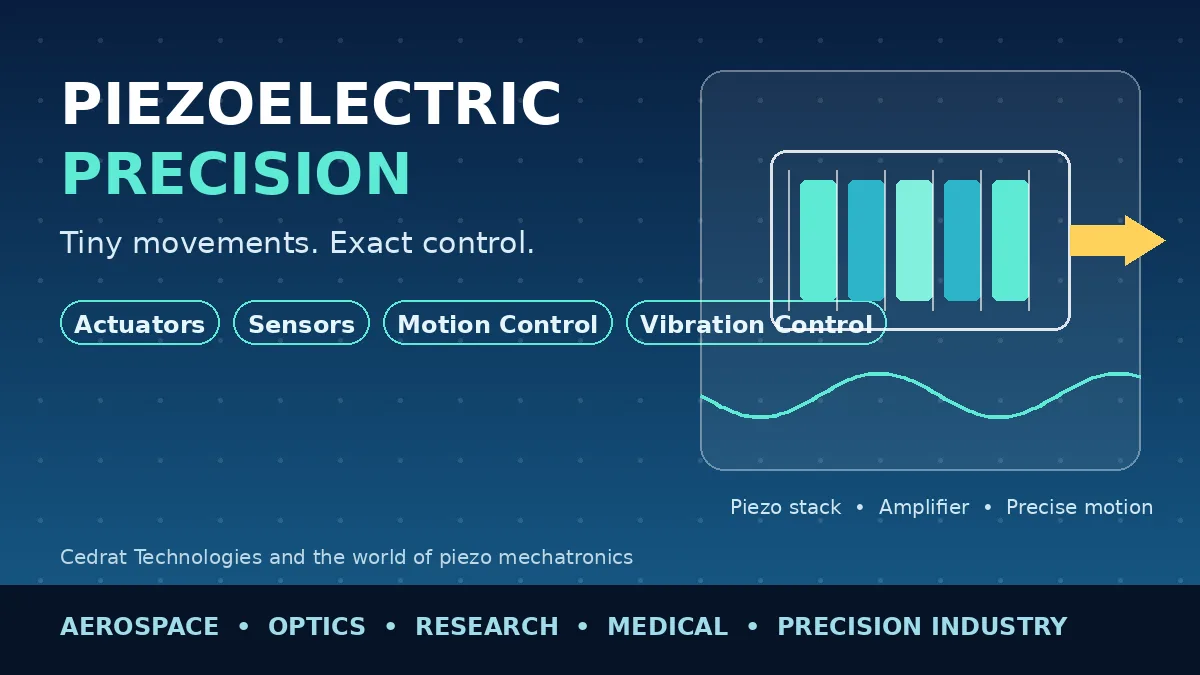
Some of the most important movements in modern industry are almost invisible. However, a lens that shifts by a fraction of a hair can decide image quality. Moreover, a valve that opens a fraction late can ruin a careful experiment. Therefore, engineers increasingly rely on motion that is tiny, fast, and repeatable.
Cedrat Technologies sits firmly inside that specialist world. Specifically, the French company works in piezo mechatronics, a field built around smart materials. Additionally, its work covers piezoelectric actuators, sensors, and complete mechatronic systems. Consequently, the name appears wherever precision matters more than raw size.
This guide explains the technology in plain, practical language. Firstly, it shows how piezoelectric motion actually works under the surface. Secondly, it maps the main product families and their everyday jobs. Finally, it helps buyers judge any piezo supplier with sharper questions.
What is Cedrat Technologies?
Cedrat Technologies is a French high-technology company based in Meylan. Moreover, Meylan sits in the Inovallée technology park near Grenoble, in south-eastern France. Additionally, public company profiles describe it as a specialist mechatronics business. Hence, its home region is widely known for research and microtechnology.
In general terms, the company designs and manufactures precision components. For example, its documented fields include smart actuators and smart sensors. Furthermore, it develops mechatronic systems and detection systems for demanding users. As a result, research work and technology transfer sit alongside manufacturing.
Readers who enjoy clear writing about technical subjects may also like this guide to making technology feel human in writing. Similarly, piezo engineering rewards people who translate complexity simply. Indeed, the clearest specification usually wins the best engineering outcome.
Why does a small specialist firm matter to big industries?
Large programmes often depend on very small, critical components. For instance, a satellite mechanism may weigh only a few grams. Nevertheless, that mechanism must survive launch vibration and years of service. Therefore, buyers value proven specialist suppliers over general catalogues.
Additionally, specialist firms accumulate deep knowledge in one narrow field. Consequently, their engineers understand failure modes that generalists often miss. Moreover, that depth helps when a standard part cannot fit. In practice, custom development then becomes a realistic option.
How does piezoelectric technology actually work?
Piezoelectric materials change shape when an electric voltage is applied. Conversely, the same materials generate a charge when they are squeezed. Therefore, one material family can both move things and sense things. Indeed, that two-way behaviour explains the technology’s remarkable versatility.
Each individual movement, however, is extremely small in scale. Specifically, a single piezo element expands by only a tiny amount. Consequently, designers stack many thin elements together for useful travel. Furthermore, clever mechanical housings can amplify that travel even further.
Meanwhile, the response speed is a major part of the appeal. For example, piezo devices can react far faster than conventional motors. Additionally, they hold a position without constantly consuming holding energy. As a result, they suit tasks where stillness matters as much as motion.
What do engineers mean by nano positioning systems?
Nano positioning systems move objects with extremely fine resolution. In simple terms, they adjust position in steps smaller than a micrometre. Moreover, closed-loop control uses sensor feedback to correct tiny errors. Hence, the system can repeat the same position again and again.
Such control matters greatly in modern optics and research. For instance, microscope stages must hold samples perfectly steady during imaging. Similarly, laser systems need mirrors aligned with exceptional accuracy. Ultimately, precision motion control turns delicate ideas into reliable instruments.
What does a piezo mechatronics range usually include?
A mature piezo mechatronics range is broader than one actuator. Firstly, it normally includes several actuator and motor families. Secondly, it adds sensors, transducers, and detection components for feedback. Finally, it supplies the electronics that drive and control everything.
Public descriptions of Cedrat Technologies follow exactly that pattern. Specifically, they list smart actuators, smart sensors, and mechatronic systems. Additionally, they mention detection systems based on magnetic or acoustic effects. Therefore, the company is best understood as a systems specialist.
How do actuators and motors create precise motion?
Amplified piezo actuators use a housing to magnify small ceramic movement. As a result, they deliver longer strokes while keeping response fast. Moreover, piezo motors use repeated tiny steps to create longer travel. Consequently, users gain fine resolution without giving up useful range. Additionally, micro positioning tasks benefit greatly from that step-by-step control.
Different jobs, however, need very different motion profiles. For example, a scanning mirror needs speed more than force. In contrast, a valve mechanism needs force, sealing, and reliability. Therefore, smart actuators are always selected against the real duty cycle.
Engineers comparing wider innovation suppliers can also review this overview of another technology firm and its digital solutions. Similarly, careful comparison works better than headline claims alone. Indeed, datasheets and test evidence should drive every final choice.
Why do sensors and transducers matter just as much?
Motion without measurement is only half of an engineering system. Piezoelectric sensors, by contrast, detect force, vibration, and tiny changes quickly. Additionally, magnetic and magnetostrictive sensing can cover other measurement needs. Hence, a combined range lets designers close the control loop.
Ultrasonic transducers add another important string to that bow. For instance, they can support inspection, detection, and process assistance tasks. Furthermore, health monitoring systems use sensing to spot problems early. As a result, machines can warn operators before damage spreads.
What role do drivers and controllers play?
Every piezo device needs suitable drive electronics behind it. Specifically, drivers deliver the voltage pattern that creates controlled movement. Moreover, controllers read sensor feedback and correct the position continuously. Therefore, electronics quality shapes accuracy just as much as mechanics.
Poor electronics, however, can waste an excellent actuator completely. For example, electrical noise can appear as unwanted mechanical jitter. Consequently, serious suppliers treat amplifiers and controllers as core products. In short, the full chain matters, from ceramic to software.
Where are these systems used in modern industry?
Demanding sectors share one common need: dependable, precise movement. Aerospace mechatronics is a clear example of that shared need. Additionally, optics, research laboratories, and medical engineering face similar pressures. Hence, piezo systems appear across many high-value applications.
How are piezo systems used in aerospace and space?
Aircraft and spacecraft punish components with vibration and shock. Nevertheless, piezo mechanisms are widely used in demanding aerospace environments. For instance, they can adjust optics, damp vibration, and position instruments. Moreover, their compact size suits tightly packed embedded equipment.
Active vibration control is especially valuable in this sector. In fact, vibration damping technology protects sensitive payloads during launch and flight. Specifically, sensors detect unwanted movement, and actuators push back against it. As a result, sensitive payloads stay steadier during difficult conditions. Ultimately, steadier instruments collect better data and last longer.
Teams working in regulated technical fields may also value this guide to careers in medical technology innovation. Similarly, aerospace and medical engineering both reward deep specialisation. Indeed, both sectors recruit people who combine electronics and mechanics.
Why do optics and research laboratories rely on piezo motion?
Optics work lives or dies by alignment and stability. For example, adaptive optics positioning corrects mirror shape or angle rapidly. Additionally, micro-scanning systems move beams or samples in controlled patterns. Therefore, piezo stages have become standard tools in advanced laboratories.
Research users also value flexibility and programmability highly. In practice, experiments change, and positioning hardware must adapt quickly. Furthermore, repeatable motion lets different teams reproduce each other’s results. Consequently, good motion hardware quietly supports better science overall.
How does this technology help medical and precision manufacturing?
Medical piezo devices support tasks that need gentle, controlled movement. For instance, precise valves and pumps can handle very small fluid volumes. Moreover, compact actuators fit inside instruments where space is scarce. Hence, designers can build smaller and less invasive equipment.
Precision manufacturing faces a parallel set of challenges daily. Specifically, machine tools and inspection systems need fast, repeatable positioning. Additionally, active damping can improve surface finish and measurement quality. As a result, piezo components support quality long before final inspection.
Businesses planning wider upgrades can learn from this review of digital transformation in business operations. Similarly, hardware upgrades work best inside a clear strategy. Indeed, new components deliver most value when processes change too.
Why do engineers choose piezo over conventional motors?
Conventional motors remain excellent for large, continuous rotary movement. However, piezo devices win when resolution and response dominate requirements. Moreover, they contain no gears, so backlash stays naturally low. Therefore, tiny corrections happen cleanly, without mechanical play.
Compactness is another reason engineers keep returning to piezo. For example, a small actuator can fit inside an optical assembly. Additionally, low moving mass helps systems respond quickly and settle fast. Consequently, designers can shrink instruments without sacrificing control quality.
Reliability also shapes the decision in harsh environments. In particular, solid-state motion avoids many familiar wear mechanisms. Furthermore, well-designed mechanisms are built to tolerate shock and vibration. As a result, piezo solutions suit embedded systems that cannot be serviced easily.
Finance and operations teams tracking technology change may enjoy this article on how brokers update their technology platforms. In contrast, engineering teams judge updates by test results, not fashion. Nevertheless, both groups need evidence before they commit serious budgets.
What should buyers check before specifying a piezo system?
Good buying starts with the application, not the catalogue. Firstly, define the required travel, force, speed, and resolution honestly. Secondly, describe the environment, including temperature, vibration, and duty cycle. Finally, state whether open-loop or closed-loop control is genuinely needed.
Honest numbers prevent expensive mistakes later in the project. For instance, over-specifying resolution can inflate cost without adding value. Conversely, under-specifying force can stall a promising prototype completely. Therefore, early conversations with application engineers are worth having.
Which questions should you ask any piezo supplier?
Useful questions reveal how a supplier thinks and tests. For example, ask how the quoted stroke behaves under real load. Additionally, ask which driver and controller the figures assume. Moreover, ask what testing supports the stated lifetime and reliability.
Support questions matter just as much as technical ones. Specifically, ask about training, documentation, and help during integration. Furthermore, ask whether custom development is available for unusual requirements. As a result, the answers show whether support continues after delivery.
Operations leaders can also borrow ideas from this guide to optimising technology revenue streams with data. Similarly, piezo projects benefit from measured, data-led decisions. Indeed, small pilot tests usually beat large, untested commitments.
What are the limits of piezoelectric technology?
Piezo technology is powerful, yet it is not universal. Firstly, basic piezo travel is small without amplification or stepping designs. Secondly, drive electronics add cost and design complexity to projects. Therefore, simple jobs may still suit conventional motors better.
Material behaviour also demands respect from system designers. For example, piezo ceramics can show hysteresis and creep effects. Consequently, accurate applications often need feedback sensors and closed-loop control. In practice, good engineering manages these traits rather than hiding them.
Environmental limits deserve equal attention during early design. Specifically, temperature, humidity, and mechanical shock can affect performance. Moreover, correct mounting and preload strongly influence long-term results. Hence, installation guidance from the manufacturer should never be skipped.
Even protective product design follows similar logic elsewhere. For instance, this review of a technical jacket built for weather protection stresses fit and conditions. Similarly, piezo hardware performs best when matched to its environment. Ultimately, honest limits produce more reliable engineering decisions.
How is this field likely to develop next?
Demand for smaller and smarter instruments keeps rising steadily. Consequently, piezo mechatronics should keep growing inside research and industry. Moreover, energy harvesting is an increasingly discussed piezo application area. In simple terms, vibration energy can sometimes power small sensors.
Integration is another clear direction for the whole field. For example, actuators, sensors, and electronics increasingly arrive as matched systems. Additionally, smarter controllers make complex behaviour easier to programme. Therefore, users can focus on applications instead of component matching.
Training and knowledge transfer will also matter more over time. Specifically, public profiles note that Cedrat Technologies supports technology transfer activities. Furthermore, training helps industrial users adopt specialist components with confidence. As a result, expertise spreads beyond the original design team.
Frequently asked questions about Cedrat Technologies
What does Cedrat Technologies make?
The company works in high-performance piezo mechatronics in general terms. Specifically, documented fields include piezoelectric actuators, sensors, and mechatronic systems. Additionally, detection systems and related drive electronics complete the picture. Hence, its focus is precise motion, sensing, and control.
Where is Cedrat Technologies based?
Public profiles place the company in Meylan, near Grenoble, France. Moreover, the site sits within the Inovallée technology area. Additionally, that region hosts many research and microtechnology organisations. Therefore, the location fits the company’s specialist engineering focus.
Which industries use piezoelectric actuators?
Many demanding industries use piezoelectric actuators every day. For example, aerospace, optics, research, and medical engineering all use them. Furthermore, precision manufacturing and instrumentation rely on their fine control. As a result, applications keep expanding as instruments become smaller.
How is a piezo actuator different from a normal motor?
A piezo actuator moves through material deformation, not rotating parts. Consequently, its travel is small, but its resolution is extremely fine. Moreover, its response is fast, and it can hold position steadily. In contrast, normal motors suit larger travel and continuous rotation.
What is active vibration control?
Active vibration control uses sensing and actuation together. Firstly, sensors measure unwanted vibration in a structure or instrument. Secondly, actuators generate a counteracting movement against that vibration. As a result, the protected equipment stays steadier and performs better.
Conclusion: precision is the real revolution
Cedrat Technologies represents a quieter kind of industrial revolution. Instead of bigger machines, it focuses on smaller and smarter movement. Moreover, piezoelectric actuators, sensors, and mechatronic systems support that shift directly. Therefore, its work matters wherever accuracy decides success or failure.
Buyers should still approach every supplier with disciplined questions. For example, check travel, force, control, environment, and support carefully. Additionally, demand test evidence rather than accepting broad marketing claims. Ultimately, that discipline turns promising technology into dependable results.




