
Most sewing courses start with a finished garment. Good fashion design pattern making books start much earlier. They start with the flat shape that makes the garment possible. Moreover, they show you why that shape works on a real body. A sketch can hide almost any mistake. A pattern cannot hide anything at all.
Consequently, pattern making rewards honest learning. You measure the body carefully. Each drawn line serves a clear reason. Then a test garment reveals whether the pattern works. Furthermore, every error teaches you something visible and specific. In short, a good book turns guessing into a repeatable craft.
Why pattern making is the foundation skill in fashion design
Designers often talk about silhouette, colour and fabric first. Pattern makers, however, decide whether those ideas can exist. A beautiful sleeve fails when the armhole shape is wrong. Similarly, an elegant dress fails when the waist sits in the wrong place. The pattern controls both outcomes long before sewing begins.
Additionally, pattern skill gives you creative freedom. You stop depending on commercial patterns for every new idea. Instead, you can change a neckline with confidence. You can also move a dart, add volume or reshape a skirt. As a result, your designs become truly yours rather than slight variations.
Pattern knowledge also protects your money and time. Cheap test fabric reveals fitting problems before you cut expensive cloth. Moreover, a corrected pattern works again and again. You can reuse it across fabrics and seasons. Over time, therefore, one well-fitted block saves hours of repeated trial and error.
There is a wider benefit too. Careful pattern work supports slower, better clothing. In contrast, guesswork feeds waste and disappointment. Readers exploring how young women are leading the charge against fast fashion will recognise this mindset. Good patterns help garments fit well, last longer and earn regular wear.
What a good pattern book actually teaches you
Strong pattern making books for beginners share one quality. They teach a system rather than isolated projects. You learn a sequence of decisions in a logical order. Furthermore, each new chapter builds on the previous one. Weak books, in contrast, jump between garments without explaining the connections.
Blocks and slopers, the starting shapes
Firstly, every serious book introduces basic pattern blocks. Some authors call these foundation patterns pattern slopers. A block is a plain, close-fitting shape with minimal style detail. It usually covers the bodice, skirt, sleeve and trouser. Moreover, the block records body measurements plus basic wearing ease.
Your block becomes your personal reference point. You draft new styles by changing that proven shape. For example, a bodice block can become a blouse or a dress. A skirt block can become a pencil skirt or a flared skirt. Consequently, you never start each design from a blank page.
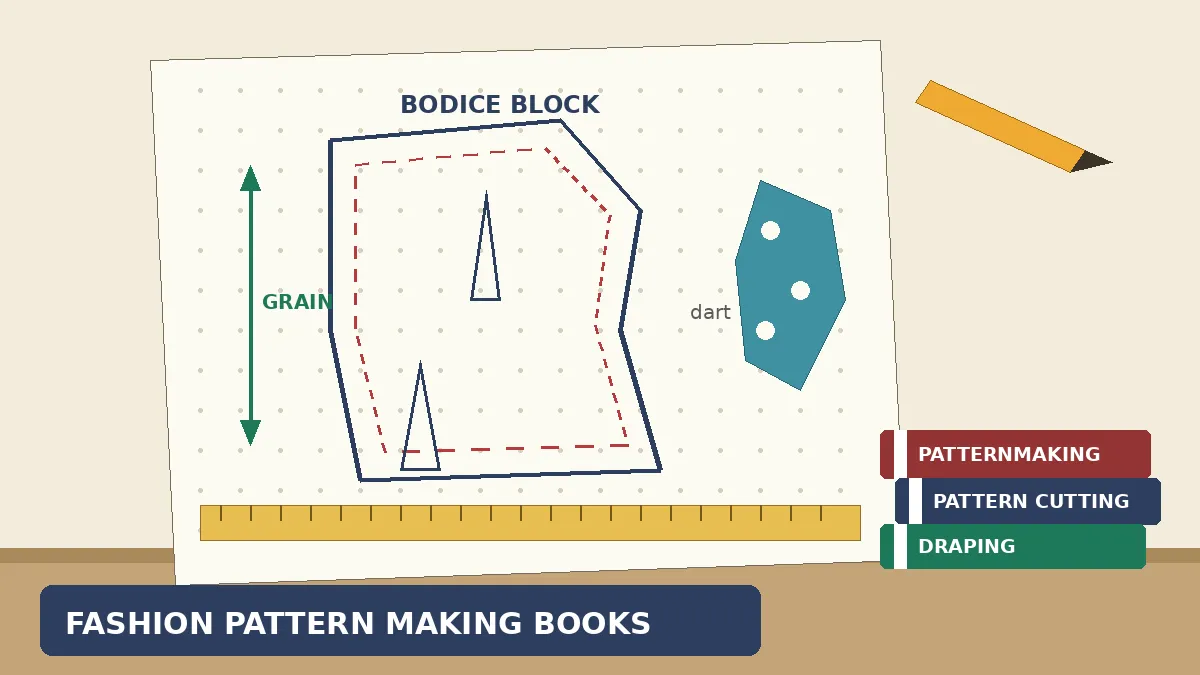
Good books also explain bodice block drafting step by step. They show where each measurement belongs on paper. They also explain why the bust point matters so much. In addition, clear diagrams show the grain line and centre lines. Without those references, later pattern manipulation techniques become confusing very quickly.
Darts and dart manipulation
Secondly, a good book teaches darts with real patience. A dart removes extra fabric so flat cloth fits curved bodies. Bust darts, waist darts and shoulder darts each do different jobs. However, many beginners treat darts as fixed decorations. Skilled pattern makers treat them as movable shaping tools.
Dart manipulation sits at the heart of flat pattern making. You can rotate a dart to a new position. You can also convert darts into princess seams or gathers. For instance, moving waist shaping creates a completely different silhouette. A good book shows each move on paper and on the body.
Two classic methods dominate this teaching. The pivot method rotates the pattern around the bust point. The slash and spread method cuts the pattern and opens new space. Furthermore, strong books compare both methods side by side. You then learn which method suits each design problem best.
Fit, ease and pattern grading
Thirdly, good books treat garment fitting as a skill, not luck. They explain wearing ease and design ease separately. Wearing ease lets the body move and breathe comfortably. Design ease, in contrast, creates the intended style volume. Confusing those two ideas causes many disappointing first garments.
Fitting chapters then show you how to read a toile. A toile is a test garment in inexpensive fabric. Drag lines point towards the area that needs more room. Horizontal wrinkles, for example, often signal a length problem. Moreover, good books teach you to change one thing at a time.
Pattern grading completes the professional picture. Grading grows or shrinks a pattern across a size range. However, grading never scales every measurement by the same amount. Bodies change unevenly across sizes, and good books explain that clearly. Consequently, grading knowledge matters when you sew for other people.
The main types of pattern making books
Pattern books look similar on a shelf, yet they serve different readers. Some books teach a complete drafting system from measurements. Others focus on adapting blocks you already own. Still others explore draping, tailoring or creative experimentation. Choosing well, therefore, starts with understanding these book types.
| Book type | What it teaches best | Best suited to |
|---|---|---|
| Textbooks and drafting systems | Blocks, drafting steps, fit and pattern theory | Students and serious self-learners |
| Principle and companion guides | Why patterns work, plus basic pattern changes | Beginners who feel overwhelmed by drafting |
| Draping books | Shaping fabric on a dress form in three dimensions | Visual learners and couture-minded designers |
| Creative manipulation books | Volume, sculptural shapes and experimental design | Confident makers seeking fresh ideas |
| Vintage and specialist books | Period shapes, tailoring and niche garments | Makers with a defined style interest |
Textbooks demand patience, but they repay serious effort. They usually include measurement charts, drafting sequences and fitting guidance. Moreover, they often cover sleeves, collars, skirts and trousers together. That breadth matters because garments share one connected logic. A sleeve chapter, for instance, always links back to the bodice.
Vintage-focused books serve a different purpose. They help you recreate period silhouettes with authentic shaping. For example, a maker recreating 80s fashion dungarees as an icon of retro style needs period proportion knowledge. Similarly, dramatic steampunk fashion for men relies on structured, historical garment shapes. Specialist books explain those shapes far better than modern basics books.
Specialist books also cover demanding functional garments. Workwear and uniforms must fit movement, durability and daily comfort together. Pattern logic, therefore, sits quietly behind even fashion seal medical scrubs for healthcare professionals. Different garments look unrelated, yet the same block principles support them all.
Flat pattern making and draping, two routes to one garment
Many readers ask one question early on. Should you learn flat pattern making or draping first? The honest answer depends on how you think. Flat methods suit logical, measurement-led learners very well. Draping techniques, in contrast, suit visual and tactile learners. Most professionals eventually use both approaches together.
Flat pattern making happens on paper at a table. You draft blocks from measurements using rulers and curves. You then adapt those blocks with dart manipulation and slash techniques. Furthermore, flat work suits precise shapes and repeatable production. A shirt, trouser or fitted skirt usually begins this way.
Dress form draping happens in three dimensions instead. You pin and shape fabric directly on a padded form. You watch folds form and adjust them immediately. As a result, draping reveals fabric behaviour that paper cannot show. Flowing gowns, cowls and bias-cut designs benefit especially from draping.
| Aspect | Flat pattern making | Draping |
|---|---|---|
| Starting point | Measurements and paper | Fabric on a dress form |
| Main strength | Precision and repeatability | Immediate visual feedback |
| Typical garments | Shirts, trousers, structured styles | Gowns, cowls, fluid designs |
| Core skill | Drafting and pattern manipulation techniques | Reading fabric fall and balance |
Neither route removes the need for a toile. You still sew a test version and check the fit. You still transfer corrections back onto paper carefully. Moreover, draped designs still become flat patterns for cutting. The two methods, therefore, meet at the same finishing line.
Classic pattern cutting books worth knowing
A small number of pattern cutting books appear in almost every serious discussion. Teachers recommend them across different countries and fashion schools. Moreover, each classic serves a slightly different learning need. Knowing those differences helps you avoid an expensive, unsuitable first purchase.
Comprehensive textbooks for structured study
Helen Joseph-Armstrong wrote Patternmaking for Fashion Design, a long-established American textbook. The book covers pattern making for fashion design in unusual breadth. It addresses flat pattern work and draping within one volume. Furthermore, teachers value its clear instruction and modern illustrations. Because it uses imperial measurements, however, metric readers must convert carefully.
Winifred Aldrich wrote Metric Pattern Cutting for Women’s Wear, the leading British counterpart. Aldrich taught pattern cutting and built her books around metric drafting. Her system offers clear basic blocks and many pattern adaptations. Additionally, separate Aldrich volumes cover menswear and childrenswear drafting. Many British fashion schools still treat her womenswear book as essential reading.
Which textbook suits you better? Your measurement system gives the simplest answer. Imperial learners usually find Armstrong more natural to follow. Metric learners, in contrast, usually settle faster with Aldrich. Your garment focus matters too, because Aldrich splits topics across separate volumes.
Books for principles and for draping
How Patterns Work, published by Assembil, takes a gentler route. The book explains fundamental principles instead of drafting blocks from measurements. It defines darts, grain lines, seam allowances and blocks very carefully. Moreover, it shows pattern changes away from specific garments. Beginners, therefore, can grasp the logic before facing complex drafting tables.
Connie Amaden-Crawford wrote The Art of Fashion Draping for three-dimensional learners. Her book teaches draping from basic foundations towards advanced projects. It covers bodices, skirts, sleeves, princess designs and bias-cut styles. Furthermore, step-by-step illustrations guide each drape on the dress form. Visual learners often progress faster with this hands-on approach.
Pattern Magic by Tomoko Nakamichi serves a later learning stage. The series explores sculptural pattern manipulation and surprising garment shapes. It challenges you to rethink how flat shapes create volume. However, it assumes confidence with basic blocks and standard drafting. Keep it, therefore, as an inspiring second or third book.
How to choose the right book for your level and goal
Firstly, judge your real starting point honestly. Have you sewn garments from commercial patterns before? Can you take accurate body measurements without help? Do you understand seam allowances, grain lines and notches already? Your answers reveal whether you need principles, drafting or both.
True beginners should start with explanation before heavy drafting. A principles guide builds vocabulary and confidence first. After that, a structured textbook feels far less intimidating. Intermediate makers, in contrast, can move straight into a drafting system. They already know sewing order and basic garment construction.
Secondly, match the book to your actual goal. Hobby dressmakers need strong bodice, skirt and sleeve coverage. Aspiring professionals also need pattern grading and production-ready marking. Costume and vintage makers need period shapes and specialist silhouettes instead. One book rarely serves every goal equally well.
Thirdly, check the practical details before you buy. Does the book use your preferred measurement system? Does it include the garment types you actually sew? Are the diagrams large, clear and easy to follow? Additionally, check whether the drafting assumes a standard size chart.
Styling knowledge still matters alongside technical skill. A pattern only succeeds when proportion, fabric and styling agree. Broader reading, such as an ultimate fashion guide with expert styling tips, sharpens that judgement. Technical accuracy gives the garment structure. Good taste, meanwhile, decides whether people want to wear it.
A realistic self-study routine that builds real skill
Reading alone never creates pattern skill. Your hands must repeat each idea until it feels familiar. A steady weekly routine beats occasional long study sessions. Moreover, short projects reveal progress and keep motivation alive. The routine below suits most beginners with limited spare time.
- Weeks one and two, learn the language. Read the opening chapters slowly. Practise taking measurements on yourself or a partner. Additionally, label sample pattern pieces with every marking.
- Weeks three and four, draft your first blocks. Complete one skirt block and one bodice block. Check every measurement twice before cutting paper. Furthermore, note each mistake beside the corrected draft.
- Weeks five and six, sew and fit toiles. Use inexpensive plain fabric for both blocks. Mark drag lines and balance problems directly on cloth. Then transfer each correction back onto paper.
- Weeks seven and eight, practise dart manipulation. Move one dart three different ways on paper. Sew at least one version and compare the results. Consequently, abstract diagrams become physical, memorable knowledge.
- Weeks nine and ten, adapt a block into a garment. Change a neckline, sleeve or skirt flare deliberately. Keep the change small and fully documented. Moreover, finish the garment properly rather than abandoning it.
- Weeks eleven and twelve, repeat with a new fabric. Choose a fabric with different weight or drape. Compare its behaviour against your earlier toile carefully. That comparison, above all, teaches real pattern judgement.
Notes, tools and pattern care
Each session should end with brief written notes. What did you change on the pattern? What happened when you sewed the test version? Which instruction in the book finally made sense? Those notes, over time, become your personal sewing pattern drafting companion.
Small presentation details also build professional habits early. Label every pattern piece with its name and size. Add the grain line, cutting quantity and date too. Furthermore, store corrected blocks flat and away from moisture. Careful storage protects months of fitting work from damage.
What tools do you need for how to draft sewing patterns at home? A long ruler, French curves and pattern paper cover most tasks. You also need sharp pencils, paper scissors and a measuring tape. Additionally, keep inexpensive toile fabric ready for every new block. Expensive software, in contrast, can wait until much later.
Common mistakes when learning from pattern books
Firstly, many beginners skip the toile to save time. That shortcut usually wastes far more time later. Expensive fabric then reveals problems that paper hid. Moreover, unpicking finished seams damages many fabrics permanently. A calm toile stage prevents nearly all of that frustration.
Secondly, many learners copy drafts without understanding them. Copying builds neat paper, but it builds little judgement. Ask why each line sits where it sits. Ask also what happens when you move that line. Curiosity, therefore, turns a drafting exercise into lasting knowledge.
Thirdly, beginners often chase too many books at once. Each drafting system uses slightly different blocks and assumptions. Mixing systems mid-project creates confusing, mismatched pattern pieces. Instead, complete one system from block to finished garment. You can compare other pattern drafting books safely after that.
Fit problems also tempt learners to change everything at once. Multiple changes hide which correction actually worked. Change one area, then sew another quick test. Additionally, photograph each toile from front, side and back. Photographs reveal balance problems that mirrors often hide.
Finally, remember that selling or sharing finished work raises the standard. A small boutique, for example, needs consistent sizing across every garment. Reading about a boutique built on elegance and personal style shows that customer-facing side. Behind it, however, disciplined blocks and honest fitting do the quiet work.
Questions readers ask about pattern making books
Can you learn pattern making from books alone?
Yes, you can learn the core skill from books alone. Books give you systems, diagrams and repeatable exercises. However, you must sew toiles and correct real fitting problems. Reading without sewing, in contrast, leaves the knowledge purely theoretical. Consistent practice turns printed instructions into genuine pattern skill.
How many pattern books does a beginner need?
Most beginners need only two books at the start. One book should explain principles in plain, patient language. The other book should teach a complete drafting system. Additional books help later, especially for draping or specialist garments. A small, well-used library always beats a large, untouched one.
Are pattern making books useful if you already sew well?
Experienced sewers often gain the most from pattern books. Sewing skill shows you how garments assemble in practice. Pattern study, additionally, shows you how to reshape those garments. Together, both skills let you fix fit and invent designs. Even small details, such as styling a finished look with a pretty hair accessory that completes an outfit, land better on a well-fitted base.
Bringing it together, books as patient teachers
Fashion design pattern making books earn their reputation quietly. They teach blocks, darts, fit and grading as one connected system. Moreover, they let you revisit difficult steps at your own pace. No class timetable rushes you past a confusing diagram. The page simply waits until the idea clicks.
Choose one system that matches your measurements and goals. Work through it slowly, from first block to finished garment. Sew every toile, and record every correction honestly. Furthermore, add draping or creative books only after that foundation holds. Skill built in that order rarely collapses under harder projects.
Your first well-fitted block will change how you see clothing. Seams will reveal their logic instead of looking arbitrary. Shop garments will show their pattern decisions at a glance. Above all, your own ideas will finally have a reliable route into cloth.




