
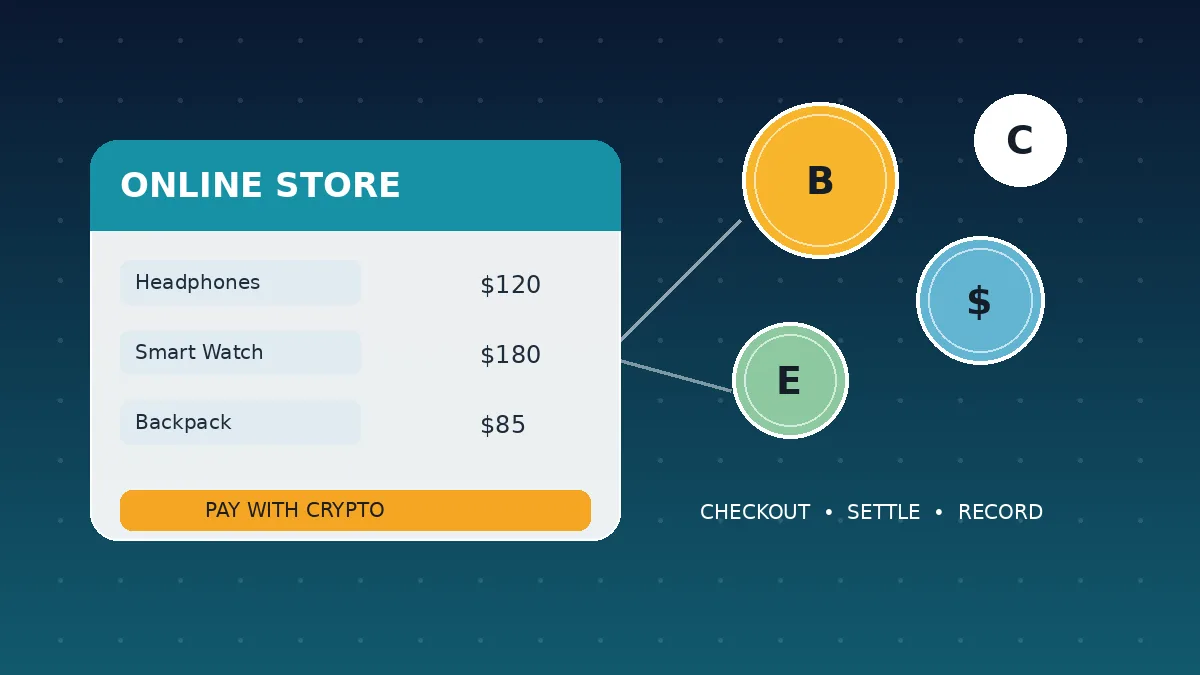
Adding crypto to a checkout sounds exciting at first. However, the daily reality feels far more ordinary. In practice, cryptocurrency ecommerce means pricing goods in normal currency, showing a crypto amount at checkout, and then handling settlement carefully. Moreover, it means planning refunds, records, and price swings before the first order arrives.
Many sellers rush this decision. Consequently, they discover the hard parts only after a customer pays. For example, a coin price can move between checkout and settlement. Similarly, a refund cannot simply reverse the original blockchain payment. Therefore, this guide explains the full flow in plain language, including the benefits and the drawbacks.
What does cryptocurrency ecommerce mean for a seller?
Simply put, cryptocurrency ecommerce means accepting digital assets as payment for online orders. Usually, the store still lists prices in dollars, pounds, or another local currency. Then, the checkout converts that total into a crypto amount for payment. As a result, the customer pays from a wallet, while the merchant manages settlement behind the scenes. For example, bitcoin payments and ether payments both follow this same basic pattern.
The model suits some stores better than others. For instance, digital products and international orders often fit the model well. In contrast, stores with complex returns may find crypto harder to manage. Likewise, sellers with mostly local card customers may see limited demand. Hence, the first step involves judging real customer interest, not following hype.
Growth also matters here. Indeed, a payment option should support the wider store, not distract from it. When you plan scalable ecommerce architecture that limits technical debt, every new checkout method adds maintenance. Therefore, treat crypto as one payment rail among several, not as a replacement for cards.
How does a crypto payment work at checkout?
The checkout flow looks simple from the outside. Nevertheless, several steps happen in quick succession. Firstly, the customer chooses crypto instead of a card. Secondly, the system creates a payment request for that order. Finally, the customer sends funds and the store waits for confirmation.
From basket to blockchain confirmation
First of all, the gateway generates a wallet address or a QR code. Next, it locks an exchange rate for a short window. Then, the buyer sends the exact amount from their wallet. After that, the network confirms the transaction on the blockchain.
Confirmation times vary by network and congestion. For example, some networks confirm within seconds or minutes. Meanwhile, other networks can take longer during busy periods. Consequently, stores should not ship high-value goods before confirmation. Instead, show a clear pending status and explain the wait honestly.
Underpayment creates another common problem. Occasionally, a buyer sends too little because of a wallet fee. Alternatively, the rate window expires before payment arrives. Therefore, good systems flag partial payments and offer clear next steps. In addition, they link every payment to an order number automatically.
What does the customer see during checkout?
Customers need clarity more than novelty here. Specifically, they should see the coin, the network, and the total amount. Moreover, they should see the rate and the payment deadline. Similarly, they need a warning about sending on the wrong network.
Wrong-network payments cause real support headaches. For instance, funds sent on an unsupported chain may prove hard to recover. Hence, display the network name in large, plain text. Furthermore, test the whole flow on mobile, because many wallets live on phones. As a result, fewer buyers abandon the payment midway.
What are your main setup options?
Sellers usually choose between three broad routes. Each route trades control against convenience and effort. Moreover, each route changes who holds the funds. Therefore, compare custody, support, and technical work before you commit.
Custodial gateways and hosted checkout
A custodial crypto payment gateway holds funds on your behalf at first. Then, it settles money to your bank or wallet later. Additionally, it provides a hosted checkout page, so you add little code. Well-known examples of this category include services such as BitPay and Coinbase Commerce, mentioned here only as familiar names in the field.
This route suits beginners particularly well. For example, the provider handles addresses, confirmations, and rate conversion. Moreover, the provider usually offers plugins for common store platforms. However, you depend on that provider for access and payouts. Consequently, you must accept its account checks, supported coins, and terms.
Self-hosted and open-source options
A self-hosted crypto payment processor runs on your own server instead. In this model, payments go directly to a wallet you control. BTCPay Server is a widely known open-source example of this type. Crucially, no third party custodies the funds for you.
Control brings responsibility, though. For instance, you must secure the server and protect wallet keys. Furthermore, you must maintain updates and monitor uptime yourself. On the other hand, you avoid reliance on a single provider. Therefore, technical teams often prefer this route, while small teams often do not. Moreover, self-hosted crypto payments keep settlement under your direct control.
Direct wallet payments and simple invoices
Some sellers accept payment directly to a wallet address. Likewise, freelancers often use a simple invoice or payment link. This approach needs almost no setup at all. Nevertheless, it creates manual work for every single order.
Reconciliation becomes the main burden here. For example, staff must match each incoming payment to an order. Moreover, pricing and rate locking stay entirely manual. As a result, direct payments suit very low volumes only. Once orders grow, an automated gateway usually saves time.
How do you handle price volatility?
Volatility remains the biggest practical worry for merchants. After all, a coin received today may hold a different value tomorrow. However, sellers have two established ways to reduce that exposure. Both methods work best when chosen before launch.
Instant conversion and rate locking
Instant conversion to fiat changes crypto into local currency at receipt. In other words, the gateway sells the coin soon after confirmation. Consequently, the merchant receives a more predictable bank settlement. Additionally, rate locking protects the short checkout window itself.
Rate locking fixes the price for a limited time. During that window, the buyer knows exactly what to send. Meanwhile, the seller knows what the order should settle for. However, an expired window can still leave a mismatch. Therefore, your policy should explain how you handle late payments.
Why do many sellers settle in stablecoins?
Stablecoin payments offer a middle path for many stores. Stablecoins are tokens designed to track a fiat currency, usually the dollar. Examples include USDC and USDT, which aim to hold a steady value. As a result, pricing and refunds become far simpler to explain.
Stablecoins also simplify bookkeeping in practice. For instance, a sale priced at fifty dollars maps neatly to fifty units. In contrast, a volatile coin needs a fresh valuation for every order. Nevertheless, stablecoins still carry issuer and network risks. Therefore, sellers should understand the token and chain they accept.
Choice of network matters alongside coin choice. Indeed, network fees and confirmation speeds differ widely between chains. Moreover, customers hold funds on different networks already. Hence, support the networks your buyers actually use, not every chain available. Similarly, review that choice as customer behaviour changes.
What should you know about crypto payment fees?
Fees in crypto payments come in separate layers. Firstly, the buyer or merchant pays a network fee to the blockchain. Secondly, a processor may charge its own service fee. Finally, conversion or withdrawal may add another cost. Therefore, judge the total cost, not a single headline figure.
Network fees behave very differently from card fees. For example, they depend on network congestion, not order value. Consequently, a small order can feel expensive on a busy network. Meanwhile, a large order can cost the same network fee. In addition, busy periods can raise fees without warning.
Processor fees also vary by provider and setup. Self-hosted software removes the processor layer, for instance. However, it replaces that saving with server and staff costs. Likewise, custodial services may bundle conversion into their pricing. As a result, compare like with like, including support and settlement. Above all, avoid assuming crypto is always cheaper than cards.
Why are refunds different with crypto?
Refunds expose the sharpest difference from card payments. A confirmed blockchain payment cannot be pulled back by a bank. Moreover, crypto has no chargeback system in the card sense. Therefore, the phrase no chargebacks crypto sounds attractive, yet it shifts work onto the merchant. In short, crypto refunds always need a deliberate manual process.
How do manual refunds work in practice?
A refund means sending a new payment back to the customer. Firstly, staff verify the original transaction and order. Secondly, they agree the refund amount and currency with the buyer. Finally, they send funds to a wallet address the customer confirms.
Each step needs care and a written record. For example, the price may have moved since the original sale. Consequently, you must decide whether you refund the crypto amount or the fiat value. Furthermore, you should state that rule in your policy before launch. Similarly, confirm the return address carefully, because a wrong address can lose funds.
Partial refunds and returns add more complexity. For instance, a customer may return one item from a multi-item order. Additionally, digital goods may already have been used or downloaded. Therefore, adapt your existing returns policy instead of copying card rules blindly. In fact, a clear crypto-specific section prevents most disputes.
What are the real benefits for online stores?
The benefits are genuine when they match your market. Firstly, crypto can reach buyers who prefer paying from wallets. Secondly, it can help some cross-border orders avoid card declines. Moreover, confirmed payments reduce chargeback fraud risk for merchants.
International selling deserves a balanced mention here. Admittedly, crypto does not remove shipping, duties, or local consumer law. However, it can simplify the payment leg of an overseas sale. When you study scaling ecommerce growth in new markets, payment fit clearly matters. Therefore, test demand in one market before a global rollout.
Local sellers can also learn from nearby models. For example, neighbourhood marketplaces winning at local ecommerce succeed by matching local payment habits. Likewise, crypto works when it matches a real habit. Conversely, it fails when it solves a problem customers never had. Hence, survey buyers before you invest heavily.
What are the drawbacks you should plan for?
Drawbacks deserve equal weight in this decision. Firstly, only part of your audience will want to pay this way. Secondly, support questions increase during the early months. Moreover, staff need training on confirmations, networks, and refunds.
Technical and operational risks also remain. For instance, wallet key loss can mean permanent loss of funds. Similarly, a misconfigured gateway can misprice orders quickly. Furthermore, provider outages can pause crypto checkout without warning. As a result, keep card payments available as a fallback always.
Reputation questions matter for some brands too. Indeed, some customers associate crypto with speculation or scams. Therefore, present the option neutrally and explain it plainly. Additionally, never pressure buyers toward crypto with discounts you cannot sustain. In contrast, quiet availability tends to build trust over time.
Planning helps place crypto in context. When leaders discuss digital transformation in business, they stress process change over tools. Likewise, crypto adoption changes support, finance, and fulfilment processes. Consequently, involve those teams early, not after launch day.
How do tax, accounting, and legal rules affect you?
Rules vary widely by country, and they change over time. Therefore, this section flags questions, not definitive legal answers. Always confirm your position with a qualified local accountant. Moreover, check whether your provider must verify your business identity.
Many tax systems treat crypto as property or an asset. Consequently, receiving it can count as income at its value on receipt. Later, selling or converting it may create a further gain or loss. In addition, sales tax or VAT usually still applies to the underlying goods. Hence, the tax on the product does not disappear because payment used crypto.
What records should you keep for every sale?
Good crypto tax record keeping starts at the moment of sale. Specifically, record the date, the coin, and the amount received. Moreover, record the fiat value and the exchange rate used. Similarly, save the transaction identifier and the wallet addresses involved.
- Order number and customer invoice for each payment
- Date, time, coin, network, and amount received
- Fiat value at receipt and the rate source used
- Transaction identifier and settlement or conversion details
- Refund amount, refund address, and approval record
- Fees paid, split between network and processor charges
These records support both accounting and customer support. For example, they let you reconcile wallet balances against orders. Furthermore, they help an accountant calculate gains on later disposals. As a result, crypto accounting for merchants becomes routine, not a year-end scramble. Meanwhile, poor records turn every tax question into guesswork.
Business structure affects the wider picture too. Indeed, owners weighing how small businesses scale sustainably must align payments with finance systems. Similarly, your accounting software should import or record crypto sales cleanly. Therefore, test the finance workflow before promoting the new option.
How do you test crypto payments before launch?
Testing prevents the most embarrassing launch failures. Firstly, place small test orders on your live store setup. Secondly, test an underpayment and an expired rate window. Finally, test a full refund from start to finish.
Customer communication needs testing as well. For instance, check every email that mentions payment status. Moreover, read the checkout help text as a complete beginner. Does the page explain networks and confirmations clearly? Consequently, rewrite any step that needs outside knowledge.
Marketing should stay honest after launch. When you review the global impact of digital marketing on business, hype clearly travels fast. However, overstated crypto claims can damage trust quickly. Therefore, announce the option simply, explain the coins accepted, and link to your refund policy.
Checkout design influences completion rates strongly. Indeed, small friction points lose sales across every payment method. Studies of fintech user retention and cognitive closure show that unfinished tasks linger in memory. Likewise, a confusing crypto checkout leaves buyers stuck mid-task. As a result, show progress, confirmation counts, and a clear completion message.
Is cryptocurrency ecommerce right for your store?
The honest answer depends on your customers and capacity. If buyers ask for crypto, the case becomes stronger. Moreover, if you sell internationally or digitally, the fit may improve. Conversely, if returns are complex and demand is absent, waiting makes sense.
Start small when you do proceed. For example, launch with one gateway and a limited coin set. Additionally, settle through instant conversion or stablecoins at first. Then, review volumes, support tickets, and refund cases monthly. Consequently, you learn from real data before expanding the setup.
Ultimately, cryptocurrency ecommerce rewards careful operators. It offers a real extra payment choice, not a shortcut to growth. Furthermore, it demands clear policies, tidy records, and patient support. Therefore, adopt it for sound operational reasons, and it can serve your store well for years.
Frequently asked questions
Do you need your own wallet to accept cryptocurrency payments?
Not always, because custodial gateways can hold funds for you. However, self-hosted setups send payments to a wallet you control. Therefore, the answer depends entirely on your chosen route. Moreover, holding your own wallet means protecting its keys carefully.
Can a customer reverse a crypto payment after sending it?
No, a confirmed blockchain payment cannot be reversed by the sender. Instead, only the merchant can send a refund as a new payment. Consequently, buyers must trust your stated refund policy. For this reason, clear policies matter even more with crypto.
Should a new store accept many coins at once?
Usually not, because each coin adds pricing and support complexity. Firstly, start with the assets your customers actually hold. Secondly, consider stablecoins for simpler pricing and refunds. Then, expand only when real demand justifies the extra work.
Does accepting crypto remove sales tax or VAT?
No, tax on the goods normally still applies as usual. In most systems, the payment method does not change the product tax. Moreover, you record the sale at its fiat value at receipt. Therefore, ask a local accountant how to report it correctly.




